
China’s new export controls on its rare earth elements industry have provoked a new round of American tariffs. What are the drivers and implications of this economic war?
On October 9th, China announced a tightening of its export controls on rare earth elements, which will now include a number of new elements and refining technologies. China controls around 90% of the world’s capacity to produce rare earths, which are essential inputs in the production of technologies from AI, microchips, and smartphones to advanced military hardware. In 2023, 70% of rare earth minerals used in the US came from China.
On October 10, President Trump condemned the measures and responded with a new round of 100% tariffs on all imports from China as well as US export controls on “critical software” to China. Targeted US export controls on critical software to China may affect China’s domestic production of software-based goods, such as smartphones. Meanwhile, the US’s new 100% blanket tariffs on Chinese imports will send shockwaves through both economies.
These developments have far-reaching implications that extend beyond the obvious deterioration of US-China bilateral relations. The economic impact of a 100% tariff on Chinese goods will likely be passed onto American consumers, resulting in a deepening of the cost-of-living crisis already affecting communities across the country. The new tariffs will go into effect on November 1, 2025.
The cost of living crisis is one of the most politically significant issues in America today, and was a decisive factor in the 2024 Presidential election of Donald Trump. President Biden faced record-low approval ratings in part due to the crisis, which Trump deceitfully promised to address throughout his campaign. The renewed tariff war with China will raise consumer prices, and with it, the precariousness of life for an increasingly discontented US working class.
Beijing’s move is not the first of its kind. China’s near monopoly on the production and processing of rare earths can be wielded as a chokepoint in the supply chains of critical US tech, automobile, and military industries, and has been used as a mechanism of leverage against the economic aggression of the Trump administration. After President Trump’s infamous ‘liberation day’ tariffs were announced in April, China responded in kind with a set of export bans on rare earths.
On May 12, 2025, negotiations took place in Geneva to mutually lower tariffs between the two countries by 115%. However, on May 30, Trump accused China of violating the Geneva deal. In support of this claim, administration officials cited that “China did not ease its restrictions on rare earth exports as was supposedly a part of the deal.” Days later, the Chinese foreign ministry announced that the export restrictions remained due to “a number of discriminatory restrictive measures against China, including issuing export control guidelines for AI chips, stopping the sale of chip design software (EDA) to China, and announcing the revocation of Chinese student visas.”
Restrictions were once more eased and tariffs lowered during talks held in London on June 10, but developments this October have brought tariff walls back up and even more comprehensive rare earth export bans back into force.
In relation to rare earths and critical minerals more broadly, US policy under Trump’s second term has been shaped with the economic consequences of an escalating trade war with China in mind. The two primary manifestations of this strategy have been domestic resource nationalism and the forging of (often coercive) critical minerals deals abroad. This analysis will explain how these objectives are connected to both the economic war on China and the Trump Administration’s overall vision of American power projection moving into the second quarter of the 21st century.
Domestic Resource Nationalism
China’s dominance of rare earth supply chains presents a major problem to US policy makers interested in engaging China in conflict. Importantly, high-powered magnets that require rare earths are necessary in the production of advanced military hardware, which was cited as the factual basis for the most recent round of export controls by the Chinese foreign ministry.
On October 9, they claimed, “In the context of turmoil and frequent military conflicts in the world, China has taken note of the important uses of medium and heavy rare earths and related items in the military field. China, as a responsible major country, employs export controls on related items according to the law, in order to better defend world peace and regional stability, and to fulfill non-proliferation and other international obligations.”
The foreign ministry framed the export controls as not directed at any particular country, but this is obviously untrue. While not as rare as the name suggests, rare earths are both geographically concentrated and require technologically complex processing stages. The US has only one operational mine in Mountain Pass, California, and thus currently lacks the extraction and industrial refining capacity to achieve ‘supply chain independence’.
In July 2025, MP Materials (the firm operating Mountain Pass) entered into a multi-billion-dollar public-private partnership with none other than the Pentagon itself. After Trump’s first round of blanket tariffs on China was met with a response in the form of rare earth export restrictions, the Pentagon decided to take action. In the words of James Litinsky, the CEO and Founder of MP Materials, “this initiative marks a decisive action by the Trump administration to accelerate American supply chain independence.”
MP Materials is planning on building another site for the extraction and processing of rare earths with the help of this new partnership. However, the industrial policy necessary to build out these advanced supply chains has been virtually nonexistent in the US under recent (neoliberal) Republican and Democratic administrations alike. Reaching a level of supply chain independence capable of feeding the insatiable demands of the US military industrial complex and so-called ‘AI arms race’ is a task that will take years if not decades.
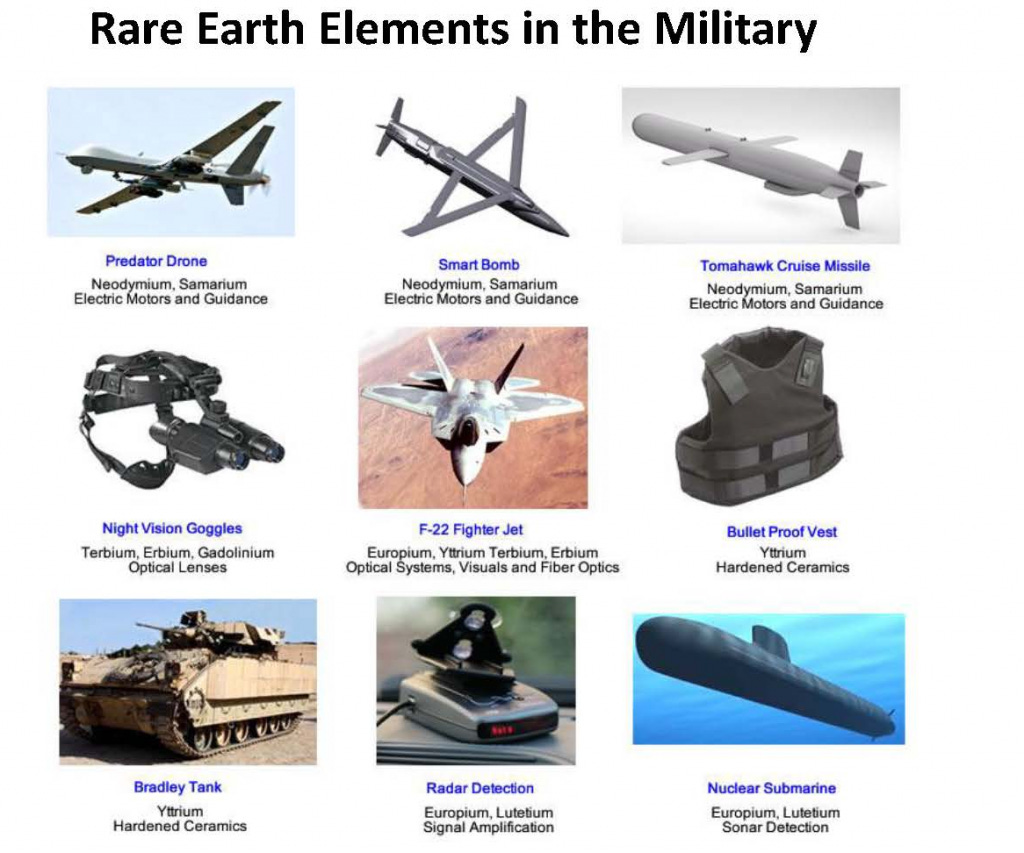
To compensate for the exposed vulnerabilities in the rare earths industry vis-a-vis China, the US has turned abroad to attempt to circumvent China’s supply chains. Since assuming office, the Trump Administration has signed deals or held talks for the procurement of rare earths in the DRC, Ukraine, Brazil and most recently Australia, while also threatening on multiple occasions to invade and possibly annex Greenland, which has large concentrated reserves of rare earths.
Circumventing China’s Rare Earths Chokepoint: The Art of The Deal (and of Imperialist Plunder)
Greenland
President Trump created a media storm at the beginning of his second term in January when he controversially claimed that the US was interested in taking Greenland, a semi-autonomous Danish possession, by military force. In an interview with NBC News in May, he reiterated this vision. “We need Greenland very badly,” the president said. “Greenland is a very small number of people, which we’ll take care of, and we’ll cherish them, and all of that. But we need that for international security.”
Greenland has the world’s eighth-largest deposits of rare earths, and hosts two companies involved in mining projects: Energy Transition Minerals (majority owned by a Chinese company) and Critical Metals (owned by US-based capital), which recently purchased ownership of the large rare earths project formerly operated by Tanbreez Mining.
Reuters reported in January 2025, “U.S. and Danish officials lobbied the developer of Greenland’s largest rare earths deposit last year not to sell its project to Chinese-linked firms.” The firm, Tanbreez Mining, ended up selling to the New York-based Critical Metals instead. The third largest investor in Critical Metals, the brokerage firm Cantor Fitzgerald, is run by Howard Lutnick, who also happens to be the sitting Secretary of the Department of Commerce under the Trump Administration.
According to Reuters, Critical Metals is now in talks with the defense contractors Lockheed Martin, RTX, and Boeing regarding the integration of rare earths operations in Southern Greenland into the supply chains of the military industrial complex. Lockheed told reporters that “it continuously assesses the rare earth supply chain to ensure access to critical materials.”
Even if the potential military invasion of Greenland was a Trumpian bluff, the penetration of US capital to develop the island’s reserves of rare earths will likely proceed. The island also hosts the US military’s Pituffik Space Base and holds geo-strategic significance beyond its vast mineral wealth.
Australia
On October 20, 2025, the White House released the “United States-Australia Framework For Securing of Supply in the Mining and Processing of Critical Minerals and Rare Earths.” The White House announced that this new bilateral framework was created to “support the supply of raw and processed critical minerals and rare earths crucial to the commercial and defense industries of the United States and Australia.” The deal, worth $8.5 billion, will raise financing for projects in Australia and the US.
Due to its relative proximity to China, Australia has been a key US ally in the Indo-Pacific region. It hosts the most important US intelligence base outside of the continental US, Pine Gap, which has been exposed by Edward Snowden’s leaks and other accounts to have played an important role in US wars in West Asia.
Australia has served the role of US client state for decades, and is once again proving its utility to Washington through this critical mineral framework; however, this deal cannot help the US build a domestic rare earths supply chain in the short run. The fruitfulness of these new prospective projects will likely be at least a decade or so in the making.
Ukraine
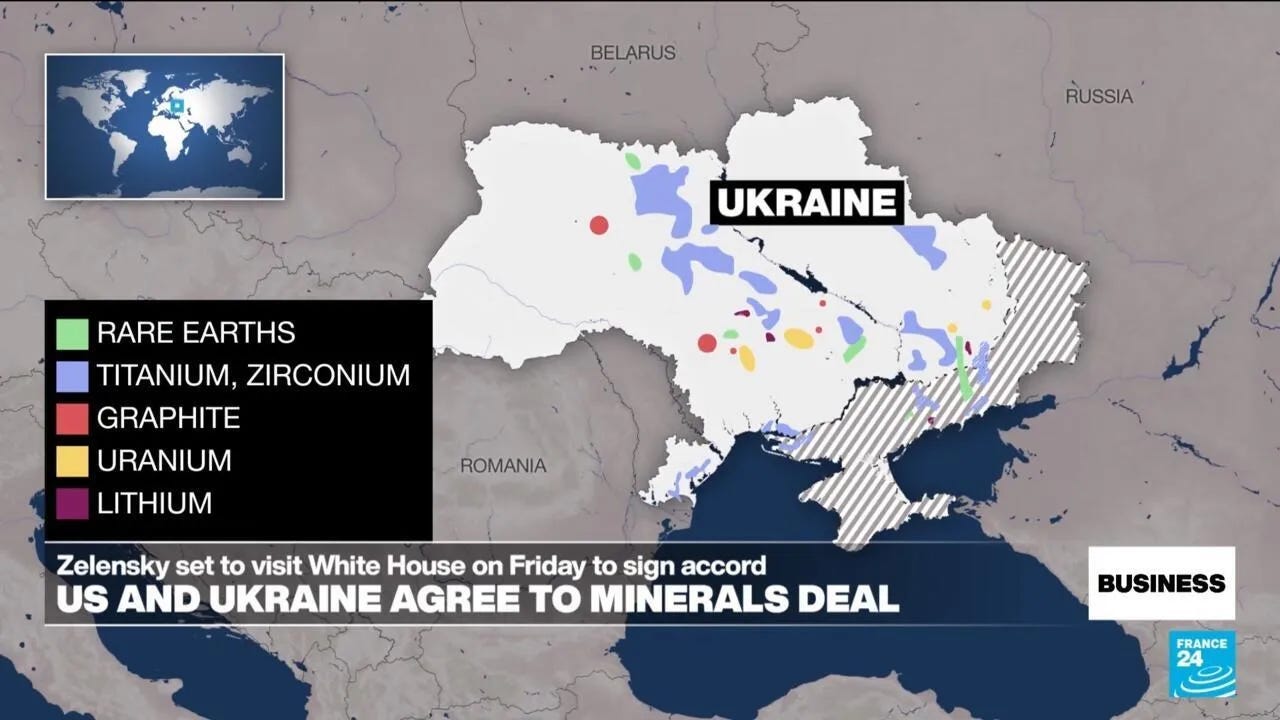
Trump came to power in January 2025, with a promise to end the Russia-Ukraine War. While peace negotiations have been entirely unsuccessful so far, a ‘minerals for security’ deal was struck between the US and Ukraine in May, which included rights to Ukraine’s vast reserves of rare earths.
The established “United States–Ukraine Reconstruction Investment Fund” states that “Each Governmental Authority of Ukraine that is authorized to issue a license or special permit for subsoil use for any Natural Resource Relevant Assets shall include in the terms of such license a provision allowing the U.S. Partner (or its designee or assignee) to negotiate for offtake rights on market-based commercial terms.”
US-based capital will have first priority in the plunder of Ukraine’s largely untapped mineral wealth, which includes, but is not limited to, rare earths. Beyond its utility as a Western bulwark against Russia and as a wedge to deepen Europe’s dependence on the US economy, Washington sees Ukraine as playing a role in its attempt to re-route its cutting edge technology supply chains around China.
The Democratic Republic of The Congo
In a similar fashion to the Ukraine deal, the Trump administration made a ‘minerals for peace’ deal in the DRC, which offered security guarantees to the war-torn country at the price of its natural resource sovereignty.
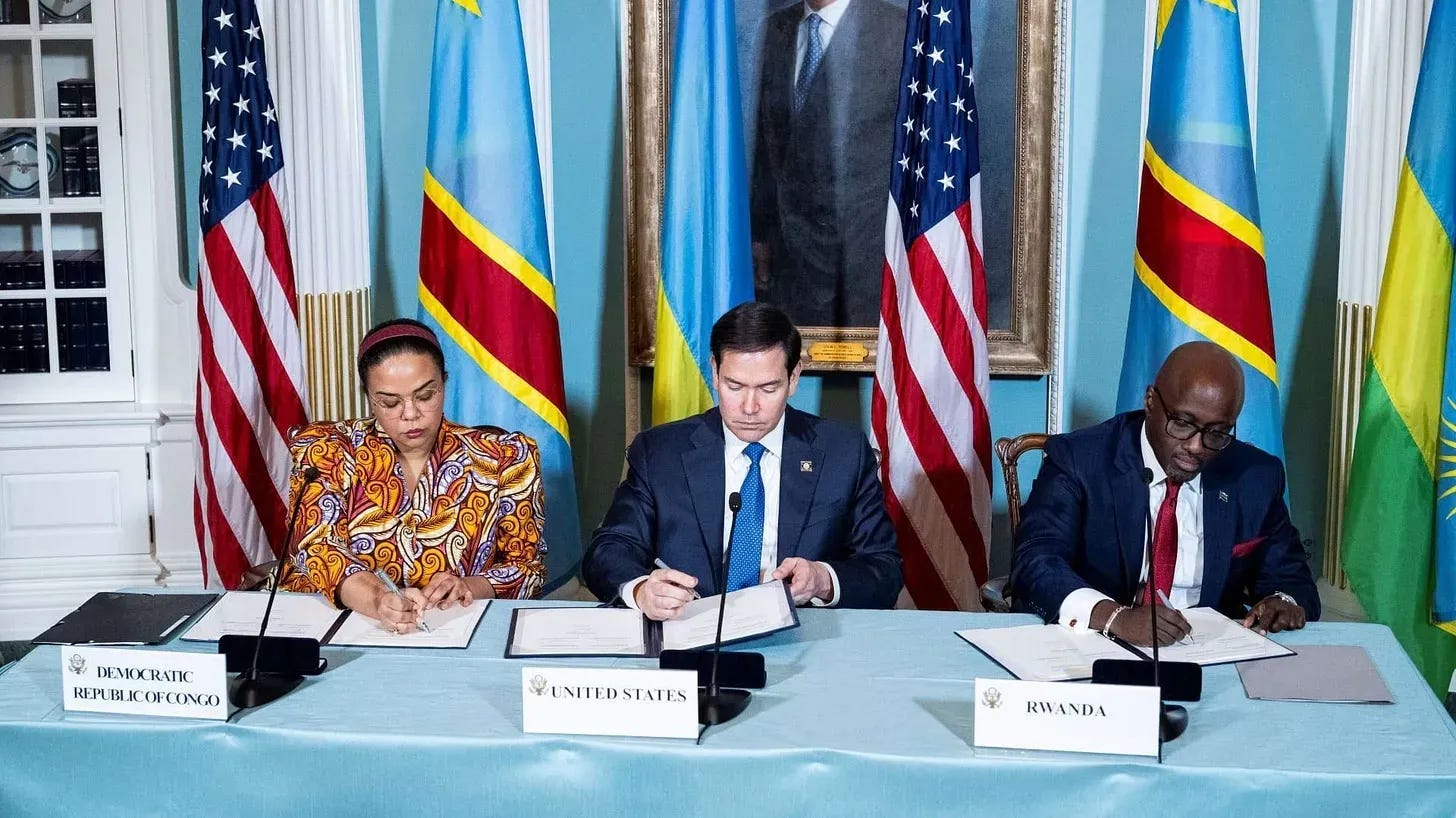
On June 27, 2025, US Secretary of State and National Security Advisor Mark Rubio brokered the deal between the Democratic Republic of the Congo and Rwanda in Doha, Qatar. Rwanda, a key US ally in the region, has been backing the M23 rebel group that now occupies the mineral rich regions of the Eastern DRC. As a part of the deal, the Trump Administration stipulated that mining concessions to the tune of “multibillion-dollar investments” be included, according to US special adviser to Africa Massad Boulos.
The Eastern DRC is rich in a variety of critical minerals for the world’s new qualitative productive forces today. It is the world’s leading hub of cobalt and coltan operations, which have been subject to various inquiries on the basis of massive human rights and environment abuses rampant in the industries. However, the Eastern DRC also has rare earths, which are included for speculation in the US draft framework. A Canadian company, Simba Essential Minerals, is already operating a rare earths mine in the Eastern DRC province of Kivu.
Brazil
Brazil boasts the second-largest reserves of rare earths on the planet, behind only China. The center-left government of Lula de Silva has had a historically contentious relationship with Donald Trump, who is a close ally of the leader of the former far-right President Jair Bolsonaro. Despite ongoing political turmoil between the two leaders, diplomatic talks regarding Trump’s tariffs have opened up the possibility of a partnership to develop Brazil’s rare earth deposits.
Currently, the vast deposits in Minas Gerais, Goiás, and Bahia are largely underdeveloped. In need of large capital investment for processing and refining capacity, Brazil’s reserves are certainly on Washington’s radar. However, Lula’s center-left government is not interested in any deal that will leave Brazil at the bottom of the value chain. Brazil has a long and ongoing history of colonial extraction: a model that only produces underdevelopment and social and ecological immiseration. According to an analysis from Rare Earth Exchanges, Lula’s government is “pushing for value chain sovereignty” and will stipulate “local beneficiation requirements” in any serious rare earths deal.
The Stakes
The Trump administration cannot escalate any type of conflict with China while it retains a near monopoly on the mining and processing of rare earth elements. These minerals are currently irreplaceable in the production of the most important 21st-century technologies, including microchips for AI, renewable energy, and the most up-to-date military applications. If Trump were to attempt to escalate, for example, over the situation in Taiwan, resulting in a military confrontation, President Xi could place a devastating total export ban on rare earths.
The US ruling class wants conflict with China more than anything. This is reflected in the bipartisan consensus that has emerged concretely since President Obama’s “Pivot to Asia” declaration in 2011, which amounted to pursuing unilateral US aggression towards China ostensibly over a range of different human rights, democracy, and trade issues. The former two can be identified as disingenuous at best, given the ever-expanding US track record in the departments of human rights abuses and subversion of democracy at home and abroad. Trade, and more specifically, development, is the defining issue.
China’s state-monitored approach to market-oriented development throughout the era of neoliberal globalization—a process which began in the 1980s with the financialization of the world economy, de-industrialization of the US economy, and disarticulation of global supply chains—has successfully precipitated the emergence of rivals to US big tech monopoly capital. Chinese firms like Huawei, DeepSeek, Baidu, and Alibaba present the first real challenge to the total global dominance of firms like Google, Amazon, and Apple.
By nature, and despite praising the ideology of the free market when it suits them, quasi-monopolies hate competition more than anything. All competition must be crushed for monopoly super-profits (rents) to remain viable. China’s supplanting of the international division of labor established by centuries of Western imperialism was its unforgivable crime. In a speech at the American Dynamism Summit, Vice President JD Vance gave some telling remarks about globalization. He said, “The idea of globalization was that rich countries would move further up the value chain, while the poor countries made the simpler things.”
In clear reference to China’s development, he went on, “It turns out that the geographies that do the manufacturing get awfully good at the designing of things. There are network effects, as you all well understand. The firms that design products work with firms that manufacture. They share intellectual property. They share best practices. And they even sometimes share critical employees. Now, we assumed that other nations would always trail us in the value chain, but it turns out that as they got better at the low end of the value chain, they also started catching up on the higher end. We were squeezed from both ends.”
Here was an open admission of how China’s technological development and competition with Western monopolies are antithetical to US objectives in the world economy. Ultimately, US aggression towards China, and the attempt to end China’s rare earths leverage is all about retaining American power in an era of its relative decline. The US attempt to regain global hegemony by de-developing China demands that the US end its dependence on China for its critical supply chains; otherwise, escalation is self-defeating.
Lastly, the Trump administration and its billionaire backers have wedded themselves to the so-called ‘AI arms race’, which not only requires complex critical mineral and infrastructure supply chains, but is also deeply integrated with US monopoly capital. The US economy is currently riding an AI bubble, backed by the US government and the largest firms in finance, big tech, fossil fuels, and the military-industrial complex.
The Magnificent Seven big tech giants, Apple (AAPL), Nvidia (NVDA), Microsoft (MSFT), Amazon (AMZN), Alphabet (GOOG, GOOGL), Meta (META), and Tesla (TSLA), represented 30.35% of the entire stock market capitalization as of the end of September 2025, and over half of its growth. These firms and the other major tech corporations are investing billions of dollars in the development of AI data centers across the world and have been subject to enormous waves of financial speculation that are propping up the US stock market. Even OpenAI CEO Sam Altman has recently admitted that AI is in a bubble.
McKinsey estimates that “by 2030, data centers are projected to require $6.7 trillion worldwide to keep pace with the demand for compute power.” Time will tell if anything close to this wild figure comes to fruition, but regardless, the supply chains for AI’s physical infrastructure start with critical minerals. With the ruling class’s eggs in the AI basket, and potential bottlenecks from an adversarial China, supply chain integrity for rare earths (and critical minerals more broadly) is an imperative for the future of the US empire.
You can also access the latest news at this address: www.whatfinger.com
 Site Title