-
Israel takes dangerous step in the conflict by attacking Iranian diplomats- Attacking embassies, consulates and diplomatic personnel is an intolerable crime under international law.
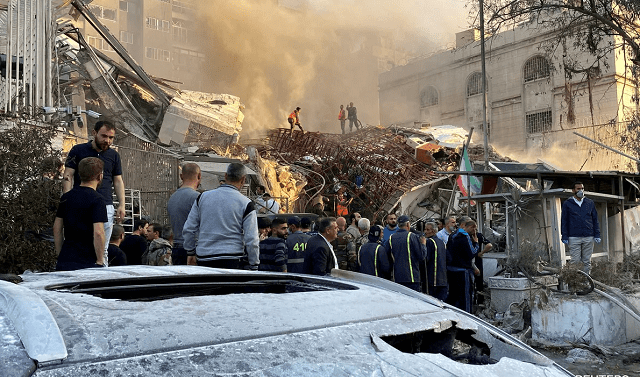
Attacking embassies, consulates and diplomatic personnel is an intolerable crime under international law. The inviolability of diplomatic buildings is a global principle that enables the elementary conditions necessary for international relations. Even in situations of total war and high-intensity conflicts, respect for diplomacy must be observed by the belligerent sides to prevent even worse escalations of violence from occurring.
Israel, however, appears unwilling to respect any international norm. Recently, the Zionist State bombed an Iranian diplomatic building, close to the Iranian Embassy in Damascus. At least seven Iranian citizens were murdered in the operation, including diplomats and a senior Revolutionary Guard commander. As expected, Tehran has promised retaliation and is already mobilizing its military forces for a possible conflict situation.
In fact, the act of bombing diplomatic installations can be considered terrorism, as it deliberately aims to kill civilians, without any military objective. As we know, attacks against civilians have become increasingly frequent in the Zionist war strategy. The Israeli regime simply appears to see all Palestinians in the Gaza Strip as legitimate targets, which leads the IDF to destroy all of the city’s civilian infrastructure and generate an ever-increasing number of non-military casualties among local residents.
However, it appears that Israel is also expanding its attacks on civilian targets to the international level. The destruction of one of the buildings of the Iranian Embassy in Damascus was certainly one of the most serious moves ever made in the current conflict. To make matters worse, Israeli officials have promised to carry out more attacks against Iranian and Shiite public figures, regardless of where they are located. Apparently, from now on Tel Aviv will openly adopt a rhetoric of “hunting” against Iranians.
Obviously, this situation will only generate more escalations. Israel is accustomed to attacking targets with little power to react, such as the stateless Palestinians or Syria, which is recovering from a brutal civil war. Iran, however, is a country in a different position. Tehran is the largest military power in the Middle East, having impressive weapons production and combat mobilization capabilities. The country controls the production of the main current military equipment, with modern long-range missiles and drones among its main tools of war.
Furthermore, Iran has more than only its military and Revolutionary Guard, controlling a complex network of anti-Zionist movements across the Middle East – the so-called “Axis of Resistance”. Armed organizations such as Hezbollah, the Iraqi Resistance, Syrian Shiite militias, the Houthis and the Palestinian guerrillas themselves are members of the Axis and are willing to fight a war in favor of Iran at any time. Even if Israel strives to destroy targets linked to regular Iranian forces, it will be difficult to neutralize the top leaders of all these organizations at the same time.
An open war between Iran and Israel would be catastrophic for the region from all points of view. Analyzing the military power of both countries, it is possible to say that Israel is militarily weaker. However, Tel Aviv has nuclear weapons. The possibility that Iran also has such weapons cannot be ruled out, but at least publicly there is no information to prove this. What is known, however, is that the Iranians already have full uranium enrichment capacity and control the industrial process that could lead to the production of an atomic bomb.
In a war scenario, Iran would also be favored by its complex geography. As a large country and with mountains that protect some of its important cities and industrial centers, Iran is less vulnerable to collapse in the face of foreign incursions than Israel. Furthermore, Tehran would mobilize the Axis of Resistance militias to attack Israel on several flanks, quickly making the Zionist state unable to fight given the existence of multiple fronts. In this scenario, Israel would be forced to choose between two fates: surrender or the use of its extreme arsenal.
However, history shows us that Iran has a great capacity to achieve military objectives without generating collateral damage. The country is used to asymmetric warfare, responding with patience and high precision to the provocations suffered, without escalating the regional situation into total war. Tehran will certainly do its best to retaliate against Israel without a formal declaration of war. It is possible that there will be more Axis of Resistance attacks against occupation forces in the coming days, just as it is possible that Israeli and American targets will be destroyed in high-precision raids.
It is not yet certain that there will be an open war, but it is absolutely clear that there will be a serious escalation. Israel is making a serious mistake by thinking that it will go unpunished after attacking the greatest military power in the Middle East.
You can also access the latest news at this address: www.whatfinger.com
-
Cashless Society- Is It True, That The Government Is Going to Remove Cash, And We, Are Going to be A Cashless Society?

We’ve all heard that we’re moving towards cashless societies, but we’ve all probably brushed it off as doomsaying or too-far-into-the-future technology.
Except now we’re getting closer to that reality.
According to an article from January 2024, some banking experts are predicting that Sweden will eliminate cash as a payment method by the year 2025 and that all of their transactions will use a digital payment method, such as credit and debit cards, RFID signals, digital wallets, and so on.
Should this happen, this would make Sweden the first cashless country in the world.
In this article, we are going to take look at the various countries that are aiming towards cashless societies in the near future as well as what this means for merchants moving forward.
Merchants need to have a greater understanding of what payment solutions are going to look like in the future.
It is important to note, that while some predictions indicate the United States will go cashless, it still remains a distant reality.
Let’s take a look at what a cashless society and cashless countries would entail for merchants, as well as for individuals.
What Is A Cashless Society?

A cashless society in its simplest terms is a society in which purchases of services and or goods are made by credit cards/electronic funds rather than cash or check.
You might be thinking, “well aren’t a vast majority of purchases made electronically already?” You would be correct, as it is impossible to deny the convenience of electronic transfers and purchases.
This being said, just because countries are taking tremendous steps to go cashless, that doesn’t mean that it will be enforced by the government.
It is also important to remember that there are individuals who still prefer cash, as they feel there is less government control.
A cashless society doesn’t mean just a major shift from cash to electronic payments, it means a complete shift in that cash is no longer used for anything.
To better understand what going cashless means, let’s take a look at the pros and cons below.
Pros
There are many benefits to going cashless. Those who are able to take advantage of ever-growing technology will find that one of the main benefits is convenience.
With apps like Venmo, Paypal, and Zelle, it is hard to deny the convenience that technology has provided us with.
Should countries decide to go cashless, this would greatly decrease illegal activity such as money laundering, illegal transactions, illegal gambling, and drug operations.
Here are the main benefits that you could expect from a cashless country.
- Convenience: Far more convenient for consumers and for merchants, especially when those are traveling and dealing with currency exchange.
- Lower Crime Rates: Going cashless would mean there would be no tangible money to steal, reducing crime.
- Decreased Money Laundering: It is harder for people to launder money without cash as it is much easier to track electronic payments/spending with digital paper trails.
- Time: A lot of time will be saved from not managing cash for both businesses and consumers.
- Health Benefits: In general, cash is dirty. The spread of viruses and other illnesses can be greatly halted when germs aren’t being spread through cash.
While a lot of these points may seem like common sense, they are extremely valid points of discussion.
In general, many individuals probably would agree that all of these things are positives.
This being said, let’s take a look at some of the cons with a cashless society.
Cons
From what we’ve gathered, the main downfalls of going totally cashless are security breaches and personal spending habits. To combat this, over the years, the banking and credit card processing industries have seen drastic increases in security.
While hacking can certainly be a concern, digital paper trails could end up being the reason why you’re able to get back $2,000 that was stolen from you. If this was cash, it would be much harder to prove it wasn’t you who spent the funds or that you were robbed.
- Security: Should your bank account get hacked, you wouldn’t have any additional funds until it’s cleared up.
- Spending Habits: Some may have trouble saving money when physical cash isn’t leaving their wallets.
- Tech Problems/Glitches: Should there be glitches or outages, merchants may have trouble accepting payments, leaving you without the ability to purchase goods when needed.
- Digital Paper Trails: All transactions would be easy to track and this could be something that frequent cash users won’t like.
Overview Of A Cashless Society

So, what would a cashless society look like? In a way, similar to what we’re seeing today with electronic transfers, and more and more businesses accepting different forms of electronic payments.
This is one of the major reasons why merchants need to make sure they are working with reliable and up-to-date payment processing companies.
Without cash and coins, all payments would be handled electronically. Rather than using cash to exchange value, you would be authorizing transfers of funds from one bank account to the next.
While credit cards and debit cards are definitely seeing a heavy uptick in overall users, they may not be the only thing to contribute to a totally cashless society.
In addition to the traditional Visa, MasterCard, and American Express cards, as well as Discover, JCB (Japan Credit Bank), there are other options you need to be prepared for.
There are apps like PayPal, Venmo, Zelle, and Cash apps. There’s WeChat Pay and AliPay mobile chat and payment apps, which have 800 million users around the world.
And lastly, there’s Brazil’s Boleto Bancário, which is organized by the Brazilian Federation of Banks, which makes up 25% of the country’s total payments with 3.7 billion transactions per year.
Mobile wallets would also likely be heavily prevalent with services like Apple Pay. Countries that are starting to stray from cash and have seen a steady rise in mobile payments.
The last thing to touch on is cryptocurrencies. Cryptocurrencies are already being used for transfers and they also bring new technology and innovation.
This being said, cryptocurrencies like Bitcoin are still considered to be extremely high-risk for merchants and consumers.
To sum this all up, we would likely see an increase in security and an increase in mobile apps focusing on convenience for consumers and merchants.
Cashless Cities

Smarter Travel predicts that cities like Stockholm, Reykjavik, Seoul, Singapore, and several cities in China will go cashless. So what does this mean for retail and online merchants, and their merchant service providers?
While these cities going cashless will only affect a fraction of the globe, merchants who accept all forms of payment may need to get used to more and more alternative forms of payment to crop up.
Cashless Countries
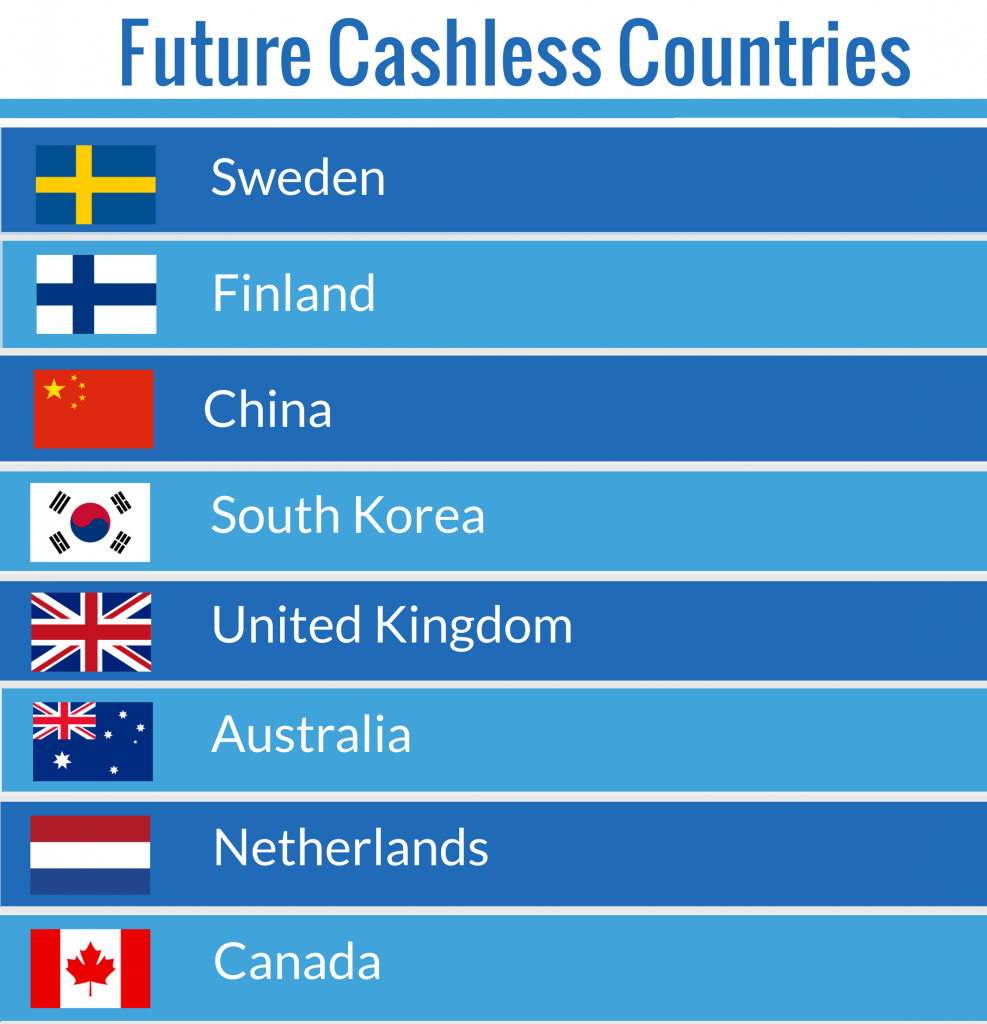
There are currently no cashless countries. This being said, there’s a growing number of countries seeking to go cashless in the coming years.
Let’s take a look below at some of the countries that are closest to going cashless:
- Sweden
- Finland
- China
- South Korea
- United Kingdom
- Australia
- Netherlands
- Canada
Sweden
With a date set in 2025 to go completely cashless, Sweden is arguably the closest country to achieve this. It is currently not uncommon to see signs that say “No Cash Accepted” in various shops in Sweden.
A recent study from the European Payments Council showed that cash transactions accounted for only 1% of Sweden’s GDP in 2019 with cash withdrawals steadily declining by about 10% a year.
While consumers are generally happy, those struggling financially or technologically still continue to rely on cash.
Recent reports show that mobile payments are accelerating very sharply in Sweden. One of the main reasons for this is that Swedes are tech-savvy.
For example, Swish, which is a mobile app, had over 7.8 million users in July of 2020 and also performs close to 50 million transactions a month.
Should Sweden achieve a truly cashless economy, visitors will want to be sure that they have forms of electronic payments.
Finland
Finland has a smaller population of around 5.5 million. This being said, cash in Finland is becoming irrelevant through rural and urban areas.
So, what is Finland doing differently than Sweden? Finland is not taking as aggressive measures as Sweden in going towards a fully digital economy, however, it is reported that Finland is currently more capable of going fully cashless this moment.
Finland currently ranks second to just Ireland in terms of frequency of use of cards, and fifth in e-commerce spending, and second in smartphone penetration.
China
While China is a bit behind both Finland and Sweden, the growth in electronic payments is far more significant, given its massive population size.
Like other countries that have been aiming towards going cashless, China has shown a rapid adoption of mobile payments. Currently, one of the most popular ways to pay by phone is through QR code scanning.
China is leading the charge in eCommerce and is the biggest eCommerce market in the world. With annual online sales of $672 billion and an annual growth rate of 27.3%, China doesn’t show signs of slowing.
South Korea
South Korea is currently more cashless than China, however, there are far fewer people.
More and more South Koreans are starting to rely on credit cards and various digital payment tools. South Korea already has most of the infrastructure in place nationwide to go cashless.
It was reported that roughly 6% of South Korea’s GDP being eCommerce spending and more than 100 transactions on every credit card per year.
This should keep South Korea in the conversation in the coming years when it comes to the idea of going cashless or even just relying more on electronic solutions.
United Kingdom
The UK has embraced technology, including the digitization of money. London, specifically, has done so the most so far and continues down this path.
The UK has a strong presence in online banking and it is currently in second place to just the United States when it comes to financial tech areas. There has also been a strong increase in merchants accepting more card and mobile payments.
In 2020, the UK was 3rd to just the United States and China in eCommerce GDP, and they sit well above 4th place, Japan.
Australia
Australia is a bit behind the other countries mentioned in this list, however, it is definitely worth the mention. We are currently seeing Australia start to digitize most of its economy. It is predicted that most individuals in Australia will own a smartphone by 2020.
This is a major advancement as a lot of payments are done via mobile transactions nowadays.
On top of this, internet banking penetration is now over 75% of the total population.
Over the last 5 years, the use of debit cards has increased by over 90% and online banking transactions have increased by over 43%.
Netherlands
The Netherlands is one of the leaders in Europe when it comes to electronic transactions. A striking statistic is that 99% of the population currently owns a debit card.
Over half of payment transactions in 2020 were contactless and via debit card. This is a huge step towards the potentiality of going cashless.
With this being said, cash still remains to be an important payment type.
Canada
While Canada is nowhere near going cashless, they have some very interesting statistics regarding electronic transactions.
83% of Canadians no have a smartphone. This is huge as consumers use smartphones to pay bills, shop online, and transfer funds. A study even suggested that nearly 80% of Canadians wouldn’t leave home without their phones.
We’re also seeing that over 70% of personal purchases in Canada are now card-based. While it’s hard to deny this boom, going completely cashless in Canada seems to still be far away.
Will The U.S. Become A Cashless Country?
With a disparate level of technology and a wide span between rich and poor people, it is hard to see the United States going completely cashless in the near future.
When a significant number of our population are poor, refuse to use smartphones, or are severely unbanked/underbanked, one could guess that cash will be around for a long time.
Not to mention the various laws that require that anyone who sells something must accept cash as a form of payment, as well as several cities that have also passed ordinances to prevent businesses from going completely cashless.
While many believe the United States won’t be going cashless anytime soon, countries with lower levels of economic inequality and greater trust in government seem to be pushing the envelope.
This being said, the United States, like most countries, is making some major moves when it comes to electronic payments and transactions.
What Can Merchants Do?
Now, more than ever, merchants should be doubling down and making sure that they are able to accept various payment methods.
As certain cities and countries around the world continue pushing electronic transactions, it will be more important than ever that your business is able to process various payments.
Even if countries don’t go completely cashless, tourists may be reluctant to travel with cash and may resort to different forms of payment.
Wrapping Up
While we still have a few years before Sweden goes totally cashless and the other countries begin to follow suit, take this opportunity to look at accepting different payment methods and forms of currency.
Should you be a merchant, it is extremely important to make sure that you are working with a merchant services provider that is ready to adapt to an ever-changing industry. Not only does Corepay do this, but we also offer solutions to all types of industries including high-risk.
The video below is simply shocking… Because not even Trump or Putin expect such a thing!!!
This Could Kick-Start World War 3 Fellow Patriot
Our country is headed to a Nuclear World War 3
And we are NOT prepared for it…
This coming war won’t be fought with tanks and infantry like the first two…

You can also access the latest news at this address: www.whatfinger.com
-
Would the United States be the safest place on Earth in the event of another world war? If not, where would it be?
This article is from a veteran’s perspective.
I am a 100% disabled Army Veteran. What follows is the result of my love of Ken Burns documentaries, PBS, and multiple drunken “discussions” with fellow Veterans from each branch of the military. I based my Naval scenarios on history and where my Navy Chief friend served while in the Atlantic Fleet. I was never a Commissioned Officer and I never attended War College. While I do not think the Allies could win WW3, I am optimistic that America would be safe. This is an opinion. Do not base your survival on my opinion. Study history. Follow the News. Know who your politicians are and know the politicians that are in line for the presidency.
Yes and no. It is extremely difficult to invade the United States of America. Even if the United States was invaded, it would be near impossible for an enemy to hold onto any territory in the US and it would be impossible for an enemy to disrupt our war machine enough to impact our efforts overseas.
Most Veterans and military personnel have not fought a real war like WW3 would be. We have lots of practice fighting and losing against insurgencies. For instance, WW2 ended in Europe when Allied Forces reached Berlin but the war in Iraq really began when forces reached Baghdad.
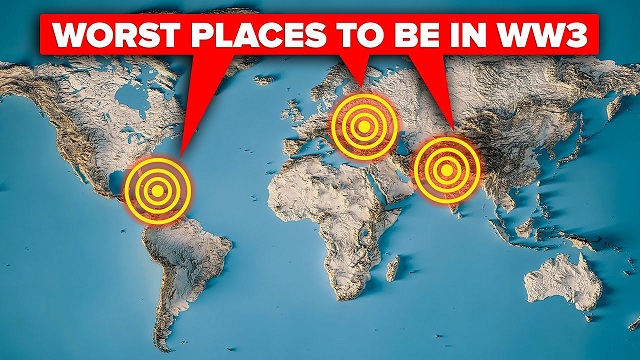
WW3 will likely be between the US allied with Europe, Israel, and India. We will also be Allied with the Western Hemisphere. China, Russia, and the majority of the Middle East will more than likely align against us.
In this situation, the US is more than likely safe from attack. This is because there are few places of strategic value in a World War. More than likely, our Naval forces will try to control the Pacific Ocean. Allied forces will control the Black Sea, the Mediterranean Sea, and the Suez Canal. I don’t know what the US Atlantic fleet would do but I would use it as an escort force worldwide.
WW3 would be hard to win for either side. The USA has vast resources and the manufacturing capacity to turn those resources into war machines. Unfortunately, Russia has more resources and China can manufacture just as fast or faster than we can. The USA is hard to invade but Russia and China would also be hard to invade. Allied ground forces would try to push into Russia from the former Eastern Bloc. Allied forces will try to push into Russia from the Middle East. Israel will take advantage and will capture the Golan Heights and huge portions of the territory surrounding them. If Israel succeeds, Russia is at risk of invasion.
China will more than likely sit back and provide support for Russia. People are afraid of North Korea becoming a nuclear power. I’m not. If WW3 has nuclear weapons, Pakistan and India will be the ones to use them. If Pakistan loses, India will become a useless ally. If India wins, they become a useless ally. There are no winners in nuclear war. With India out of the way, China will take out their regional rival , India, and will end up controlling India and most of the Middle East. Whoever wins the Middle East campaign will more than likely win the war. Access to the Mediterranean will cause Europe to have to fight two fronts if they lose.
The fight for Europe will be a stalemate. The Black and Mediterranean Seas will change control over time and will change back over time. Europe will lose any capacity to make weapons of war or provide enough food for itself. The Russian and Chinese militaries will win the war if they take over mainland Europe. The Allies will try to march on towards Moscow. They will more than likely fail like Napoleon and Nazi Germany did.
During all this, America will likely be safe as long as we have a Navy. If the Atlantic fleet is lost, The East Coast will be invaded if we do not negotiate peace.
If America is not safe, the Middle and Southern parts of Africa and South America would be the safest places on Earth. If you are a scientist, Antarctica is a great place.
If WW3 happens, the Allies will more than likely lose. I believe ground forces would be stuck in the Eastern Bloc and Afghanistan. Europe will be bombed into oblivion. Western Russia will also be bombed but the Allied Air Force will not be able to reach far enough into Russia to matter. The Allies will do well in the Middle East and it will be split between the Allied and Axis Powers.
If Pakistan and India do not use nuclear weapons, the Allies will more than likely win. India is to strategic for the Axis Powers to not control. India can bring a real war to China, Russia, and the Middle East. The US and Europe would be able to use a Western Front to attack Russia. Israel, the US, and India would be able to fight the Southern and Southeast Fronts against Russia and China. India and the US would be able to attack China and Russia on the Eastern Front because the US Navy could be more aggressive in the Pacific because China is fighting a war that is close to home. All of America would be safe in this scenario.
The video below is simply shocking… Because not even Trump or Putin expect such a thing!!!
This Could Kick-Start World War 3 Fellow Patriot
Our country is headed to a Nuclear World War 3
And we are NOT prepared for it…
This coming war won’t be fought with tanks and infantry like the first two…
You can also access the latest news at this address: www.whatfinger.com
-
EXPERTS On The Collapse Of Our Planet Are Terrified Of The Future! (They can clearly see the coming collapse of global civilisation from an array of interconnected environmental problems.)
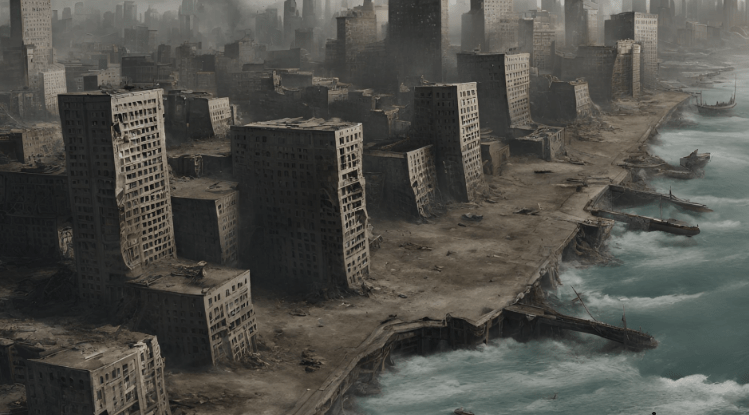
“Environmental problems have contributed to numerous collapses of civilizations in the past. Now, for the first time, a global collapse appears likely. Overpopulation, overconsumption by the rich and poor choices of technologies are major drivers; dramatic cultural change provides the main hope of averting calamity.” ~ Paul & Anne Ehrlich
Experts on the health of our planet are terrified of the future. They can clearly see the coming collapse of global civilization from an array of interconnected environmental problems. “We’re all scared,” said Paul Ehrlich, president of the Center for Conservation Biology at Stanford University. “But we must tell the truth about what’s happening and challenge people to do something to prevent it,” Ehrlich told IPS.
Global collapse of human civilization seems likely, write Ehrlich and his partner Anne Ehrlich in the prestigious science journal, Proceedings of the Royal Society. This collapse will take the form of a “…gradual breakdown because famines, epidemics and resource shortages cause a disintegration of central control within nations, in concert with disruptions of trade and conflicts over increasingly scarce necessities”, they write.
Already two billion people are near starvation today. Food production is humanity’s biggest industry and is already being affected by climate and other environmental problems. “No civilization can avoid collapse if it fails to feed its population,” the authors say.
Escalating climate disruption, ocean acidification, oceanic dead zones, depletion of groundwater and extinctions of plants and animals are the main drivers of the coming collapse, they write in their peer-reviewed article “Can a collapse of global civilization be avoided?” published this week.
Dozens of earth systems experts were consulted in writing the 10-page paper that contains over 160 references. “We talked to many of the world’s leading experts to reflect what is really happening,” said Ehrlich, who is an eminent biologist and winner of many scientific awards.
Our reality is that current overconsumption of natural resources and the resulting damage to life-sustaining services nature provides means we need another half of a planet to keeping going. And that’s if all seven billion remain at their current living standards, the Ehrlichs write.
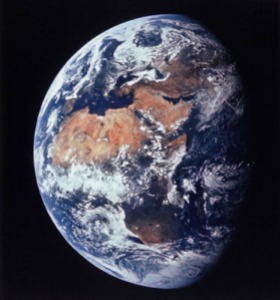
“The Earth is One ~ The World Not Yet” photo from NASA
If everyone lived like a U.S. citizen, another four or five planets would be needed.
Global population is projected to increase by 2.5 billion by 2050. It doesn’t take an expert to conclude that collapse of civilization will be unavoidable without major changes. “We’re facing a future where billions will likely die, and yet little is being done to avoid certain disaster,” he said. “Policy makers and the public aren’t terrified about this because they don’t have the information or the knowledge about how our planet functions,” he said.
Last March, the world’s scientific community provided the first-ever “state of the planet” assessment at the Planet Under Pressure conference in London. More than 3,000 experts concluded humanity is facing a “planetary emergency” and there was no time to lose in making large-scale changes.
In 2010, a coalition of the national scientific bodies and international scientific unions from 141 countries warned that “the continued functioning of the Earth system as we know it is at risk”. “The situation is absolutely desperate and yet there’s nothing on the front pages or on the agenda of world leaders,” said Pat Mooney, head of the international environmental organization ETC Group. “The lack of attention is a tragedy,” Mooney told IPS.
Solutions exist and are briefly outlined in the Ehrlich paper. However, these require sweeping changes. All nations need to do everything they can to reduce their emissions due to fossil fuels regardless of actions or lack of them by any other country, Ehrlich said.
Protection of the Earth’s biodiversity must take center stage in all policy and economic decisions. Water and energy systems must be re-engineered. Agriculture must shift from fossil-fuel intensive industrial monocultures to ecologically-based systems of food production. Resilience and flexibility will be essential for civilization to survive.
A key element in meeting this unprecedented challenge is “…to see ourselves as utterly embedded in Nature and not somehow separate from those precious systems that sustain all life”, writes England’s Prince Charles commenting on the Ehrlich’s paper.
“To continue with ‘business as usual’ is an act of suicide on a gargantuan scale,” Prince Charles concluded.
You can also access the latest news at this address: www.whatfinger.com
-
What’s would you do if an EMP knocks out all of the power where you live? (It would have to be a crippling global event to severely impact us. If things aren’t back up and running after 6 months, life has changed.)

In the case of something like a massive solar flare emitting an EMP and frying all the electronics and machines of the globe — I’d lose Internet, electricity, the ability to buy food, and water. It would have to be a crippling global event to severely impact us. If things aren’t back up and running after 6 months, life has changed.
My daily work would shift to water and food procurement.
There’s several stock tanks within four miles that are pumped using wind (I think. I know a few have been changed over to solar.) So, I’d have to take a walk for water. And on my way back and forth, I’d be foraging and planting seeds — or maybe relocate to where there’s water. By the time our food stores ran out, hopefully something could be harvested and eaten.
My wife and I would likely die if we stayed put. Not much of a strategy, really.
But if my neighbors (all farmers and ranchers) decide to gather and form a local community, that might be a different story. There’s maybe a couple dozen humans between who’s out here on the plateau and who lives in the canyons — and thousands of cattle. Less people than one good-sized family that lived out here 100 years ago…but maybe we could band together and make things okay for ourselves.
The nearest city is 180 miles away and so far off any beaten path — if anybody shows up, they’re probably somebody we know. This is the ‘bug-out’ location for a few of my friends and their families, but I doubt they’d ever make it. (They like to dream, so I let them. It’ll never happen anyway.)
I was an Army medic and used to work in a nursing home. I’ve forgotten way more than I remember, but I probably know a few things in the medical realm that people might appreciate. I’m sure somebody would need the medicine we make.
I was also once a gunsmith. I still sometimes repair a neighbor’s gun from time to time, so they know my limitations there. Doesn’t take electricity to make and replace a screw that went flying off into the grass. (I got rid of a lot of tools, but those unusual taps and dies — hanging onto those.)
Most of the locals know different things about plants and animals around here, other than all the stuff people might grow. We all know how to clean and skin an animal and plant/harvest a crop. Yeah, it’d be a lot harder without tractors and stuff — but I’ve never had a tractor and never driven one. I’m not at a loss without one.
And there’s several random hobbies, making cordage, spinning, weaving, tool making, pottery, music, blah-blah.
Aside from the abandoned copper mine and iron ore everywhere, everybody has metal scrap pile and everybody welds. I’m fairly certain we can cobble a forge together and bang out whatever our families might need. We have a lot of wind that I’m sure we can put to smart use.
The lathes, mills, and drill presses might not have a functioning motor, but the rest of it is still fabulous and precise. Take out the electric and combustion motors. Use wind, water, and flywheels to power the machinery. (I would imagine everybody is twitchy about using electricity again.)
And the old tractors without all the computers are probably just fine, so quite possibly we could make our own vegetable diesel or alcohol and get those fired up — same with semis and pickup trucks.
I also have a bunch of stuff for group decision-making, organizing our self-government, conflict resolution, logistics, and who knows what else up in my head.
I don’t think I know much these days, but there’s many places where I think I can at least be of some assistance. I like to think I’d be a handy person to have around, but who knows? I might just be in the way.
If crops don’t come and the community doesn’t form, I guess we’d just grab the essentials and start walking to see what the future holds.
You can also access the latest news at this address: www.whatfinger.com
-
Which is the safest country if World War III happens?

Most popular answer on this question is Switzerland???
New Zealand would be the safest country and Australia, a very close second.
You want to think about strategy? logistics ALWAYS comes first!
As well defended as Switzerland is, the oldest form of taking a defensive structure would inevitably destroy them.
Siege
Switzerland is almost entirely dependant on imports for their food. There simply isn’t enough fertile ground to support their population of 8.3 million.
You want to beat Switzerland? Starve them.
They can hide behind their broken bridge, rock covered mountain roads, fallout shelters and armed forces all they like. But without food Switzerland is screwed.
It wouldn’t take more than a few months before Switzerland is forced to surrender.

Australia has a massive natural advantage.
Australia is surrounded by water. Australia also has no nearby foreign deep sea ports capable of staging an amphibious assault. This means that any amphibious task force would require massive supply chains which would be very difficult to maintain and defend.
[1]

Australia has has a small but highly motivated and experienced defense force of 58,000 personnel.
But these guys are who you really need to worry about. These bastards are unbeatable.

‘The Great’ Emu War – Wikipedia
If the attackers make it to Australia, well guess what… you have probably just reached northern Queensland or Darwin. That’s all the way in woop woop (middle of bum f**k nowhere).
The next closest major urban center would be Brisbane and that’s 3,424km from Darwin.
Also guess where Australia keeps an decent chunk of their defense force?
Darwin. *wink wink*
[2]

[3]

You want to lay siege to Australia?
You are on the right path. But unfortunately for you “our land abounds with nature’s gifts”. Australia has abundant fertile land to farm. More than enough to be self sufficient.
As for Nukes. Yeah piss off, we are so big that if you wanted to destroy all of Australia then you would throw enough fallout into the atmosphere you would inevitably doom earth. We all die in that scenario.
In essence, to achieve a successful landing on mainland Australia would be a logistical nightmare. To capture anything important would require a miracle.
New Zealand is shares very similar characteristics as Australia but NZ is even further away from everything else. NZ has a disadvantage due to their smaller size but their distance factor makes up for this.
Australia and New Zealand have enjoyed a very strong relationship since their creation and getting to New Zealand would mean facing the wrath of the entire Australian Defense Force as well.
Also many people outside of the Commonwealth don’t even know New Zealand exists. New Zealand is the most low key country there is. And good relations with pretty much everyone helps NZ quite a bit.
The New Zealand government already understands their defensive position, which is why they have an extremely small defense force of 11,440 personnel but their measure is similar to that of Australia’s defense force personnel.
Finally to emphasize the effectiveness of the ANZAC
[4] forces I’ll leave this quote [5].
“If I had to take hell, I would use the Australians to take it and the New Zealanders to hold it.” -Erwin Rommel.
So to all potential attackers of WWIII, you want hell? Come take it!
[5]. Historical accuracy of this quote is debatable. Even if it’s false the adf has been coined the best small army in the world on many occasions.
You can also access the latest news at this address: www.whatfinger.com
-
Where is the safest place to live on earth in the event of massive climate change?

What we think we know about natural consequences, within 30 years:
- The seas will rise some
- Weather will become more extreme, while staying the same in type
- dry places will be dryer
- wet places will be wetter
- hot places will be hotter
- Precipitation patterns may change regionally
- Supply chains will falter, some will fail, regional food production will become more essential, especially hydroponics and indoor farming
- Food supplies will change from global to more regional, agriculture will have to go fully organic, regenerative. Disowning industrial agriculture corporations, giving the land back to farmers, will be essential in the transition.
- Forests in lower, hotter regions will burn off, or dry out and die off. Reforestation via rewilding animal populations, may be a solution
- Some rivers will dry out, fish populations will go extinct regionally
- Mountains will be free of snow for longer periods. The Alps will require an adjustable water management system, including new rainwater retaining systems where glaciers have vanished.
- Floods in places where rivers were constrained by human intervention, and large spaces have been sealed with construction, will increase in severity and frequency.
- Groundwater aquifers may dry up regionally, and/or become heavily contaminated (Colorado River, Nile)
In Europe
Central and Northern Europe, Northern Spain, North Western France, the entire Alps, except some Baltic coastal regions like Holland and Belgium, should be safe.
In General, being in hilly regions is preferable, make sure there’s plenty of precipitation, preferably spread out over the year. These patterns will change, keep informed.
I expect that, where I live, wooded mountains in the middle of Tirolia, Austrian Alps is a good place to make a stand as any. I live right by the river, and even in the flooding last year, I had a dry basement. I have to say though, another 10 cm and that would have changed. So, I am looking to move a bit higher up on the sunny hillside, just a couple hundred meters, since I grow my own food, I don’t want to be too high up. So far, in my region, not much has happened to the weather patterns beside the snow becoming less and less. I guess, finding enough snow for snowboarding will not be my biggest problem.
We will also have direct humane consequences. The rich of the world never cared for the poor, that will not change. Yes, there will be regional protests, but the rich, spoiled western consumers have proven that, beyond protesting, they do not want their consumerism and comfort to be infringed upon.
We know, the planet can not sustainably support the current human population, unless, we, the rich 10%, reduce our CO2 footprint and consumption of resources by a factor of 10. Let’s face it, that’s not happening, so what’s the alternative? For decades we have read the reports from Asia and Africa, about exploited peoples and exploited resources, nothing has changed. We are just fine with our transnational corporations exploiting these countries and their peoples, just don’t bring them here. If we wanted these things to change, we would change our consumer behaviour, our strongest, most powerful democratic voice.
From this, our behaviour, I conclude
- Rich, well armed countries will keep immigrants out by force. Hundreds of Millions of migrants, climate refugees will move north through Africa, or Turkey and the Balkan, and starve or die of disease on the way.
- Rich countries will let the populations in poor countries which are more affected by climate change, suffer the brunt. Poor countries will be naturally depopulated via starvation, squalor, gang violence and disease, the world population will be decimated. This is necessary, as these poor people of these regions have a CO2 footprint of 100 kilograms a year, which can not be allowed to increase. After all, we’ll keep ours at 11 tones a year, 16 tons in the US.
- Rich, well armed countries will keep exploiting poorer countries, mostly the rich north keeps taking the candy from the poor south.
- The rich in the north will finally understand that they are not ethical, or morally upstanding, and come to terms with it. They will let the poor perish in the hundreds of millions, (sorry, survival of the well armed, survival of those who lack empathy, or do not let their empathy stop them from subduing the poor and weak) to then have the planet in a condition that has a better chance of supporting a reduced human population sustainably. (Look around, this has begun years ago)
You think I exaggerate? Think again.
The broken $100-billion promise of climate finance — and how to fix it
At Glasgow’s COP26 summit, countries will argue for more money to mitigate and adapt to the effects of climate change.
Did you really think they would pay? If the rich would pay this bill, then the poor people would raise their CO2 footprint, that can’t be allowed to happen. If this bill is paid, the path is laid to make the rich countries pay for their historic CO2 consumption. Sorry, that’s not happening.
COP26: Rich countries ‘pushing back’ on paying for climate loss
Poorer countries say they are not able to get compensation for the damage caused by climate change.
Remember, who the UN have become:
Corporate Capture of Global Governance: WEF-UN Partnership Threatens UN System
Deeply concerned about corporate capture of the UN system, 289 organizations from all regions of the world, as well as 27 individuals, have endorsed a collective letter to the United Nations Secretary General, H.E. Mr. António Guterres, to terminate the strategic partnership agreement recently signed by the United Nations and the World Economic Forum.
The UN has partnered with the WEF, the World Economic Forum, which is funded and governed by corporate elites. ABB, Cisco, Chevron, Glencore, OPEC, Shell, BP, Amazon, Microsoft, The Bill and Melinda Gates Foundation, Virgin etc.
Hundreds of Civil Society Organizations Worldwide Denounce World Economic Forum´s Takeover of the UN | Transnational Institute
The call, made in an open letter, denounces attempts to ‘delegitimiz[ing] the United Nations and weaken(ing) the role of states in global decision-making.
Now, in the UN, and via the most powerful economic Lobby Group, the WEF, these unelected global leaders make legislation. They write the laws that should regulate their industries in the interest of humans and the environment. It’s absurd.
The privatisation of global governance: forget New York, keep Davos? ǀ View
Notwithstanding the differences, one would be excused to compare the WEF’s Annual Meeting in late January in Davos with the annual high-level meeting of the UN General Assembly in late September in New York. Both are preceded by overview reports presented by their respective CEOs.
These wealthier, more established nations to support the world’s most vulnerable countries moving forward, would be a nice thing to have, but you don’t really believe that will happen, do you?
UN under fire over choice of ‘corporate puppet’ as envoy at key food summit
Organisation accused of kowtowing to big business by appointing former Rwandan agriculture minister with links to agro-industry
I am only showing these, to make you understand what we are, we, the rich and powerful in the Western social democracies. We need to recognise why things are happening the way they are.
Europe will have her Navies prevent African Climate Refugees from leaving North Africa, just like we have made the refugees coming through Belarus, Turkey, Greece and Italy into political ping pong balls. In Greece and Turkey we have refugee camps where the conditions are inhumane, to put it mildly, who cares, Libya has become a Mecca for human trafficking, need I say more.
Protesting is not the same as actually caring. Asking to give a refugee family asylum in your home, that would be caring, but I have yet to hear of such cases happening.
As for the the US
In General, the US are a vast country, the hilly or mountainous regions in the West and in the East, where there is historically enough precipitations, should be good places to make a stand, ecologically speaking.
When it comes to humans, the US are a different place. Even right now, right and left are beyond speaking terms, the right have left our realm of reality altogether. If Trump wins in 2024, all I can say, emigrate, go to Mexico or Canada, unless you are really rich, then you can afford protection.
Due to virtually unrestricted gun ownership and literally pandemic psychosis and psychopathy, the amount of arms in the population will be society’s Achilles heel in the US.
- Well armed groups of marauders will ravage the unarmed, the unprotected. Remember, there is not even enough solidarity in the US for a universal healthcare system.
- Every living being that draws power or water from the colorado river, will have to move. That’s 40 Million Americans moving from California north east.
40 Million People Rely on the Colorado River. It’s Drying Up Fast.
One of the country’s most important sources of fresh water is in peril, the latest victim of the accelerating climate crisis.
- What the US have done to other nations (North American Native Peoples, China, Philippines, Marshall Islands, East Timor, Iraq, Afghanistan, Central and south America) will give you an Idea of what will happen with the poor inside the US, what the rich 1% or 10% will do with the rest. Consider how the poor, vets included, the sick and the weak are treated in the US, historically, and currently.
Here, a little History, not for the faint hearted with empathy.
In summary.
- Move north, away from flat coastlines, away from severe storm paths, away from big urban areas
- Move to where the locals are friendly, in a tight, advanced solidary society, preferably non religious and well educated
- Learn how to be of help inside the society you chose, making it better and safer by being part of it
- Learn how to grow food, indoor and outdoor, sustainably, If you have surplus, help out those who have not enough, fortunes change
- Learn how to build a sustainable home, live sustainably
- Learn how to consume less, while living healthier and more honest with yourself
Live Long And Prosper.
You can also access the latest news at this address: www.whatfinger.com
-
America’s Immigration Crisis, Due to Biden’s Failed Policy
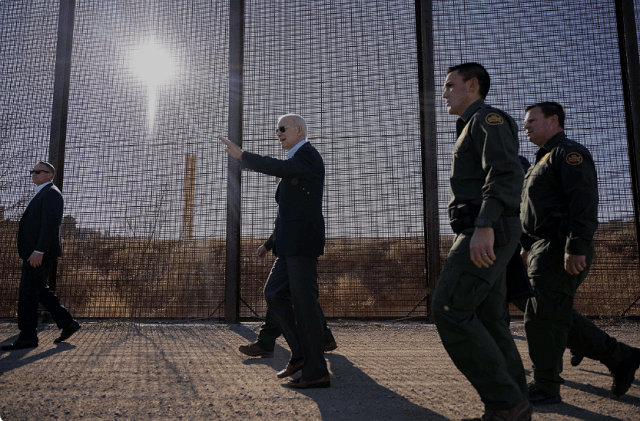
CNBC just put out a video on the problems migrants are causing as cities struggle to deal with new immigrants being dropped on their doorsteps. Even many of the cities that opened their arms to welcome these people want the government to halt the inflow. Coupled with this are calls for Washington to send money to help these cities out. Today, major cities like New York, Denver, and Chicago are finding themselves under extreme financial pressure and not getting the federal funding or assistance needed to cope with the inflow. All this has many Americans saying, enough is enough. The big question is how and when will this end.
Even some of those formerly advocating the loosening of immigration standards and open borders are coming to a place where they are untenable. Sadly, with the flow of more immigrants has come a slew of problems. Part of the problem is that many of the people streaming over our borders are not workers, this inflow includes people needing expensive healthcare and criminals. Yes, with the good come the bad unless restrictions are in place. More people are not the answer to crafting a strong economy, quality is far more important than quantity.
Remember, this immigration fiasco is occurring while American citizens are forced to stand in long lines with passports in hand. Anyone who has traveled knows you can’t just walk into any country without any questions asked. All this highlights the fact that immigration has been an issue for decades and not properly addressing it will not make it go away. A reasonable solution to solving our immigration problems has eluded both Republicans and Democrats time and time again and reduced those caught within the system into political pawns.
The debate over immigration, processing new arrivals, and addressing millions of undocumented immigrants, receives plenty of press but most of our immigration problems lurk below the radar. The point is that we should be careful what we wish for. In our complicated world, there are often pros and cons for every issue. The ongoing migrant crisis is unprecedented and is hitting countries across the world. Here in America, it is impacting not only the border states but is reaching deep within the country.
Even small businesses in my state, far from the border, are required to confirm a worker is legal to work. This is a bit ridiculous for small firms with only a few workers, all from their own family and people they have known since birth, but that’s the law. The comment section of the CNBC video is full of opinions on how opening the border is impacting America. Since these people are flooding to cities, that is where most problems are apparent. Several of the themes revolve around things like, “As a Chicagoan, my city is being ruined.” People from New York and Denver are also echoing the same message and crying about what Texas has dealt with 100 times over.
Immigration is the crux of the issue and Trump’s so-called wall became an emotionally divisive symbol that took our eyes off the real problem. America’s immigration policy is a costly mess. Like it or not, those in charge of such things as controlling our borders are letting immigration reshape the world. This is happening far faster than most people can imagine. Let’s call a spade a spade, immigration mainly benefits those entering a country and not the country’s current residents. Otherwise, countries would have to pay people to come rather than build fences to keep them out.
Washington has been playing games and politics with America’s immigration policy for years it has been a political football. The immigration system is badly broken and fixing it is easier said than done. A huge part of the problem stems from the fact most people can not agree on exactly what kind of immigration system we should have. To many Americans, the key issue is how open the borders should be and who should be allowed to enter. Now Washington’s inaction is coming back to haunt us.
Tens of billions of dollars are wasted each year on this costly inefficient system according to an article published by the American Action Forum way back in April of 2015. The article explored the cost of a broken immigration system on American business. The fact is that when the American Action Forum (AAF) analyzed the total costs of the immigration system, they found close to $30 billion in annual regulatory compliance costs. It hardly takes a rocket scientist to determine that reducing the number of people “illegally” entering the country would save billions of dollars and allow the system to function better even in its current poorly crafted form.
A lot more of our political attention should be focused on the broken bureaucratic apparatus that comprises our current immigration system. While we spend hundreds of billions of dollars on this and that in overall cost the wall Trump proposed now seems a rather puny amount. This is confirmed by figures that show merely doing away with making and handling the penny America would save enough to pay for a border wall. Of course, none of this is a solution to the Deferred Action For Childhood Arrivals (DACA) situation. Loading millions of people on buses and deporting them will never happen. At the same time, those wanting more open borders should realize the current situation does not work either.
Washington should step away from the “emotional” aspects of immigration such as flowery debates about the rights of people and what they “deserve” and focus on the key issues of restoring a functioning government and getting on with real immigration reform. In the overall scheme of things considering America’s multi-trillion dollar budget, the 5.7 billion dollars requested for the wall is peanuts. In truth, it is easy to see how America will get a good economic return on money spent on a barrier that works 24/7 year after year. Most taxpayers, if asked, would see this as a far better investment than paying government workers to stay home, as we did during the last government shutdown.
You can also access the latest news at this address: www.whatfinger.com
-
What the World Needs to Learn From Venezuela- Five Steps To Address The Food Crisis In Venezuela (Deadly Riots In Venezuela Bring Food Shortage to Global Stage)

The writer of these posts is a middle-class Venezuelan father, in a country which has the world’s highest inflation rate at more than 4000%. Venezuela is an economic collapse nightmare with extreme shortages of food, riots severe hunger, a crippled economy, crumbling infrastructure, collapsed healthcare system, and a failing government.
A number of years ago, Venezuela was the richest country in South America, now it is the poorest. Daily life in the former oil-rich country is plagued with starvation, violent crime, gangs, corruption, and child fatalities, and it is getting worse. In this post, the Venezuelan Prepper makes five recommendations, based on traditional methods, to boost food security.
Just this week, I saw some pictures that touched me deeply. They were images that made me go into a state that I find very hard to describe. In writing this article for you, I hope I am able to describe some sense of what is going on, and I am always interested to hear your rewarding comments and responses.
In writing this post I am contradicting what my government so strongly enforces, a monopoly on the food chain. They have tried to solve the economic collapse of Venezuela by controlling the food supply in the country, but they have failed. More and more every day people grow in hunger and consume less food. Now it has reached a point where children are dying of starvation. Soon, there won’t be a country left to save.
I don’t care if there is a risk to my safety. Seeing a picture of a starving child on my Twitter feed warrants me to say ‘enough is enough’.

Venezuela should not be in a food crisis
One of the most important and damaging effects of the economic collapse in my wonderful, rich and gorgeous country of Venezuela has been, as everyone knows, the food scarcity. I won’t go into the details about the reasons as to why there is a food crisis, and how it occurred. The causes are many and have different factors that influence them.
Our society has never been one that has faced severe disasters, or natural events caused by bad weather, or plagues that have affected crops. Our weather is considered one of the most beneficial and stable types to grow foods. We don’t hurricanes or heavy storms like other areas of the world. There is snow just in the Andean mountains, and our coastlines have plenty of sea life for a stable food supply. We can grow whatever we need in decent amounts for the entire year.
With all of this in mind, it is very hard to sit here and say Venezuela is in a severe famine. So bad, that many children are dying just because they can’t get access to enough food. It is hard to explain to fellow readers from the prepping community that I write for, but I will do my best. This is what happens when an economy collapses.
Venezuela’s agricultural strength
Most of the Venezuelan population is, or was, concentrated in the cities. No surprises here, of course. Much like other western nations in the world, moving to the city comes with the promise of better salaries and general improvement of living conditions (not so much improvement nowadays though), and the reasons to leave out the crop fields and heading to the city has been more or less the same in every other modern country.
Talking with the elder farm people, like my father’s family, they told me that back in the old days of homesteading practices they would store plenty of staple foods that last a long time like dried beans in 200 liters steel barrels, a sort of bread made with “tapioca” (a tubercle) called “cazabe”, a staple developed by the Amazonian tribes that is now a daily side dish all over the country. They would also store dried corn for processing and cooking a well-known dish called “arepa“, dry salt meat (similar to jerky, but without too many additives like paprika or other condiments) and dry fish. All of these foods were common preparations before the fridge and electricity became common. All of these were needed in the dry season. These healthy country customs were thrown out the window, though as technology progressed.
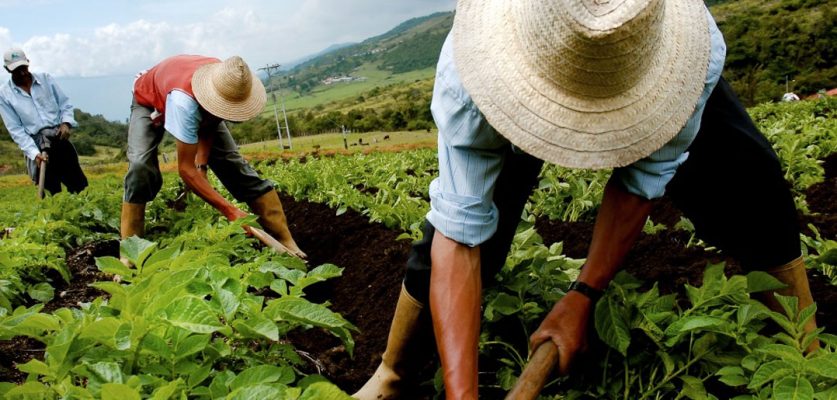
Venezuela’s land is full of nutrients, the problem is, it’s not being farmed. People got used to fresh meat, poultry, fish, and the “mechanizing” of the farming, simultaneously to the Green Revolution worldwide, quickly made the people forget about the need of stockpiling food for times of necessity. Who needed to stockpile, living in a major city where the kilo of flour was just a couple of blocks away in any mother-and-father-owned store. And now we are paying the price, indeed.
I am the kind of person who finds it hard to be sitting on too much spare time. I feel the need to build stuff, create, contribute, and write about all the avalanche of ideas flowing into my brain, especially after this disaster in my country.
For now, all I have been thinking about is the issue affecting so many Venezuelans, and I wanted to write what could be done right now to improve the local food production so that it can get back to decent levels, that avoid the worst, and more criminal effect of all the crisis: the child starvation.
How can we solve Venezuela’s food shortage? Do what we did before
As possible mitigation solutions for the widespread food emergency, in the country where I am, there is a lot of those called “superfoods” such as quinoa, cañihua, and chia. These are grains that can be cultivated within a short cycle, and there is lots of land in our Andinean mountains that could be used for this because the microclimate is good for that. Perhaps the altitude is much less than the original place of the crops but it deserves to give it a shot.
The approach to production would even be beneficial, because it would allow the rotation of the traditional crops, mainly onion, potatoes, carrots, and strawberries (yes, Venezuela is so wonderful that we can grow strawberries in the middle of the tropic, and enjoy a pineapple-strawberry smoothie) and would provide the farmers with another income source, and a know-how about a product that could be profitable in the near future.
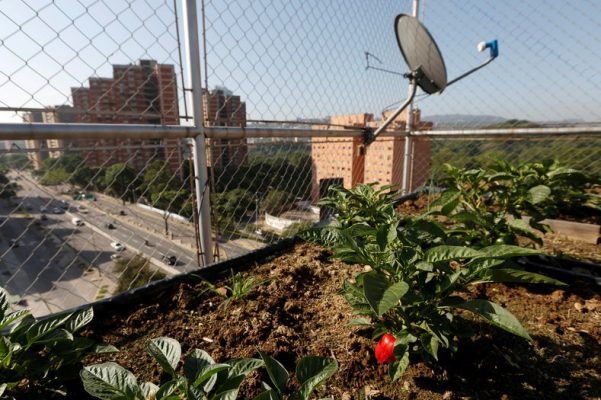
Some Venezuelans are moving to more traditional methods, such as urban farming wherever they can, even on rooftops in the capital Caracas. Photo: REUTERS/Carlos Jasso. We have plenty of sun and rainwater in the place where I come from, as a matter of fact, I am starting to develop a project with specialists in nutrition, farming and other areas. The Andean grains have been, for a long time now, the main staple of the regional tribes, and recent research has positioned them as a very high degree of nutritional value. These grains, with origins in Peru and Bolivia, have been proven to keep a decent level production in some of the South American valleys. Their main attraction about them is their high nutritional value, and using modern-day technology could increase superfood productivity rates.
These grains have been included in several development programs looking exactly for what we need now: an exponential increase in food security, to provide assistance for the most vulnerable population right now, the elderly and the children.
Five Steps To Address The Food Crisis In Venezuela
There are five steps the Venezuelan government needs to carry out, with its communities, to address food problem:
1. Start using Venezuela’s food-ready land
Every owner of a plot of land suited for growing anything should start to prepare it.
There is no excuse for not doing growing food on land that is ready for it. People are at home and not leaving for work as the salaries are far too small and it is more difficult going to work without public transportation and the daily struggle for food. Instead, they are staying at home and doing some other work in exchange for food will be enough.
Specialist assistance is needed to maximize the production of the crops with the largest amount of nutritional content, and this is something that needs to be done immediately. The reports from the people starving and the pictures of their malnourished children in the social networks should indicate the need to address the food concerns right away.
2. Stop the corruption around food with police and security
The need for a proper surveillance is paramount. In the worst-case scenario, neighbors will not hesitate to trespass and massacre your farm to feed their starving children. Anyone that tries to defend it will be defending with their lives. This, and Venezuelan gangs want a ransom paid to leave you and your farm alone.
There is the need of some kind of passive defense, perhaps even concealing or isolation, with all that involves. Legal marijuana plantations in the US, Canad, and Australia are under immense security for the sake of money, the Venezuelan government needs to step in and provide the same security in their national interest of keeping their people alive.
3. Establish urban and regional farming communities
The rural and urban farming community needs to join resources, to get together the necessary means to processing the production. There is a lot of farm machinery that could be to be improvised and made from tools, and old, manual machines could be repaired and put to work. This is important as the scarcity of fluid and lubricants for the engine powered machines could affect labor and affect the production.
The idea is to take a step back in technology, in a more local and regional level, to produce food enough for the children and elderly of the communities. For this is necessary to increase in the labor force available, which goes to my next point.
4. Encourage Venezuelans to leave the city and move to the country
The people in the barrios (central part of the towns) should leave and provide assistance to the food production efforts in farming communities. A lot of people are suffering because they refuse to leave the barrios and go to the production fields. They could, however, take their families with them and follow a more homesteader lifestyle, build a hutch, and find a decent job in a farm, allowing them to cultivate vegetables and fruits for their families.
For Venezuelans, the traditional approach was to leave the country, I mean the crop fields, and move to the cities for a better opportunity. But people are reluctant to give up their living conditions in the barrios, and that is very much part of the problem.
5. Remove taxes on farmers to encourage more people to cultivate food
The government is seizing production from the farmers to feed the rest of the country. This is something that should be addressed too. The national cattle farmers association president of Venezuela, a 68-years-old farmer, was arrested a few days ago because he refused to give the 10% of the cheese production, to the National Guard, just because there was a regional decree imposing a “tax” to the farmers, seizing part of their production.
Circulating the national roads with semi trucks loaded with any kind of food has become an enormous risk as you may have verified already. Under this circumstances, local production should be already increasing, but people lack the skills, the properties, or even the needed strength, energy and health to start farming the fields.
I am starting with a project about I don’t have a clue, that, more than sure, is a potential risk for my personal security because of the attack from the government to anyone who tries to break their monopoly in the food supply chain. If this brings unexpected consequences to my safety I will have done what I considered right. If everything starts to go right, I will be more than happy to have provided help to people in desperate need. If it doesn’t they will have to take my shovel from me.
You can also access the latest news at this address: www.whatfinger.com
-
What to Own When the Dollar Collapses: Every Possible Solution (When it comes to preparing for an economic collapse, there are a lot of different schools of thought.)

When it comes to preparing for an economic collapse, there are a lot of different schools of thought. Some people believe that stockpiling food and supplies is the best way to go, while others think that having a stash of cash on hand is the key to weathering the storm. But what if neither of those options is available to you? What if the only thing left to rely on is your own two hands? In this blog post, we are going to take a look at every possible solution for what to own when the dollar collapses.
A part of this article is summarized in the following video:
What to Own When the Dollar Collapses
1. Gold, Silver, and Other Precious Metals
Precious metals like gold and silver have been used as a form of currency and store of value for centuries. In times of economic or political turmoil, precious metals are often seen as a safe haven asset.
Investors typically turn to gold when they are worried about inflation eroding the purchasing power of their paper money holdings. Gold is also seen as a hedge against geopolitical risk. Silver, on the other hand, is more industrial in nature and is used in many different industries, from electronics to photography. As such, it can be more sensitive to economic trends.
When considering investing in precious metals, it’s important to understand that there is no one-size-fits-all solution. Each investor’s circumstances are unique and will dictate what type of investment makes sense. But for those looking for an alternative to traditional investments like stocks and bonds, precious metals may be worth considering.
A few additional precious metals for your consideration:
- Platinum: Platinum is a white metal that is rarer than gold. It is often used in jewelry and has industrial applications. Platinum prices are usually more volatile than gold prices.
- Palladium: Palladium is a silvery-white metal that is similar to platinum in terms of rarity and uses. Palladium prices tend to follow the same trends as platinum prices.
- Rhodium: Rhodium is another rare metal with a silvery-white color. It is often used in catalytic converters and has industrial applications. Rhodium prices can be very volatile, so it may not be suitable for all investors.
2. Foreign Currency
When it comes to foreign currency, there are a few different options that can be considered.
- The Japanese yen has been one of the strongest currencies over the past few years as Japan continues to recover from its debt crisis. And with interest rates still near zero, there’s no reason to think that this trend will change anytime soon.
- The euro is also often seen as a safe bet. This is because the Eurozone has been relatively stable compared to other parts of the world. Furthermore, the European Central Bank is perceived as being hawkish on inflation, which makes the euro a good choice for investors looking for stability.
- The Swiss franc has also been one of the strongest performers over the past few years, thanks largely to Switzerland’s status as a stable economy during uncertain times of market turbulence. Even when the markets are relatively calm, investors are still flocking to Switzerland seeking safety. All this demand has helped push up the value of Swiss francs.
- The Chinese yuan has been on the rise in recent years. This is because the Chinese economy has been growing steadily in recent years, while other economies have been struggling. As a result, the value of the yuan has been rising against other currencies. For example, since 2010, the yuan has risen by 20% against the US dollar.
3. Foreign Stocks
Investing in foreign stocks could be a very wise move. After all, if the value of the dollar plummets, then the value of foreign stocks is likely to go up since they will be priced in stronger currencies.
Of course, there are risks involved with investing in foreign stocks. For one thing, you may not be familiar with the company or understand how it operates in its home country. Additionally, political and economic conditions in other countries can impact your investment (think Brexit).
That being said, here are a few foreign stocks that could be worth considering:
- Royal Dutch Shell (RDS-A): This oil giant is based in The Hague and has operations all over the world. While oil prices can sometimes be all over the place, Shell is still a well-run company with a diversified business model. As the oil prices rise, Shell’s stock continues soaring.
- HSBC Holdings (HSBC): Based in London, HSBC is one of the largest banks in Europe with around 7200 branches across 80 different countries. It’s been through some tough times lately due to concerns about its growth prospects and exposure to China’s economy, but HSBC remains a solid long-term pick for many investors.
- Nestle (NSRGY): A food and beverage powerhouse headquartered in Switzerland, Nestle owns some of the most iconic brands out there, including Gerber baby food, Nespresso coffee machines, and much more. Here is a live chart of this stock:
4. Foreign Bonds
When it comes to protecting your portfolio from a potential dollar collapse, there is an option to invest in foreign bonds. Foreign bonds can offer stability and diversification, as well as the potential for higher returns.
There are a number of factors to consider when investing in foreign bonds, including inflation rates, interest rates, and political risk. Inflationary risks are particularly important to consider, as high inflation can erode the value of your investment. It’s also important to be aware of currency risks – if the value of the US dollar falls relative to other currencies, your investment will lose value (in USD terms).
One way to mitigate some of these risks is to invest in foreign bonds with shorter durations – that is, bonds that mature sooner rather than later. This way you’re not exposed to as much interest rate or currency risk. Another strategy is to ladder your investments, which means investing in a series of bonds with different maturity dates, so that not all of your money is invested at once.
Of course, no investment is without risk – but by diversifying into foreign bonds you can help protect yourself against the potentially devastating effects of a collapsing dollar.
As a side note, keep in mind that a direct purchase of foreign bonds can be a highly challenging task. Try going through an exchange-traded fund or a closed-end fund to ensure a successful purchase.
The following video from Kingcademy gives a crash course on foreign bonds:
5. Bitcoin and Other Cryptocurrency
While gold, land, and various commodities propose a physical form of investment, you can diversify your assets by investing in Bitcoin and other cryptocurrency.
Bitcoin is often called “digital gold” because like gold, it is scarce (there will only ever be 21 million bitcoins in existence), durable (it can’t be destroyed or corrupted) and portable (you can carry millions of dollars’ worth of bitcoin in your pocket). It also has similar properties to gold in that it isn’t controlled by any government or central bank. This makes it an appealing choice for people who are looking to protect their wealth from inflation or a potential collapse of the US Dollar.
Other cryptocurrencies also offer similar benefits. Ethereum, for example, has been designed with the intention of being used as a global currency and platform for decentralized applications. This makes it different from Bitcoin, which was primarily designed as a digital store of value. However, both Bitcoin and Ethereum offer investors protection from inflation and the possibility of huge gains if they continue to rise in popularity and value.
6. Collectibles
Collectibles can hold their intrinsic value even when the local currency loses its own value. Here are some things to consider collecting:
- Gold and silver coins: These have always been considered a safe investment, and for good reason (see the earlier discussion about precious metals). They retain their worth even in times of inflation or economic chaos.
- Jewelry: Fine jewelry is not only beautiful, but it’s also an excellent investment. Look for pieces made with quality materials like gold, platinum, and diamonds. Avoid costume jewelry, which has no resale value.
- Artwork: Collecting art can be a passion as well as an investment. If you buy wisely, your collection will increase in value over time. But beware of fakes! Do your research before making any purchases and consult with an expert if needed.
- Classic cars: For many people, classic cars are more than just vehicles – they’re collector’s items. If you have the space (and the budget), consider investing in one or two classic cars. They could become quite valuable down the road.
- Firearms: Many people view firearms as essential for self-defense in unstable times. Whether or not you agree with this sentiment, there is no denying that guns can be worth a lot of money. So, if you’re interested in firearms, start collecting now.
7. Income-Producing Real Estate
Real estate is a solid option that shields you against the devaluation of the US dollar. Let’s review the reasons:
- Real estate is a physical asset that can’t be created or destroyed. Unlike paper assets like stocks and bonds, which can become worthless overnight, real estate will always have value as long as there is a demand for it.
- Real estate provides a hedge against inflation. As prices go up, rents generally increase as well, providing a built-in mechanism for increasing cash flow over time. Over the long term, investments in income-producing real estate tend to keep pace with or outperform inflation.
- Real estate offers potential tax advantages. In many cases, you can deduct expenses related to owning and operating an investment property from your taxable income (consult a tax advisor to confirm eligibility). Additionally, any capital gains you realize when you sell an investment property may be subject to preferential treatment under the tax code.
- Income-producing real estate can generate passive income streams. If you purchase a property with the intention of renting it out, you can collect regular rental payments without having to actively manage the property yourself (though there will be some work involved in finding tenants and maintaining the property). This type of investment can provide ongoing cash flow regardless of what happens in the broader economy. Moreover, because rental properties tend to appreciate over time, such investments also offer the potential for significant capital gains when they are eventually sold.
For these reasons, investing in income-producing real estate should be considered by anyone looking to protect their wealth during an economic downturn.
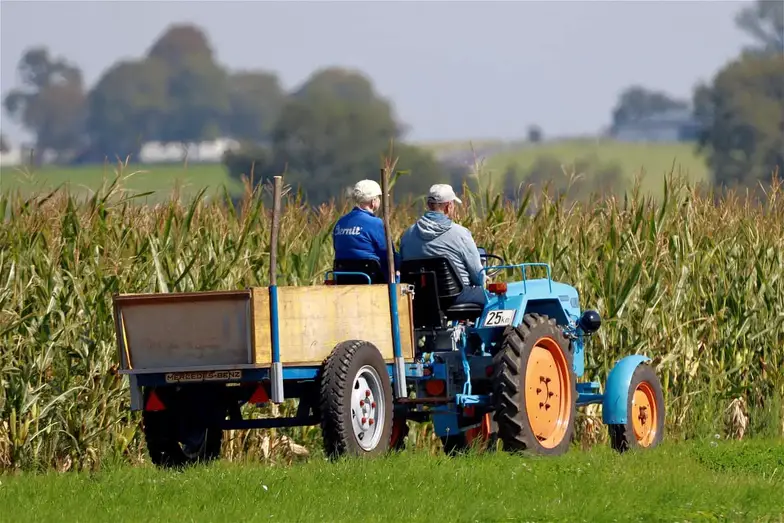
8. Land and Agricultural Commodities
When the dollar collapses, land and agricultural commodities will be some of the best investments you can make. Here’s why:
- Land is a physical asset that can’t be created or destroyed.
- Agricultural commodities are essential for human survival and will always be in demand.
- Both land and agricultural commodities are limited in supply, which means they have the potential to increase in value as demand increases.
- Unlike stocks or bonds, land and agricultural commodities can’t be printed or created by central banks, so their supply is more stable.
- They offer protection against inflationary pressures, as their prices tend to rise when the cost of living goes up.
- They provide a hedge against political instability and economic uncertainty, as investors flock to these assets during challenging times.
9. Off the Grid Living Solutions
A major economical collapse might require more than just investing in precious metals and foreign currencies. There is a good chance you will need to live off the grid, away from your country’s control and infrastructures. Here are some things you can do to be prepared and survive:
- Grow your own food: This is one of the best ways to become self-sufficient and independent from the government or other institutions. You can grow a garden with fruits and vegetables, or even keep chickens for eggs. If you have the space, consider starting a small farm. For more in-depth information, please see my article on off grid farming.
- Store water: It is important to have a clean water supply in case tap water becomes contaminated or unavailable. You can store water in barrels or containers and purify it using a filtration system or boiling. You can also establish your own water system; I have a separate post that explains in detail everything there is to know about off grid water systems.
- Generate your own power: Solar panels and wind turbines are becoming increasingly affordable and can help you generate electricity when traditional sources are unavailable or unreliable. Alternatively, you can invest in a generator powered by gasoline, propane, or natural gas.
- Heating and cooling solutions: Consider investing in a wood-burning stove for heating, as well as insulation for your home to make it more energy efficient. For cooling, evaporative coolers are much more affordable than air conditioners and use far less energy.
- Learn new skills: In an uncertain future, it may be useful to learn new skills that could help you barter or trade for goods and services.
There is much more to learn about living off the grid, which is why I invite you to read my complete guide on off grid living.
10. Barter Items
When the dollar collapses, barter items will become increasingly important. Here are some items that will be especially valuable. You will notice some similarities with the previous list, since both lists deal with items essential to your survival and independence.
- Food: In a post-dollar world, food will be one of the most valuable commodities around. Stock up on non-perishable items like canned goods, grains, and nuts, which can be traded for other goods and services.
- Water: Clean water is essential for survival, so it will be in high demand in a post-dollar economy. Store water in clean containers and have a filtration system ready to go in case you need to purify contaminated water. Invest in a good filtration system – click the link to view products on Amazon and select the best reviewed one.
- Ammunition: In an unstable world, self-protection will be crucial. If you own firearms, stock up on ammunition as it will be difficult to come by after the dollar goes down.
- Tools and supplies for basic needs, such as shelter, warmth, and hygiene: Things like matches, sewing needles, fishing line, lye soap, and bandages may not seem valuable now, but could mean the difference between life and death in a post-dollar society. Make sure you have a good supply of these items stored away.
Final Words
When it comes to investing in the face of an impending dollar collapse, there are a few key things you should keep in mind. First and foremost, diversification is key. Don’t put all your eggs in one basket, so to speak. Invest in a variety of assets that will hold their value even if the dollar does tank. Gold and silver are always reliable choices, but, as stated earlier, you can also look into investments like real estate or art.
Another important thing to remember is that timing is everything. If you wait until after the dollar has already collapsed, it will be too late to invest. You need to get ahead of the curve and start investing now. The sooner you do, the better position you’ll be in when (or if) the bottom falls out from under the dollar.
Finally, don’t panic! It’s easy to let fear take over when thinking about such a potentially catastrophic event as a currency collapse. But try to stay calm and rational; otherwise you could make some very costly mistakes with your investment portfolio.
Stay safe and be prepared!
You can also access the latest news at this address: www.whatfinger.com

-
Subscribe
Subscribed
Already have a WordPress.com account? Log in now.
 Site Title