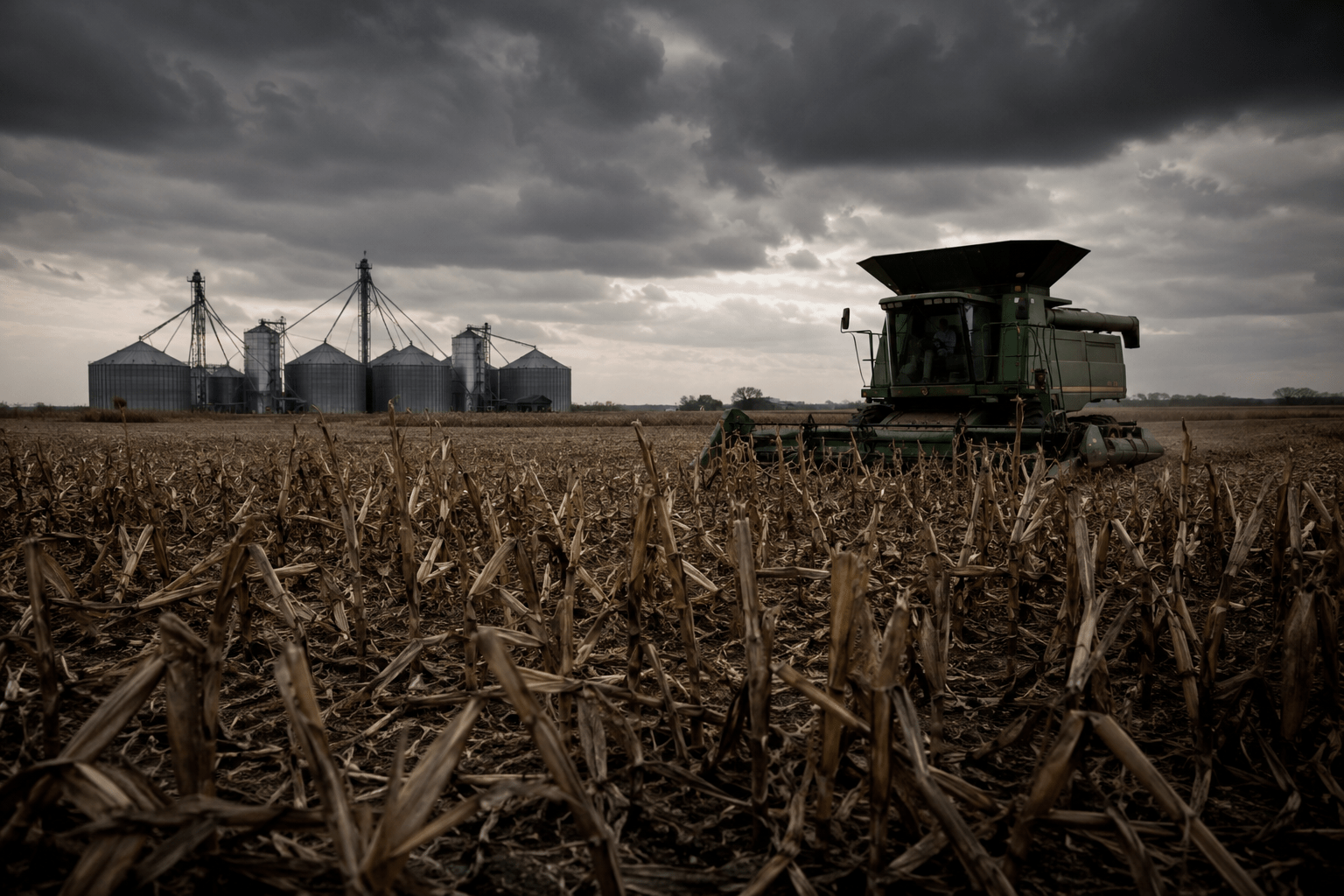
For most of modern history, famine was understood as a visible catastrophe. It arrived with failed harvests, empty granaries, and populations that could no longer sustain themselves. In developed nations, however, the concept gradually drifted into the realm of history. Food became so abundant, so accessible, and so deeply integrated into global trade that scarcity began to feel like a problem humanity had already solved. Entire generations grew up without seriously considering where their food came from, how far it had traveled, or how many systems had to function simultaneously to ensure that supermarket shelves remained stocked every day of the year.
Yet beneath that appearance of permanence lies a reality that agricultural economists, supply-chain specialists, and food-security researchers have understood for decades. The modern food system is not a monument built from certainty. It is a balancing act maintained by thousands of interconnected processes operating across continents. When those processes function normally, the system appears almost indestructible. When they begin experiencing pressure from multiple directions at once, the illusion of simplicity disappears remarkably quickly.
The story examined in this report began with a document that officially does not exist.
According to several independent sources, references to the report first surfaced during a closed agricultural risk conference held in Northern Europe during the late 2020s. The event itself attracted little public attention. Most attendees worked in sectors that rarely appear in mainstream headlines: commodity forecasting, agricultural insurance, water-resource management, shipping logistics, and food-security analysis. The discussions were technical, the presentations were dense, and the conclusions were intended for industry audiences rather than the general public.
What made the conference unusual was not any single presentation but the recurring theme that appeared across multiple sessions. Researchers working in completely different disciplines were arriving at remarkably similar observations. Specialists studying groundwater depletion were identifying vulnerabilities that resembled concerns already being raised by agricultural economists. Analysts examining fertilizer dependency were reaching conclusions that overlapped with long-term projections from food-security institutions. Climate researchers, shipping experts, commodity traders, and infrastructure planners appeared to be describing different aspects of the same emerging problem.
Individually, none of these findings suggested an imminent crisis. The world was still producing record quantities of food. Agricultural technology continued improving yields in many regions. Global trade networks remained extensive and, by historical standards, extraordinarily efficient. Viewed in isolation, most of the data pointed toward challenges that could be managed through adaptation, investment, and technological development.
The concern emerged when those datasets were viewed together.
Several participants reportedly described an uncomfortable pattern that became increasingly difficult to ignore. Over the previous century, global food production had benefited from a series of favorable assumptions. Energy remained relatively affordable for long periods. Freshwater resources, though unevenly distributed, were often treated as effectively unlimited. International trade expanded across much of the world, allowing shortages in one region to be offset by production elsewhere. Political leaders, despite conflicts and disagreements, generally accepted that stable food markets were in everyone’s interest.
By the end of the 2020s, some analysts believed those assumptions were becoming less reliable.
Their concern was not centered on any single threat. Droughts had always occurred. Political conflicts were hardly a new phenomenon. Extreme weather events, market disruptions, and transportation bottlenecks had existed throughout modern economic history. What appeared different was the growing frequency with which multiple pressures emerged simultaneously. The food system had always been capable of absorbing isolated shocks. The possibility that began attracting attention was whether it could continue absorbing several overlapping shocks year after year without fundamentally changing the way it operated.
According to individuals familiar with the alleged report, this question eventually became the foundation of a much larger assessment. What began as an examination of agricultural risk gradually evolved into a broader study of systemic resilience. Researchers were no longer asking whether humanity could produce enough food under ideal conditions. They were examining how much instability the system could tolerate before predictability itself became a scarce resource.
That distinction may sound subtle, but it would become increasingly important in the years that followed. Because the most unsettling conclusion contained within the rumored assessment was not that the world would suddenly run out of food. Rather, it suggested that the first signs of a major food crisis might emerge while harvests remained substantial, trade continued functioning, and supermarket shelves still appeared largely full. The danger, according to the theory, lay in a gradual erosion of stability that would be difficult to recognize in real time precisely because the system would continue appearing normal from the outside.

