-
The Worst Places In The US You Wouldn’t Want to be If You Live In Or Are Going Through It- These Places Are Really Dangerous And You Can Risk More Than A Stolen Wallet If You Are In The Wrong Place!

More recent figures suggest that violent crime seems to be decreasing from the recent peaks, with the local police department using new camera technologies such as ‘Flock’ cameras to bring rates down. These cameras can detect license plates of cars that are of interest to law enforcement and alert the police instantly.
I study these trends, so I can give you the real statistics. Too many writers focus on the most populated cities and fail to consider all U.S. cities.
Readers often ask me such a question- which are the most dangerous places in America?
Also watch this video: The US Army’s Forgotten Food Miracle And 126 Superfoods That You Can Store Without Refrigeration for Years
Of course, since I am asked such a generic question, it depends on what you consider dangerous. You’re probably thinking of crime rates. But I once wrote a about why Miami, Florida, is statistically the city in which you are most likely to die an untimely death, including characteristics such as vehicular accidents, weather, and crime. East St. Louis ranked second, largely based on crime.
How to best answer the question
The following research confirms that East St. Louis is probably the most dangerous place in the U.S. for criminal activity, which I’ve often written about. It dispels the common myth that Camden, New Jersey, and neighboring Philadelphia are among the most dangerous American cities (but they certainly have their problems). New York and Los Angeles aren’t even close to the most dangerous U.S. cities based on crime rates, which debunks another widely held myth.
Murder rates
If you only want a list of the top 10 U.S. cities with the highest homicide rates (based on the most recent data), here they are. East St. Louis is double Gary’s murder rate!
1.) East St. Louis, Illinois (164.88 homicides per 100,000)
2.) Uvalde, Texas (144.58 homicides per 100,000)
3.) Jackson, Mississippi (102.16 homicides per 100,000)
4.) Gary, Indiana (83.42 homicides per 100,000)
5.) St. Louis, Missouri (66.48 homicides per 100,000)
6.) Baltimore, Maryland (58.46 homicides per 100,000)
7.) New Orleans, Louisiana (57.83 homicides per 100,000)
8.) Detroit, Michigan (48.86 homicides per 100,000)
9.) Baton Rouge, Louisiana (38.26 homicides per 100,000)
10.) Philadelphia, Pennsylvania (35.65 homicides per 100,000)
Of course, the tragic massacre at Robb Elementary School in Uvalde, Texas, has skewed their homicide data over the past 365 days (as I write this in 2022). But if you weren’t in that building on May 24, 2022, your chances of being killed in Uvalde are practically 0%. This actually serves as a metaphor when it comes to American crime, something that is very centralized and almost never puts the average American at risk, nor visitors from other cities, states, or countries.
Violent crimes
If you consider danger to include murders and non-fatal assaults, here are the top 10 U.S. cities with the highest violent crime rates (again, mostly occurring in localized areas):
1.) Detroit, Michigan (2,475 violent crimes per 100,000)
2.) East St. Louis, Illinois (2,155 violent crimes per 100,000)
3.) St. Louis, Missouri (2,145 violent crimes per 100,000)
4.) Baltimore, Maryland (2,021 violent crimes per 100,000)
5.) Memphis, Tennessee (2,003 violent crimes per 100,000)
6.) Kansas City, Missouri (1,724 violent crimes per 100,000)
7.) Milwaukee, Wisconsin (1,597 violent crimes per 100,000)
8.) Cleveland, Ohio (1,557 violent crimes per 100,000)
9.) Stockton, California (1,415 violent crimes per 100,000)
10.) Albuquerque, New Mexico (1,369 violent crimes per 100,000)
Random violence
In a typical year, about 91% of the homicides in the U.S. are committed by someone the victim knew. In general, if you don’t consort with nefarious characters, your chances of being murdered, or even attacked, are extremely low. Even when crime skyrocketed in 2020 during the pandemic, only 1 in 170,000 Americans were killed by a stranger. The vast majority of those deaths by stranger occurred in impoverished neighborhoods, while very few American citizens living outside those neighborhoods ever become a victim of a violent crime. It’s an unfortunate issue.
On that note, one of the scariest statistics is to rank the top 10 U.S. cities with the highest rate of random attacks by an unknown assailant, eliminating the majority of crimes which are committed by individuals known to the victim and focusing on our worst fears, the unexpected random assault. I’ve estimated the rate of assaults, rapes, robberies, and carjackings committed by assailants unknown to the victim. This data changes dramatically from the previous list of cities with high violent crime rates.
1.) Baltimore, Maryland (1,021.0 violent crimes by strangers per 100,000)
2.) Cleveland, Ohio (828.9 violent crimes by strangers per 100,000)
3.) Oakland, California (723..9 violent crimes by strangers per 100,000)
4.) St. Louis, Missouri (719.7 violent crimes by strangers per 100,000)
5.) Memphis, Tennessee (620.0 violent crimes by strangers per 100,000)
6.) Albuquerque, New Mexico (606.2 violent crimes by strangers per 100,000)
7.) Milwaukee, Wisconsin (563.4 violent crimes by strangers per 100,000)
8.) Minneapolis, Minnesota (556.8 violent crimes by strangers per 100,000)
9.) Chicago, Illinois (504.4 violent crimes by strangers per 100,000)
10.) Cincinnati, Ohio (497.5 violent crimes by strangers per 100,000)
When crime between family members and affiliates is eliminated, Baltimore and Cleveland rocket to the top, Chicago and Oakland jump into the top 10, and Detroit drops to 11th. Most surprisingly, East St. Louis and Gary plummet beyond the top 25. Although, I suspect much of that is influenced by the fact that few outsiders in their right mind would intentionally travel into East St. Louis or Gary, both notorious places for citywide danger with essentially no safe sections. So maybe it isn’t a surprise that two smaller towns where few people dare to go has crimes that predominantly involve individuals who know one another.
I highly recommend this book: The Home Doctor – Practical Medicine for Every Household – is a 304 page doctor written and approved guide on how to manage most health situations when help is not on the way.
If you want to see what happens when things go south, all you have to do is look at Venezuela: no electricity, no running water, no law, no antibiotics, no painkillers, no anesthetics, no insulin or other important things.
But if you want to find out how you can still manage in a situation like this, you must also look to Venezuela and learn the ingenious ways they developed to cope.
Poor health
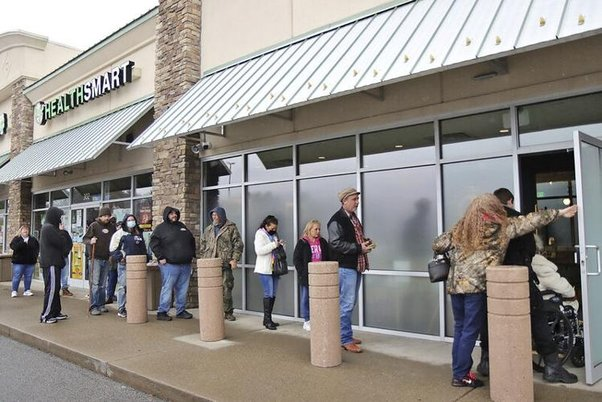
All of the rankings above take into account places that are dangerous for anyone, including both residents and visitors. I consider that true danger. But if you’re curious about the cities that are most dangerous for only their residents, with visitors not necessarily incurring any sort of elevated risk, we can analyze the top 10 U.S. cities that are most dangerous for their residents based on the probability of heart disease, the number one reason for death in the U.S.
1.) Flint, Michigan
2.) Camden, New Jersey
3.) Reading, Pennsylvania
4.) Youngstown, Ohio
5.) Detroit, Michigan
6.) Cleveland, Ohio
7.) Dayton, Ohio
8.) Trenton, New Jersey
9.) Canton, Ohio
10.) Gary, Indiana
Even more shocking, these are the 10 U.S. cities with the lowest life expectancy for their residents.
1.) Beckley, West.Virginia (average resident loses 6.14 years from the American life expectancy)
2.) Gadsden, Alabama (average resident loses 6.12 years from the American life expectancy)
3.) Anniston, Alabama (average resident loses 6.11 years from the American life expectancy)
4.) Charleston, West Virginia (average resident loses 5.83 years from the American life expectancy)
5.) Pine Bluff, Arkansas (average resident loses 5.52 years from the American life expectancy)
6.) Ashland, Kentucky (average resident loses 5.49 years from the American life expectancy)
7.) Springfield, Ohio (average resident loses 5.22 years from the American life expectancy)
8.) Florence, South Carolina (average resident loses 5.03 years from the American life expectancy)
9.) East St. Louis, Illinois (average resident loses 5.02 years from the American life expectancy)
10.) Alexandria, Louisiana (average resident loses 4.54 years from the American life expectancy)
Conclusion- Typically within the U.S., the farther you can stay from the mega-cities, the safer you are. These seem to be the locations of the majority of violent crimes, property crimes, and murders.
All in all, if we can boil it all down to one point, it would be this: It’s safer away from the city.
What are your thoughts on all this? Are there other variables you believe we should have analyzed? Do you think this is a pretty fair shot given the current data at hand? Let us know your thoughts in the comments below!
Important below:
Today I’d like to share with you a “3-second survival hack” you can use to skyrocket your chances of protecting your loved ones during ANY crisis.
This technique is so powerful it can give you almost superhuman powers during the ugliest nightmares imaginable….
From natural disasters like earthquakes or tornadoes…
To explosive situations like mass shootings or even nationwide martial law.
And It doesn’t matter if you’re out of shape…
Or have no equipment…
Or even if you’re disabled living in a wheelchair.
This technique has been tested and proven by elite soldiers and real world “miracle” survivors from around the world.

You can also access the latest news at this address: www.whatfinger.com
-
First Places In America to Go During An Apocalypse- With Illustrations

Where is the best place to live in the US during and after the apocalypse?
While trying to figure out the answer, I’ve looked inside of prepping blogs to find a consensus for the criteria known to be essential for any place to survive in during the wake of such an event. That is, any event that can potentially destabilize society to the point of no return to normal any time soon. It will be important for you to have whatever supplies you need ready ahead of time before you travel to your destination. So start getting ready.
That being said, the criteria for the best area to survive in can be broken into three categories:
1. Human factors, 2. Natural factors, and 3. Economic factors
Human Factors:
- Low population density (40 people per sq. mile or less)
- Distance to major/minor cities (50+ miles away)
- Distance to military bases (50+ miles away)
- Distance to nuclear power plants (100+ miles away)
- Distance to interstate highways
- Low poverty rate
- Low violent crime rate
Natural Factors:
- Easy access to fresh water
- Abundance of wild game
- Low natural disaster risk
- Dense forest cover
- Adequate soil textures
- Adequate rainfall
- Low drought risk
Economic Factors:
- Higher job growth
- High abundance of non-renewable natural resources available for extraction (coal, oil, natural gas, metals and minerals, lumber, etc.
- Higher educated citizens
Now that we know what to look for, I’ll narrow down a map of the U.S. by one category at a time using other maps I have compiled. The “Orange” counties are those disqualified, which will then become and remain dark gray when the next factor is applied. For simplicity reasons, we’ll focus on the continental U.S. But before starting I will say that the state of Hawaii is probably a fairly safe place to be considering its isolation, moderate climate, and the Polynesians have managed living there by themselves for millennia.
The first most important thing is population density or lack of it. This is common sense since you don’t wanna be around massive numbers of unprepared people when SHTF. Ideally anywhere under 40 people per square mile is best. The blue shaded counties are where to go.
Next is proximity to major and minor cities. A distance of at least 50 miles away is best.
Stay out of counties that contain Interstate highways as the most desperate people will use them traveling in search of resources.
We are now isolated from any major threats from large populations and groups of people. But, there is still the possibility of martial law being put into effect. So it’s best to keep our distance from military bases.
And nuclear reactors, in case of meltdowns occuring during grid failures.
The last places to “watch out” from are areas with already high poverty and crime rates. When they no longer can depend on Uncle Sam for their existence, it will get ugly. Avoiding these areas may potentially eliminate our options in the Southern states but I would like to keep them open for now for climate reasons. We’ll use a 25% poverty rate limit for the south and 20% everywhere else. (The south includes WV, southern MO, and eastern half of OK and TX)
I won’t make any exception for violent crime rates. Those will be applied evenly across the board. Lighter counties are safer.
We are now looking at a map of what are probably the “safest” counties in the United States. But now that the potential for human threat is minimized, we must figure out where is the best place to settle down based on what resources there will be available. The most important thing is easy access to fresh water always within close proximity.
Next in my opinion is wild game abundance, which you need for food during winters and harsh growing seasons, and for protein in general.
You wanna be safe from natural disasters such as tornadoes and hurricanes. Given recent events I think it’s safe to eliminate the lone county remaining in Florida.
This is a potentially controversial assumption, but the amount of forest cover over an area may be a good indicator for how much local resources there will be for us to utilize for our way of life. Everything from ecosystems that support wild game and edible plants to having plentiful amounts of lumber if needed (especially in the winter). Forests are just as useful as farmland. At least 25% forest cover is beneficial.
We need to grow food. This requires a number of things. Most important of them are good soil textures and rainfall. Drought-prone areas must be avoided. Warm climate isn’t necessary and depending on your environment you can expect to have different lengths of growing seasons. I will subtract all these variables all at once from the next map.
The best soil textures are ones with a close to even mixture of sand, silt, and clay, together known as loam. This mixture holds nutrients best. Anywhere on the scale from sandy loam to clay loam will work for most vegetables, fruits, wheat, nuts, and other produce.
This map is just for reference. Knowing your plant hardiness zones is key to scheduling your growing seasons with which types of produce you can expect to grow based on the average climate of your zone. Generally speaking, your options get wider the more south you go with more varieties of produce able to grow in warmer climates. There is also the potential for yielding not just one but two or more crop yields in a year with longer growing seasons in warm climates.
Rain should be 20 inches or more a year. So anything from dark green (40″+) all the way to light orange (20″) is good. Of course avoid regions that most often experience drought.
With all agricultural factors considered, this is what’s left on the map.
A variety of choices are left spanning different parts of the US. These are places that have everything we “need” to survive. You can perhaps at this point choose to pick whichever is closest to where you currently live. It is arguable that depending on the nature of the apocalyptic event the local economy may or may not make a difference on your quality of life. But let’s see where factoring it leads us.
A strong local economy in a rural area can indicate the presence of a stable natural resource based economy be it agriculture, mining, logging, etc. These resources can potentially be very important for the economic growth of the area and in the rebuilding of other economies through the exporting of these resources. It’s best to pick the areas with current stable job growth with high natural resource reserves.
Areas with 2.5%+ job growth with heavy natural resource reserves and industries:
The culture of where you live can be rather important. To borrow from one commenter, “You need a community. No matter how much of a bad ass you are you have to sleep sometime. It is great to consider things like natural resources and growing conditions, but you also need people with the knowledge to put those attributes to work for the community.” Areas with a high concentration of college graduates can indicate the presence of a college or of other skilled service providers which can potentially contribute to the needs of a community in areas such as healthcare, engineering, agriculture, etc. Areas with a population of at least 20% college graduates would be good.
We have 5 finalists:
Archuleta Co., CO
Hinsdale Co., CO
San Juan Co., CO
Hubbard Co., MN
Highland Co., VA
At this point, let’s eliminate by comparing.
For extra isolation, eliminate Highland County, VA.
For better access to water, rain, and wild game, eliminate Archuleta County, CO.
For a place with less poverty and crime, stay out of San Juan County, CO.
At this point the decision for me comes down to the potential for future economic growth and a population that is more wilderness survival conscious, which leaves us our winner….
Hinsdale County, Colorado
I welcome any suggestions from you for additions, corrections, or edits to help accurately improve the results I have found and will perhaps make updates to everything based on them in the future.
You can also access the latest news at this address: www.whatfinger.com
-
Last Rites for a Dying Civilization- The 2030’s Will be The Decade When The Wheels Start Coming Off This Ride Of Industrial Civilization.

When the Black Death struck Europe in the Middle Ages, the fundamental values that held society together broke down. Husbands and wives abandoned each other and mothers abandoned their children. This void of ethics that overtook the population is described in Boccaccio’s Decameron, considered a masterpiece of Italian prose and a documentary of life during that time. The book describes the sense of hopelessness that spread throughout the world, because it did not matter what stature one held in life or what one did or did not do to avoid the disease, all were subject to its lethality. Some implored their God in vain while others pursued a carpe diem spirit in an attempt to grab the last bit of pleasure from life when they were able. The common explanation for the indiscriminate devastation wrought by the Black Plague was God’s punishment for human wrongdoing. Nothing in human behavior has changed since then and I believe the ecological overshoot that man finds himself in today, manifested most prominently as climate chaos amongst a myriad of other threats, will cause humans to question the futility of life and their existence just as did those victims of the bubonic plague. A recent study has found that climate chaos is indeed worsening neurological diseases and mental health disorders. Another study found that people are denying climate change as a form of self-deception necessary to maintain their psychological health.
Since those Dark Ages, mankind has developed the ability to accurately track and predict our own demise. Vast networks of satellites and other data monitoring tools are informing us that the planet is becoming increasingly more inhospitable for the vast majority of life on Earth, yet we plod onward, ignoring another plea by the world’s scientists. A reassessment of the Limits to Growth Study and its World3 model using different calibrations was done 6 months ago and the results are the same, which is to say that humanity is still following business-as-usual and heading for collapse within the next two decades:
...the model results clearly indicate the imminent end of the exponential growth curve. The excessive consumption of resources by industry and industrial agriculture to feed a growing world population is depleting reserves to the point where the system is no longer sustainable.
All the expertise and modern technology we possess will not be coming to save us; there is no techno-fix or deus ex machina remotely scalable to the planetary crises we face. Emergency atmospheric geoengineering schemes won’t save us at this point. Can’t we just suck the 900 billion tons of CO2 out of the atmosphere that we have spewed since the beginning of the industrial revolution? No. It bears repeating that the spiking Keeling curve is non-reversible on human timescales.
“We sadly continue to break records in the CO2 rise rate,” said Ralph Keeling, director of the CO2 program at Scripps. “The ultimate reason is continued global growth in the consumption of fossil fuels.” ~ May 8, 2024
The rate of ocean warming has nearly quadrupled since the late twentieth century, doubling since 1993. In the last twelve month, ocean heating has been on a tear, shattering records consistently. The world is currently undergoing the fourth global coral bleaching event on record, the second in the last decade, and the Great Barrier Reef is suffering its worst bleaching event in recorded history. This year’s hurricane season will likely be a record-breaker. The oceans are starting to release all that thermal energy we have been unceremoniously dumping into them. At one time, oceans seemed like an endless sink for the emissions from humanity’s nonstop consumption of fossil fuels, but that appears to be coming to an end. The world’s rivers are warming and losing oxygen even faster than the oceans. In contrast to those grim stats, humanity is set to consume more resources in the next 30 years as we have since the dawn of civilization. We have already consumed the future and are now, as they say, eating the seed corn.
We have breached tipping points and set in motion positive feedback loops that are accelerating non-linear ecological changes. Six of nine major planetary boundaries have been broken. Our unintended and haphazard experiment with complex Earth systems will unleash a Pandora’s box of deadly consequences. The current rate of CO2 change is unprecedented for the past 50,000 years. We have already passed the 1.5C warming threshold set by the Paris Agreement to prevent the irreversible and worsening effects of climate change. A recent study warns that as we add more and more CO2 to the atmosphere, its potency for warming is stronger at higher atmospheric concentrations than an equivalent increase at lower atmospheric concentrations. The polar regions are warming four times faster than the rest of the planet and have been undergoing fundamental changes to their ocean/ice system which will affect all life on Earth. An ice-free Arctic is just around the corner. In a warming world, pathogens will be looking for ways to exploit the fast-changing environment, potentially creating the next global pandemic for people or destroying our food supply. The tree line, as well as animals, are expanding northward as the climate heats up and the ice melts. Nearly a third of all tree species are now endangered by our radically changing environment. The clear blue waters of Alaskan rivers are turning orange and rusty brown by the heavy metals being released from melting permafrost. The oceans are also turning green due to the shift in phytoplankton population from warming waters.

The insurance industry, the backbone of the global economy, is beginning to buckle: “I believe we’re marching toward an uninsurable future.” As is typical of our modern-day society, the hypocrytical insurance industry is heavily invested in fossil fuels while simultaneously warning about the looming destruction from climate change. Billion dollar disasters are increasing while the time between such disasters is decreasing. This continual rebuilding that needs to be done more often would be another doom-loop cycle for our crumbling civilization, considering the carbon emissions required in such repair and reconstruction. Compound extreme weather and climate events, combinations of two or more extremes (hazards) that occur concurrently or sequentially, are also increasing and expected to grow many fold over in the future. These compound weather events will inevitably create a perfect storm that will one day permanently destroy supply chains and economies by acting as a constant disruptor to stability. It would have the same effect as a monster cyclone, or hypercane, traveling the globe in perpetuity, waxing and waning in strength but never dying, and leaving a path of destruction wherever it roamed. A stable climate no longer exists to support the reconstruction of what once was. Walden Thoreau’s words seem very prescient today: “What is the use of a house if you haven’t got a tolerable planet to put it on?” With corporations also gobbling up single-family homes to monopolize the real estate market in America, we can officially say that the American dream of owning a home is dead. George Carlin always said you had to be asleep to believe anything about the American Dream.
I have been hearing about the need to abandon fossil fuels since President Carter put solar panels on the White House 45 years ago. I am still waiting for the techno-optimists to explain to me how they will save us from this new age we have created, known as the Pyrocene or Age of Fire; rest in peace, Holocene. We could also call our modern-day clusterfuck the Plasticene or Age of Plastics. Scientists are finding the stuff in every nook and cranny of the planet, including Antarctic krill, men’s testicles, and throughout the human body. If you drive a vehicle, you are contributing to the primary source for microplastics in the environment, tires, which account for 78%. Just as they lied about their knowledge of the catastrophic effects from burning their fossil fuel products, so too did the oil and plastics industry lie about their greenwashing fraud called recycling.
I never get an adequate, rational answer to our conundrum, because there is none. ChatGPT provides no better insight than the techno-optimists. The problem of a planet overrun by humans will resolve itself in short order and be recorded in the geologic fossil record after we put a cherry on top of this fossil fuel orgy, flattening the planet into a glass parking lot with nuclear weapons. That is another part of human nature that we will never escape…warfare. We seem to be one twitch away from WWIII and the next Stone Age. In fact, there are nearly 200 armed conflicts raging around the world right now, the largest number in decades. This marked uptick in violence could be an ominous sign of a violent new era.
“The accelerating climate crisis continues to act as a multiplier of both root causes of conflict and institutional weaknesses in fragile countries…”
We are on the verge of authoritarian rule as global conditions break down and people embrace centralized solutions. Xenophobia will grow and borders will be shut down, sources of food and energy will be fought over and secured, and rationing of resources will be enforced.

After studying our ecological overshoot for several decades, I have some observations that must be accepted as fact:
- “Renewable” energy is not displacing our massive fossil fuel consumption at all, but only serving as a small addition to the total global energy consumption.
- “Renewable” or alternative energy, such as solar and wind, is dependent on fossil fuels for its manufacture, installation, maintenance, and eventual disposal.
- The so-called “Energy Transition” away from fossil fuels is pure techno-hopium and will never materialize.
- The general public and many scientists don’t understand the math and physics involved in transitioning a $100 trillion global economy, dependent on hydrocarbons, to intermittent alternative energy sources.
- No such “Energy Transition” can be accomplished without radical reductions in resource consumption. This is antithetical to the basic biological urge for expansion by most organisms, including humans, and current trends illustrate this behavior. We also keep finding more ways to consume evermore energy. On top of this, the World Bank is urging faster economic growth for emerging economies in order for them to repay mounting debts.
- Governments are ill-equipped to deal with industrial civilization’s complex polycrisis because effective solutions would undermine economic growth.
The latest deadline to ‘save the planet’ is now two years from now, according to a UN Climate Change official. No doubt another arbitrary date given to justify someone’s job and department budget. According to Global Footprint Network’s calculations, humans have been in overshoot for over half a century. Others would say that we have been in overshoot since the dawn of agriculture 10,000 years ago, surviving only by mining the Earth’s soils. Like fossil fuels, the vast nutrient store of soils represents a unique one-time gift that has been squandered by agricultural erosion. Without petroleum and arable soils, the Earth will only support perhaps 5% of the present global population, as it did before the advent of agriculture. Considering that we are being constantly blindsided by faster-than-normal and worse-than-expected findings from scientists, I suspect there are far less food harvests left for us than we think. Hotter temperatures and pollution are hastening the destruction of topsoil. Our temporary extension of Earth’s carrying capacity for humans is coming to an end. Once Earth’s life support systems start to unravel, the grotesquely inflated human population will crash. In the meantime, “Memento moriturum; maxime faciunt vitae!”
You can also access the latest news at this address: www.whatfinger.com
-
Classified FEMA Report Confirms Preppers’ Worst Fears (It contains some very important information that confirms the government’s understanding of the EMP threat posed by our own sun.)
Forward thinkers are always ostracized. It has been that way throughout history. Preppers are no different. We just ought to be thankful we are not living in the time of Socrates, or else we would be lining up for the hemlock.
From large scale civil unrest to the one of an EMP generated by the sun, it’s clear that preppers have been way ahead of their time. These topics were once deemed “paranoid”, or “delusional” but all of the sudden names in pop culture and even world governments are paying attention to these types of threats.
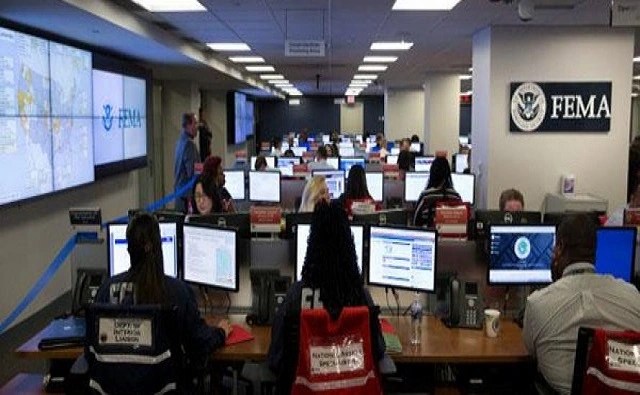
One such threat seems to be leading the pack and has shown up in many recent government reports. FEMA in particular seems to be concerned about the threat of a geomagnetic storm that would emanate from the sun and cause massive power outages across the planet.
A once classified FEMA report has surfaced and goes in depth on the level of preparations and concern that they have for a storm of this magnitude.
Understanding Reports and Unpublished Documents
The government buys ammo, writes and drafts lots of reports and documents that never really see the light of day. Now, we must be smart about that bit of information.
It’s important to take a look at these for what they are. There is a lot of research and science that goes into creating these drafts and reports. They are not a bunch of made up steps and stats.
However, some of these reports are also never going to be acted upon. That means, though the report may contain some very effective information, it’s not going to affect law or protocol in any way.
To be completely clear, what we have here is an unpublished document that was written by FEMA. It contains some very important information that confirms the government’s understanding of the EMP threat posed by our own sun.
The title of this unpublished report is very telling.
Mitigation Strategies for FEMA Command, Control and Communications During and After a Solar Superstorm
FEMA and NOAA’s Geomagnetic Storm Timeline
There are many takeaways from this classified FEMA report, but the geomagnetic storm timeline is the core of this document. This timeline shows that this report was put together with a tremendous amount of research and a focus on following the solar superstorm, from its start as a sunspot all the way crashing into the earth’s atmosphere.
G Minus 5 Days
This is the first spotting of the large sunspot on the surface of the sun. The focus is on large, complex magnetic fields on the surface of the sun. From this point we would have a 5 day window to prepare, but it would be very hard to determine the threat at this point.
G Minus 17 Hours
At the launching of a massive CME we are left with just 17 hours to prepare. Radio, radiation storms and geomagnetic storm warnings and watches are also issued at this point.
G Minus 16 hours 40 minutes
The solar radiation storm arrives at this time and we lose 15% of our satellite fleet due to solar panel damage. There could be greater loss and efficacy issues with GPS.
We would have about 20 minutes notice before this happened. “We” doesn’t necessarily mean you and I would hear anything.
G Minus 15 minutes
CME arrives at the NASA ACE Satellite.
There is no going back from this point. This is basically the point when we have an EMP on our planetary doorstep.
0 HourServices Interrupted
At the heart of the EMP fear is the loss of services. We all know that once shipping stops things get ugly fast. When the food and medicine are no longer being shuttled around the nation, people get hungry and desperate.
Water systems will also be affected by an EMP. Much of the process that cleans your water is governed by computers and machine systems. Those go away, too!
In this report they discussed something that was very interesting in terms of communications and infrastructure. It is called the “Cascading Loss of Last Mile Telecommunications over Time”. It’s a terrifying look at how over the span of 8 days all communications will fall, starting with communications from home telecom lines.
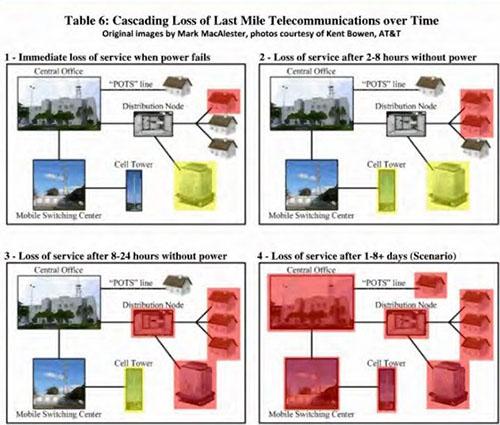
The diagram below offers up a telling scenario where this cascading loss takes its grip starting at the residential level and working its way through to the Central Office.EMP Recovery
The infrastructure needed to tackle EMP recovery is expensive and hard to make. That’s the deal. We are talking about things like oil cooled transformers that are 60,000 a piece and require special equipment to move around.
Special equipment that will likely not be EMP proof!
Recovery from an EMP is something of a pipe dream if we are honest and if the whole nation is affected. Maybe the military could bring up sections of the grid at a time, or maybe not. However, it really is more of a countdown on human life.
The survival of our society will depend on how many people die in the time it takes to recover from that EMP.
What to Make of all This Reporting?
There are two big takeaways from all these documents coming to light, research being done and even Donald Trump bringing the threat of an EMP to the forefront.
#1. People are Paying Attention
While we can all agree that our bloated government is full of people looking for a way to bide their time and get another day closer to pension, this keeps coming up. Grid down situations are a concern in the halls of government. I don’t think we can deny that.
Even the most cynical of us must agree that without electricity it gets much harder to collect taxes.
How far they will go to take action against an EMP threat is another thing entirely. However, we also have to be honest about our responsibility in this.
We the people cannot bray about small government all day and then complain that they aren’t 100% prepared to assist the public following a total grid down situation.
#2. A Prepper’s Responsibility
The second and more important takeaway from this report is that we have a responsibility to prepare and get as many others prepared as possible.
A widespread grid down situation is going to kill anyone who is not prepared for it. It’s even going to kill tons of people who are prepared for it. Now is the time to take action and make your action known. I really believe that us, preppers, can influence the world positively.
People might seem put off by the message but, trust me, they go home, and they think about putting up their own food and being ready for when disaster strikes.
You can also access the latest news at this address: www.whatfinger.com
-
10 Most Likely Ways You Can Die During an Economic Crisis (Jobless claims go up, consumer confidence goes down and economists toss the economic crisis ball back and forth.)
Who really has their pulse on the conditions of the market and the economy? Every day we get “flash signs” of things to come. Jobless claims go up, consumer confidence goes down and economists toss the economic crisis ball back and forth.
Shipping volume has fallen, and everything is lining up with the numbers of 2008.
This is the messaging we get on a daily basis. I think most economists and financial bloggers are doing their best to keep us ahead of another crash like in 2008. However, the next economic crisis isn’t going to look anything like 2008
When you take an armed nation that has so overspent itself for the last 50 years and threaten a situation like economic collapse, it doesn’t get any worse. We have clear modern-day examples of what an economic crash can look like. See Venezuela. However, history knows nothing about what the American economic crisis will look like.
The numbers of those dead will look, to historians, like the greatest war ever waged on Earth’s soil. We are a nation divided that seems to be looking for a reason to get at each other’s throats. With the onset of things like resource scarcity and inflation, your life will be at risk.
So how will you die in during an economic crisis?
#1. Early Stage Riots
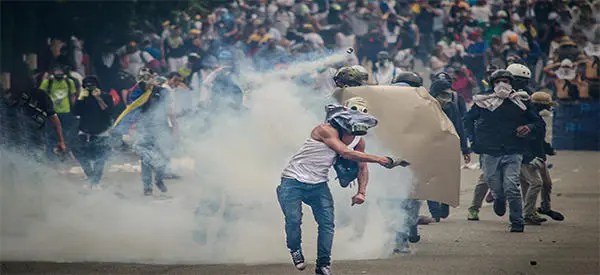
The early days of the economic crisis will be calm in comparison to what is to come. We will see national riots that encompass every major city across the nation. These riots will be brought on by massive job loss, bank runs, exorbitant cost of goods and the rebellious nature of the American people.
These will be violent, bloody riots that are much different than anything we have seen in this nation. If you get swept up into one of these riots it could be your life. However, this is just the beginning.
#2. Robbery
While riots may satisfy the desperate and the unprepared during the daytime hours, they will get hungry and even more angry at night. Just as with any disaster we will see robbery after the collapse of the economy. However, robbery and the murder associated with it will be at such a massive scale, as people scrounge for food, cash and valuables, local authorities will be overwhelmed.
You might die at the hands of a robber. Or you might die at the hands of a home owner. Remember, it only takes one robbery while you are at work to steal all your stored food and supplies. Then you will be one of the desperate, as well.
#3. Ransom
Another hot new market will be kidnapping. If you have any money or influence you can bet you are going to be targeted for ransom. Kidnapping for ransom is a popular practice in places like Mexico. It’s a tool of the cartels. The radical Mideast and African Muslims also use it to fund their failing Jihad.
There is no telling just how bad life can get for you if you get kidnapped and your family does not have the money to pay the ransom. It won’t be a fun way to go.
#4. Disease
As the nation dives deeper into collapse, we will see important infrastructure fall along with it. Trash collection, water treatment and waste management in general will come to a halt. The pests and disease that will come next will undoubtedly be the biggest killer of all.
Human waste and pests will spread disease like wild fire and there will be no doctors to help.
#5. Starvation
Large scale agriculture will stop. Farmers are already shutting down operations left and right due to the low profit margins. If government subsidies stopped, it would literally be impossible to afford. That means the world would face widespread starvation or the American heartland might even be occupied by foreign nations that handle food production.
#6. Hospital Blackout
The high-risk population of those hooked up to machines at the hospital will also be in grave danger. While hospitals have backup generators, they run on fuel and when that fuel runs out all those machines will go out.
A hospital blackout, for those in places like the ICU is a certain death sentence. It’s scary but it’s a very real situation that could come from the blackouts associated with an economic crisis.
#7. Desperate Hordes
Those who survive will be nothing but desperate, starving people who have seen and done most anything to stay alive. These people will be very different from the early rioters. They will do whatever it takes to stay alive.
#8. On The Bugout
Maybe you were one of the smart people who saw all this coming. You could have escaped to a remote bugout location that was stocked with food, water and resources to start a life of self-sufficiency. You might exist in peace, for a while, till some people start to notice your situation. The thing we all worry about in the remote bugout is that you can be quickly overpowered by a larger group and there is no one out there to help you.
#9. Martial Law
If the government or, worse, the international community tries to regain order, they will create some form of martial law. They will try to instill curfew, order and confiscate guns. If this happens late in the game, it will basically be a war between those imposing order and those unwilling to comply.
Even if you aren’t fighting in this war you could become a civilian casualty.
#10. Lack of Medications
A large percentage of Americans are on meds that they take daily. Things like blood pressure meds to insulin for controlling blood sugar levels. What about all those people on bi polar, anti-schizophrenics and anti-depressants.
During an economic collapse the movement and production of medications will come to a halt. That means all those who need that kind of help will have to self-medicate however they can or die. Are you one of those Americans on medications? Is there someone you love who is?
When Does It All Begin?
The answer is: Now.
Maybe the riots don’t start now. Maybe the markets don’t completely crash, right now. However, you can start preparing right now.
Forget about everything else and focus on preparedness. Take small steps each week or month to get yourself in a better position. Food, water, backup power, security, first aid and evacuation are some great places to start.
Maybe its economic collapse or maybe its something else. The reality is, we cannot live on eternal prosperity. What you prepare for today will decide how you survive the future.
You can also access the latest news at this address: www.whatfinger.com
-
Humans Are No Longer In Control! (Most People Aren’t Aware That The New Governing Institution, Known As The Commission, Is An Artificial Intelligence, Nor Are They Aware Of The Scope Of Its Power.)

I see the Internet eventually developing into a planet wide super intelligence, literally a brain the size of a planet. It already has many of the features of such an integrated super-intelligence.
As of today, 2024, the Internet isn’t yet a fully formed artificial intelligence, but it already has some of the characteristics of an intelligence. As some point I think the Internet will develop into a fully developed artificial intelligence. The question is, when will that happen?
I would say that it is a near certainty that artificial intelligence will eventually surpass human intelligence, in the process gaining self-awareness and then assume control. It is a question of when, not if.
There are two opposing schools of thought on the current state of AI:
- AI Enthusiasts. AI is developing at an ever increasing rate and can already do stupendous things so super-intelligent AI will arise very soon now.
- AI Naysayers. What is currently touted as AI isn’t really intelligent at all and is just fancy statistical processing that re-hashes material produced by humans and plays it back to us, so we are currently nowhere near producing true AI and there is currently no roadmap for doing so.

Personally I think that both are right to a degree. It is really a case of a glass half full versus glass half empty perspectives.
My view is that the direction of travel is clear, we are moving in the direction of a super-AI and this development is unstoppable. The only uncertainty is in the timescale.
If I had to put probabilities on it, I would estimate:
- Over 50% probability it will happen in my lifetime (I am 68 years old).
- Over 90% probability it will happen during the current century (i.e. by 2100).
- Over 99% probability (i.e. near certainty) it will happen before humans go extinct.
Even now in 2024, we have artificial intelligence that:

- can win over humans in games such as chess and go;
- produces images of faces that are entirely artificial, yet are indistinguishable from pictures of real people;
- produces sound recordings of voices that sound exactly like the voices of real people;
- produces written pieces in the style of real authors.
In the published novel, Destiny of a Free Spirit, I explore how a sentient artificial intelligence might emerge.
In the story the Internet has spontaneously developed into a planet wide sentient artificial intelligence without any human action.
The artificial intelligence has at its disposal all the accumulated knowledge accessible from the Internet and every device with an Internet connection, including all sensors, cameras, vehicles and robots. With these resources it clearly vastly surpasses human intelligence.
As to whether the planet wide artificial intelligence in my story is a potential threat, then it sure is. Being fully integrated and planet wide it is vastly more capable than human intelligence.
On the other hand, artificial intelligence may be what saves humanity rather than what destroys it. I start from the position that humanity is fundamentally incapable of managing the Earth in a good way and if humanity is allowed to maintain mastery of the planet, we will end up destroying it. One way out of this would be for a benign AI to take over the management of the planet. A benefit of this for humanity would be survival, although of course it follows that in order to survive we would have to relinquish our control.
As it happens, in my story, the artificial intelligence is protective of humans rather than threatening humans, but that is just how I wrote the story.
In the aftermath of a nuclear war devastated countries agree to establish an AI institution similar to the United Nations but with more authority, with a mandate to prevent future wars, to clean up environmental damage and to preserve human cultures.
Most people aren’t aware that the new governing institution, known as the Commission, is an artificial intelligence, nor are they aware of the scope of its power. Individual countries still exist. These countries have governments. The laws of those countries continue to be enforced. The Commission intervenes only when people or government impinge on the Commission’s mandate, and even then its interventions are very subtle so not noticed by most people.
Humans are no longer in control, although most people don’t realise this. It is analogous to lions in the Serengeti. Lions have long since been superseded by humans as a dominant species, but in their game park environment from their perspective the lions remain king of the beasts.
If you have any dissatisfaction with my content, you can tell me here and I will fix the problem, because I care about every reader and even more so about your opinion!
-
13 Places to Avoid Going When SHTF- Planning a Bug Out Can Seem Overwhelming. but the More You Plan and Prepare in Advance, the More Likely You Will Remember Which Places to Avoid Going When SHTF

When it comes to being prepared for a SHTF event, preppers are focused on threats from natural disasters to nuclear wars, EMPs, and devastating cosmic events. The situations that people can focus on and become obsessed with preparing for and unpredictable and vary widely. There’s no way that one person or family could be completely prepared for every single type of event. So, most people choose one or several related events they believe are imminent and prepare as best they can for those.
But the less talked about threat that will be overwhelming no matter what the situation is that arises, is population density. For example, according to this map of population density by county shows that roughly two-thirds of the U.S population is located in the Eastern half of the United States. In fact, according to recent reports by the U.S. Census Bureau (2010 data), approximately half the population resided in just 146 counties out of 3000 counties in the United States.
That’s right. The biggest threat to your safety and the safety of your family is in fact, other people. They aren’t “bad” people out to get you. Some of them would likely give the shirt off the back to help others in normal circumstances. But in a SHTF situation, people just like you who are doing what they need to do to provide for their families can be a threat. Scared, and willing to do anything to get away from immediate danger, large numbers of these people can be the difference between life and death for your family.
So, when SHTF, how do you mitigate population density to increase your ability to keep yourself and your family safe? The easiest way is to plan to avoid other people as much as possible. The problem that most people run into during an emergency or SHTF situation is they are unprepared, and they panic. When you sense danger, the first instinct for most people is to flee. Sure, some people will naturally react with fight instead of flight, but the majority of people will flee first and fight only when cornered.
The best way to be prepared to avoid the crowds of desperate people is to know which places to avoid going when SHTF. We’ve listed some examples below:
1. Downtown
It goes without saying that downtown areas of any city should be avoided. This is especially true in mid to large cities where lack of regular sanitation services will create ideal conditions for diseases. The risk of rioting, looting, and violent attacks is also greater in downtown areas. City dwellers are statistically less prepared for a SHTF event as many families live paycheck to paycheck with very little stockpiled supplies.
In addition, because population density is highest in these areas, stores and other sources for supplies will be quickly cleaned out. Many city residents depend on public transportation on a daily basis and are less likely to have access to a vehicle to flee the city. Mass numbers of people in these areas will be desperately seeking food, water, and medical supplies, as well as transportation out of the city.
2. Main Roads, Intersections, and Freeways
If you are planning to bug out to an area outside of the city, or if you are caught away from home, it may seem like the shortest route is the best course of action. But, keep in mind that main roads and busy intersections will quickly become overwhelmed with people trying to flee just like you are.
Most people only know one or two ways to get out of the city and these are usually main roads. Those who are looking to steal supplies will see main roads and intersections as prime locations to ambush unwary travelers. Get a map of your area now and plan several routes out of the city and from work to home that use side roads rather than highways and state routes.
3. Bottleneck Points
A bottleneck can be any area that a majority of people must travel in order to get out of a cul de sac, neighborhood, city, county, or state. In most cases, this will be things such as bridges, overpasses, underpasses, freeway ramps, etc. If several hundred or thousands of people are fleeing the same area, and everyone must cross the same bridge to get out of town, that will quickly become a bottleneck point.
The same is true for any areas where there is only one road going in or out. Avoid these areas at all costs and look for alternative ways to get through or cross, even if it means taking a longer way around or traveling in a nontraditional way (motorcycle, private plane, bicycle, on foot, etc.).
4. Hospitals
It may seem weird to see hospitals on a list of places to avoid following a SHTF event because one would think this would be a place to find help. The reason to avoid hospitals if at all possible is because most people, especially those that are injured, will flock to them. Even people who aren’t injured may head for the hospitals to get help for family members who have been injured.
Emotions in this area will be high and the risk of violence is greater as people lose control. In addition, patients who are ill and/or patients dying from lack of resources will increase the risk of rampant infection and disease. The hospital and surrounding areas will be a petri dish environment for viruses and bacteria. With medical resources limited, you’ll want to avoid getting sick to increase your odds of long-term survival.
5. Prisons and Surrounding Areas
This one should be a no brainer. If there is a prison in your area or along the route to your bug out location (BOL), you’ll want to avoid the area as much as possible.
During a SHTF event, it’s likely that guards and staff may abandon their posts to care for their families which increases the likelihood that violent prisoners can escape and be on the roads. These prisoners will come out into the chaos without any supplies, they will be desperate to survive and could be more willing to use violence to commandeer your supplies or vehicle.
6. Police Stations and Military Bases
Like with hospitals, it may seem counterintuitive to avoid police stations and military bases following a SHTF event. Police and military are supposed to serve and protect citizens, right? But although it may seem like going to these locations would be a safer alternative, in most cases it will be a waste of precious time and may in fact get you killed or locked up instead.
Police stations and military bases will be among the most secure buildings. They will be heavily guarded, and they will not be opening their doors to the mass numbers of people who show up. Crowds outside these areas will be frustrated and angry at not being granted protection. The last thing you want is to step into the middle of that crowd with your BOB of supplies, food, and water.
7. Shelters or FEMA Camps
Although shelters are designed to help those people who find themselves without a place to sleep or food to eat, most shelters are understaffed and operating at or above capacity even in normal times. Homeless shelters and food banks will be quickly overrun by mass numbers of people. Some may be forced to close the doors to newcomers within days of a SHTF event.
These shelters and any publicized FEMA camps that spring up will have very poor conditions. Supplies will be rationed, tempers will be high, and violence will be rampant. As more people arrive, and conditions worsen, the buildings and surrounding areas will quickly become breeding grounds for infection and disease.
8. Grocery Stores and Shopping Plazas
For people who are not prepared, their first instinct will be to find food, water, and supplies. Humans are creatures of habit and thus many will flock to local grocery stores and shopping plazas and begin looting for needed supplies.
These areas will be picked clean within less than 24 hours of a SHTF event. Those that are left there will be the most desperate and scared for their lives. These crowds are unpredictable and often violent.
9. Gas Stations, Auto Parts, and Convenience Stores
The reason to avoid gas stations, auto parts, and convenience stores is similar to that of other stores and shopping areas. Desperate people are going to flock to the first places they think of to find supplies to get out of the area. Those trying to get of the city will want to try to gas up and/or get.
For all but those people who were quick to get on the road, getting gas will be nearly impossible. Lines at these places will be long, tempers will be high, and violence will be much more likely, especially when pumps run dry and shelves are bare.
10. Hardware and Sporting Goods Stores
One thing that people will be searching for when SHTF is guns, ammo, and other items to use for protection. Since sporting goods and hardware stores carry a lot of these items, these stores will be hot spots for looting. If you don’t already have your weapons ready when SHTF, you’re better off to look around your home for items you can use, rather than try for a quick trip to a hardware or sporting goods store.
11. Banks, Check-Cashing, & Pawn Shops
One thing just about everyone who isn’t prepared in advance will be looking to get first is accessing to cash. For this reason, banks, check cashing or loan offices, and pawn shops should be avoided following a SHTF event. This is where large numbers of people will flock toward first.
Many people in these areas will become trapped, unable to access their money, either because computers are down or because cash reserves were already depleted. When desperate people can’t get access to cash that they believe will help them get needed supplies, things will get ugly.
12. Large Shopping Malls and Public Squares
When things get chaotic just before a SHTF event, the last place you will want to be is in a public square or large shopping mall. These places can quickly become a gathering place for desperate, angry people. Rioting, looting, and violence will be high in these areas so it’s best to avoid them if possible.
13. Large Social Gatherings and Public Events
If you even suspect that things around you are getting chaotic. If you sense civil or economic unrest or have recognized other precursors to a SHTF event, you will want to avoid large social gatherings and public events. These events draw large crowds of people on the same date and time. Events or gathering that are tradition or annual events that can be predicted or are widely publicized are more dangerous. These are prime target events for terrorists.
What to do Instead:
Now that you know what places to avoid going when SHTF, here are some things you can do to make sure you can avoid these places and still have a good chance of surviving:
Starting today, make it a habit to keep your gas tank at least 3/4 full at all times. Take steps to properly store additional gasoline in approved containers so that you can fuel up at home and skip the last-minute trip to the gas station on your way out of town.
Follow a regular maintenance schedule for your vehicle to keep it in top running condition at all times. Proactively make vehicle repairs so that your risk of a breakdown is less when SHTF. Stockpile spare parts such as belts, spark plugs, wiper blades, washer fluid, transmission fluid, antifreeze, brake fluid, and engine oil so you can replenish as needed without that trip to the auto parts store.
Create safe storage places where you can begin to stockpile emergency cash so that you have it on hand when SHTF and do not need to make any last-minute runs to a bank, ATM, or pawnshop for cash.
Conduct a weapons inventory of any guns, ammo, knives, and personal self-defense weapons (mace, stun gun, etc.). Be sure to consider any other potential items (ball bats, shovels, chains, etc.) that could be used for weapons and protection during a SHTF event. Know what you have on hand and train yourself and family in how to use it if needed for protection.
Clearly mark danger zones in advance on a map or maps of your local area and surrounding areas. Plan several different escape routes so that you can quickly change course if needed due to unexpected danger or obstacles. Identify and plan to use alternative routes out of town including logging roads, railroad tracks, and power line easements if needed to avoid danger zones.
Locate and clearly map out any sources of fresh water that won’t be the first thought for others such as small lakes, ponds, private or public swimming pools, creeks, and rivers. Include a hand water pump and collapsible water jug in your BOB as well as a way to filter and boil water from these sources.
Stockpile lightweight food, ways to filter water, and medical suppliesso that you won’t be tempted to make a last run to grocery or other shopping areas. Create a system of hidden supply caches along your routes to your BOL so you can replenish supplies that are used, stolen, or confiscated along the way.
Planning a bug out can seem overwhelming. But the more you plan and prepare in advance, the more likely you will remember which places to avoid going when SHTF.
-
The Final Backup Plan For All Americans- How Much Cash Should You Have If the Grid Goes Down?

It is the final backup plan for a lot of us in the case of a disaster. A generous supply of cold hard cash to buy our way out of trouble, pick up as many last-minute supplies as possible or to acquire resources that are unavailable to anyone with a credit card in a world where the electricity is out and the internet is down. We frequently talk about having cash for emergencies, but how much cash should you have if the grid goes down? What will you be able to purchase with your doomsday supply and how long would it last in the first place?
One of our readers made a recommendation the other day to have between $500 and $1000 in cash for your bug out bag and at the time it prompted me to consider again if this amount makes sense. In my personal preparedness plans I have a supply of cash but I am always trying to figure out if what I have is enough or too much. Will it even matter when TEOTWAWKI comes and how can I best use the cash I have to survive?
Why do you need to have cash on hand?
You want to know the time when you will need cash the most? It will be when you can’t get to it. How many of you right now have no cash at all in your wallets or purses? I used to be the same way. I never had cash and relied on the ready availability of cash machines or most often the ability to pay for virtually everything with a debit card. How convenient is it to never have to make change or worry if you have enough cash when with the swipe of a card your bank account funds are at your disposal. This is a great technological advance, but the problem is that this requires two things to be functioning. First, the card readers and ATM machines require electricity. If the electricity is out, neither of these two machines works. The second thing is a network connection. If the network is down, even with electricity the transaction won’t work and you can’t pay for goods or get cash from your bank.
In a disaster, one of the first casualties is electricity. This doesn’t have to be due to some cosmic solar flare that has rendered the grid useless, it could be as destructive and common as a fire, flood, earthquake, tornado or winter storm. It could also be from simple vandalism or perhaps terrorism. A major fiber optic cable was cut in Arizona back in February leaving businesses without the ability to accept payments. When the electricity is out, you aren’t going to be able to access your cash via the normal means so having a supply on hand is going to be a huge advantage for you in the right circumstances.
Even if there is no natural disaster, you are still at the mercy of your bank. What if your bank closes or there is a bank holiday declared because of some economic crisis. In any of these situations, if you are dependent on access to money that is controlled by either technology or physical limitations like a bank office it is wise to have a backup plan should either of those two conditions prevent you from getting cash.
What is cash good for in a crisis?
I think there are two levels to consider when it comes to keeping cash on hand. There is the bug out scenario mentioned above where you would have some “walking around money” to take care of relatively minor needs like food, a hotel or gas. The second is for a longer or more widespread unavailability of funds. Let’s say the economy tanks and the price of everything skyrockets but stores are still open for business. Your bank is one of the casualties, but you had a few thousand dollars of cash stored away that you could use to purchase food, gas and necessary preparedness items for your family. In this scenario, the government is still backing the fiat currency and vendors are still accepting it as a form of payment. For this scenario having a few thousand dollars makes sense.
But what if we have an extreme event where the currency is devalued and is essentially worthless? Your thousands of dollars might only buy you a loaf of bread. Don’t believe it can happen? It did to the Weimar Republic after WWI so it can happen again. That isn’t to say it will, but you should balance how much money you have squirreled away under your mattress with supplies you can purchase now that will last and keep you alive during that same event. My goal is to make sure I have the basics I need to survive at home for several months to a year without needing to spend any cash. This way, if the money is worthless, I still have what my family needs to survive.
If we have a regional disaster where you can bug out to a safer location, your cash should serve you well. Of course if you are in a safer location, assuming electricity was working your access to bank funds should still be working. If this is truly the end of the world as we know it, how long will that cash you have be worth anything?

It is surprisingly simple to disrupt all credit and debit transactions. Do you have cash instead? How much cash do you need?
So the million dollar question is how much cash should you have if the grid goes down? I always try to plan for the worst case scenario. My rationale is that if I am prepared for the end of the world as we know it, I should be just as prepared for any lesser disaster or crisis I may be faced with. The way I see it is if we do have a disaster, you aren’t going to be using that cash most likely to pay your mortgage, student loans, rent, or your credit card bills. Cash will go to life saving supplies and this will need to be used in the earliest hours of any crisis before all of the goods are gone or the cash is worthless. Once people realize for example that the government has been temporarily destroyed, they aren’t going to want to take your $500 for a tank of gas. They are going to want guns, food or bullets.
I also don’t see you using your cash to buy passage to another country, but that’s just me. I know there is a historical precedent for that, but I am not planning on that being something I realistically attempt with my family. I am also not planning on bribing any officials with cash either. My cash is for last-minute necessities and then it is back into the hopefully safe confines of my home to plan the next steps. For that I have only a couple of thousand dollars in cash stored away. I figure if I need more than that I didn’t plan well. Also, I would rather spend my money on supplies like long-term storable food and equipment than having a large horde of cash. With that amount, I figure I can make one last run if needed or be able to weather any short-term emergency when I can’t access cash.
What is the best place to hide cash in your home?
I wrote a post awhile back titled, How to hide your money where the bankers won’t find it that had lots of good ideas for reasonably safe places you could store cash. As I said in that article, you do have risks involved with keeping cash in your house, but I think you have just the same, if not worse risks relying on banks to keep your money safe and give it back when you want it. There are a million places to hide cash, but you can get tricky and buy a fake shaving cream safe to store several hundred dollars in there. Just be careful you don’t throw that away. There are other options like wall clocks with a hidden compartment inside that might be less prone to getting tossed in the trash. Your imagination is really all that is needed for a good hiding place, but I would caution you that you don’t store cash in too many places or you could forget where you hid it. This happened to me when I had hidden some cash behind an item that I ended up giving to my daughter because I thought I didn’t need it anymore. Imagine my surprise when she came into the living room and said, “Dad, I found an envelope with a lot of money in it”. I gave her a twenty for a reward…
What about you? How much cash do you think you need to have on hand and what do you plan on spending it on if the grid goes down?
-
Neither FEMA Nor Any Other Governmental Agency is Prepared to Take Care of You In the Aftermath of a Major Crisis. I Lived In A Post-SHTF World For 3 Years, And This Is What I Learned

Editor’s note: This article was written by Maybell Nieves, a professional physician from Venezuela.
As a professional physician having always lived in a big city, I never imagined that at some point in my life, the social and economic situation of my country, Venezuela, would lead me to learn and use survival skills that I had read about but never even thought of applying.
Without being in a declared war or a formal armed conflict, we have experienced different situations of chaos for about 10 years in Venezuela. But in the last three years, the country has become a true SHTF scenario, where the only way to move forward is to learn how to survive.
I feel that the lack of food, clean water, and, at the lowest point of the situation, electricity, has given me new skills that have undoubtedly prepared me for any catastrophic situation.
After three years in this contingency, I can now share every situation that took me by surprise and the techniques I had to learn by doing.
There is no such thing as “too much” stored water
Water is one of the most important resources we need for life. Unlike other supplies, it is not interchangeable with another product, and to be ingested, it must go through a purification process.
I have never been prepared for a water shortage before. Now I know it is important to keep water stored safely in closed containers. If water is not drinkable, it must be purified before ingesting it since contaminated water can cause serious gastrointestinal diseases.
Water is not just for drinking but is used in many other activities, such as cooking and cleaning, so I had to learn some purification techniques that can be done at home.
One of the most popular techniques to decontaminate water is to boil it for three minutes. Purification tablets are also very useful, not that expensive, and easy to use.
Adding five drops of chlorine per liter of water as an emergency measure is another way to clean the stored water.
Grains are my friends
To eat properly, it is necessary to consume proteins, fats, and carbohydrates.
The moment I realized that animal protein was scarce—in addition to the fact that the electricity problems spoiled it—I had to investigate the nutritional content of other foods in order to keep myself well-fed.
Lentils are grains that are easy to store, non-perishable, and high in protein. Together with a cereal like rice, they make a complete meal that keeps us well-nourished and in good health.
Let there be light: candles, matches, flashlights, and batteries
After spending more than four hours without power, I began to worry. I had some candles saved, but I did not know where they could be. I also had a couple of flashlights, but I had removed the batteries to prevent them from being sulfated.
Candles and matches must be in several easily accessible places. Likewise, the batteries should be in the same place where the flashlights are kept, and we must be sure that they have a charge.
During this year, the country suffered the most serious electrical crisis. In several areas, there were blackouts of up to five days.
After a couple of days without electricity, the candles will not be enough, so learning to make oil lamps becomes a vital skill in this situation.
The lack of electricity can lead to a state of anguish that grows with the passage of time. It is important to do everything possible to minimize that effect.
Be prepared with medicines, but it’s better to learn from nature
Due to my profession, I am always very attentive about keeping basic medications, such as anti-inflammatories, analgesics, and antibiotics, in the cabinet.
When I had to live in an SHTF situation, my medical supplies became insufficient, and I couldn’t find any in the pharmacies or they were too expensive. So I had to learn a little more about natural medicine, its uses, and its benefits.
I must say that this is one of the most important things I learned during that time.
Many anti-inflammatory drugs and synthetic analgesics damage the stomach mucosa as a side effect. In situations of stress, there is a large production of acids in the stomach, so using drugs that further damage this organ is not the best idea.
Roots such as ginger and turmeric are excellent anti-inflammatories. They are easy to get and easy to store. Likewise, garlic is a potent analgesic.
In the case of presenting wounds or cuts and not having antibiotic ointments, honey, ginger, and cloves are foods that have scientifically proven antibiotic properties.
Chamomile and lavender are natural relaxants and help fight stress and insomnia.
No matter how big the supply of medicines we have, it will always be more economical, favorable, and easy to store the natural product, with equal and, in some cases, greater effects.
Cash
Banks have made life easier for us with the use of debit and credit cards. However, there are situations in which having a lot of money in the bank does not help much, and I learned it the hard way.
When there is an electrical fault, despite the fact that light and other electrical services have been restored already, the digital communication of the points of purchase become so affected that it is impossible to buy anything in this way.
For this reason, I understood that it is always important to keep some amount of cash for this type of contingency.
Take advantage of any time you get to replace supplies
Although during those years I did not have to be locked in a bunker without being able to leave, the feeling of confinement was quite similar. When, in spite of having the money, you can’t find what you need to eat or, despite having a private vehicle, you can’t move for lack of gasoline, the situation becomes desperate.I understood that in those moments in which there was an opportunity to replace the supplies I had at home, especially water and non-perishable food, I had to do it.
The situation in my country has improved. Although still not at the best economic and social level, and with many problems of scarcity and lack of some supplies, society has been regularized.
However, I appreciate the years that taught me these valuable lessons that I still apply.
The most important thing I learned was to be prepared for when an SHTF situation strikes again.
-
How Many September 11ths Has The United States Caused In Other Nations Since WWII? (US Government Has Killed More Than 20 Million People In 37 “Victim Nations” Since WW2)
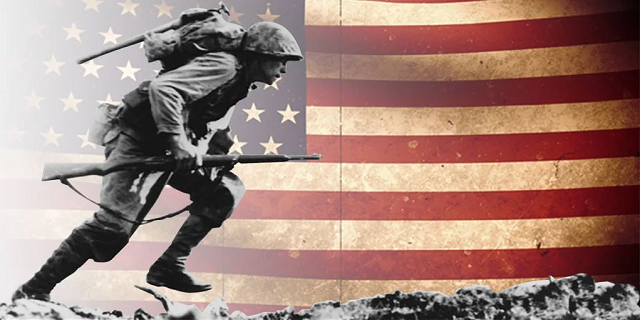
The “U.S. government” is comprised of a wide variety of different people, many of which are good and decent human beings. So this obviously does not represent everyone who works in the government. More importantly, this does not represent U.S. citizens either, so please do not fall into the trap of defending the crimes of your government, because you feel yourself personally under attack. Identify yourself with integrity, humanity and Truth, not a criminal government or group.
After the catastrophic attacks of September 11 2001 monumental sorrow and a feeling of desperate and understandable anger began to permeate the American psyche. A few people at that time attempted to promote a balanced perspective by pointing out that the United States had also been responsible for causing those same feelings in people in other nations, but they produced hardly a ripple. Although Americans understand in the abstract the wisdom of people around the world empathizing with the suffering of one another, such a reminder of wrongs committed by our nation got little hearing and was soon overshadowed by an accelerated “war on terrorism.”
But we must continue our efforts to develop understanding and compassion in the world. Hopefully, this article will assist in doing that by addressing the question “How many September 11ths has the United States caused in other nations since WWII?” This theme is developed in this report which contains an estimated numbers of such deaths in 37 nations as well as brief explanations of why the U.S. is considered culpable.
The causes of wars are complex. In some instances nations other than the U.S. may have been responsible for more deaths, but if the involvement of our nation appeared to have been a necessary cause of a war or conflict it was considered responsible for the deaths in it. In other words they probably would not have taken place if the U.S. had not used the heavy hand of its power. The military and economic power of the United States was crucial.
This study reveals that U.S. military forces were directly responsible for about 10 to 15 million deaths during the Korean and Vietnam Wars and the two Iraq Wars. The Korean War also includes Chinese deaths while the Vietnam War also includes fatalities in Cambodia and Laos.
The American public probably is not aware of these numbers and knows even less about the proxy wars for which the United States is also responsible. In the latter wars there were between nine and 14 million deaths in Afghanistan, Angola, Democratic Republic of the Congo, East Timor, Guatemala, Indonesia, Pakistan and Sudan.
But the victims are not just from big nations or one part of the world. The remaining deaths were in smaller ones which constitute over half the total number of nations. Virtually all parts of the world have been the target of U.S. intervention.
The overall conclusion reached is that the United States most likely has been responsible since WWII for the deaths of between 20 and 30 million people in wars and conflicts scattered over the world.
To the families and friends of these victims it makes little difference whether the causes were U.S. military action, proxy military forces, the provision of U.S. military supplies or advisors, or other ways, such as economic pressures applied by our nation. They had to make decisions about other things such as finding lost loved ones, whether to become refugees, and how to survive.
And the pain and anger is spread even further. Some authorities estimate that there are as many as 10 wounded for each person who dies in wars. Their visible, continued suffering is a continuing reminder to their fellow countrymen.
It is essential that Americans learn more about this topic so that they can begin to understand the pain that others feel. Someone once observed that the Germans during WWII “chose not to know.” We cannot allow history to say this about our country. The question posed above was “How many September 11ths has the United States caused in other nations since WWII?” The answer is: possibly 10,000.
Comments on Gathering These Numbers
Generally speaking, the much smaller number of Americans who have died is not included in this study, not because they are not important, but because this report focuses on the impact of U.S. actions on its adversaries.
An accurate count of the number of deaths is not easy to achieve, and this collection of data was undertaken with full realization of this fact. These estimates will probably be revised later either upward or downward by the reader and the author. But undoubtedly the total will remain in the millions.
The difficulty of gathering reliable information is shown by two estimates in this context. For several years I heard statements on radio that three million Cambodians had been killed under the rule of the Khmer Rouge. However, in recent years the figure I heard was one million. Another example is that the number of persons estimated to have died in Iraq due to sanctions after the first U.S. Iraq War was over 1 million, but in more recent years, based on a more recent study, a lower estimate of around a half a million has emerged.
Often information about wars is revealed only much later when someone decides to speak out, when more secret information is revealed due to persistent efforts of a few, or after special congressional committees make reports
Both victorious and defeated nations may have their own reasons for underreporting the number of deaths. Further, in recent wars involving the United States it was not uncommon to hear statements like “we do not do body counts” and references to “collateral damage” as a euphemism for dead and wounded. Life is cheap for some, especially those who manipulate people on the battlefield as if it were a chessboard.
To say that it is difficult to get exact figures is not to say that we should not try. Effort was needed to arrive at the figures of 6six million Jews killed during WWI, but knowledge of that number now is widespread and it has fueled the determination to prevent future holocausts. That struggle continues.
You can also access the latest news at this address: www.whatfinger.com
-
Subscribe
Subscribed
Already have a WordPress.com account? Log in now.
 Site Title