-
The Nuclear Threat Is Bigger Than Ever- The Start of Nuclear America’s War?

If SHTF, living in one of these states, may put you at the unnecessary risk of a potential missile or nuclear strike.
I’ve been studying nuclear warfare for quite a few years now. During this time, I’ve found that some states pose a much higher likelihood of becoming a target of war.
The enemies of the United States have one goal in mind, which is to destroy as many people as possible when they launch their attacks.
Luckily, we’ve avoided this thanks to a Military built like no other; the enemies know that messing with the United States is a terrible idea.
Nuclear warfare would decimate our country if our offensive systems failed when attacked. This would cause mass destruction and fallout in every corner of our nation.
Nevertheless, I’ve covered what to factor in when determining this and compiled the states that I believe pose the highest risk of missile or nuclear strike.

4 Factors To Consider
Population Density
The first thing that comes to mind when I think of what states are better or worse to reside in during war is population density.
States that have a lower population tend to be less on the radar vs. states that have ten to fifteen million or more people living there. The foreign enemies of the United States want to destroy as many people as possible when they launch their strike.
This is why residing in a state such as New York, or California puts you at exceptionally high risk for the chances of being hit by a missile or nuclear bomb. To avoid this, you’ll want to move to a state such as Montana or Maine.
These states are low-key and are not the first choice of a target for our enemies. Launching an attack on low population density states would be nothing more than a waste of resources for our enemies, and they know this.
Military Bases
If you’re at all knowledgeable about warfare, you know that military bases play a large role in where the enemies may launch a strike; but if you don’t, let me explain.
Military bases are our primary source of protection from both air and land invasion. If the various military bases were taken out, not only would we be more susceptible to land invasion, but air invasion as well.
In contrast, not all of our air missile protection systems are located near these bases; however, many of them are. So it only makes logical sense that areas with a high amount of military bases would be a priority target.
If you want to stay safe, or at least lessen your chances of becoming a victim of war, you should live in an area with as few military bases as possible.
Important Officials
In my opinion, the part that plays a massive role in determining the area of which seems attractive to attack via airstrike would be states of which many vital officials call home. A great example of this would be Washington, DC.
The enemies know that if our President or the Governor of New York is taken out that our government would be scrambled. It would undoubtedly cause havoc within our Military and cause many distractions.
Many of the officials live in Washington, DC, California, New York, and Florida, to name a few. A perfect example of this is when the united states took out Osama Bin Laden; once this operation was successful, his little army fell apart.
Imagine that scenario but on a much larger scale. However, we are considerably more prepared than Osama Bin Laden ever was. If you’re looking to avoid the chances of airstrikes, avoid the states listed below, if at all possible.
Fuel & Power
If I had to choose one thing that I thought would be one of the first things that could be destroyed via airstrikes, I’d say it’d be our fuel and power resources. Almost all of our transportation systems and power relies on electricity, gas, and oil, to name a few.
If these were taken out via airstrike, our country would come to a slow halt. This is also feasible via an EMP strike, which is essentially a nuclear bomb detonated in the sky, which would disable and fry all electronic devices, such as cell phones, computers, medical equipment, and much more.
This is a possible scenario and is much more likely to occur in states known for its power production, such as Texas.
The enemies understand that our reliance on these luxuries would cripple America if they were taken away from us suddenly, which is why it such a significant consideration for our enemies; this is why many people are beginning to build entirely off-grid homesteads.
8 States That Pose The Highest Risk
Washington, DC
The home of the President and the White House, Washington, DC, poses some of the highest risks of airstrikes out of all other states due to it being home to so many essential officials.
The White House does have, likely, the most sophisticated bunker system in the world. However, this does not mean the area is immune to war.
Washington, DC does have intelligent systems that can strike down incoming missiles. Still, they are not always accurate enough to target the rocket, and it should be remembered that they can undoubtedly fail.
The area is also home to millions of Americans, giving the enemies another reason to launch a strike. Destroying DC would lead to mass complications and unrest, and our enemies know this.
New York
If I had to choose a state that was most at risk of an airstrike, I’d choose New York. This state houses tens of millions of Americans and is home to many military bases.
New York is one of the most influential places globally, housing the One World Trade Center and many other critical buildings and operations important for the world.
As we know, the previous two world trade centers have already been destroyed, so it has already fallen victim to terrorism. If a nuclear strike were imminent, no one would have enough time to escape the strike.
New York is also home to many vital officials, which could be the motivation to target this area. It is well protected from air missiles, but as mentioned before, they are not always successful.
California
It’s a given that California is added to this list. This state is called home by over thirty-seven-million residences, making it the most populated state in the nation.
This makes it have an exceptionally high risk of becoming a victim of missile strikes. It does have in its favor a multitude of military bases, which could strike down an air missile.
Military bases are typically a good target for our enemies, so this is a sketchy situation. We can protect the state, but if the protective systems fail, it will result in mass destruction.
California is also home to several influential politicians and features many of our big tech giants and energy systems, which are definitely on our enemies’ radar.
Virginia
This was an easy decision to have added, mostly due to the dense amount of military bases near the Hampton area. There are nearly 20 all within a small space, which, if taken out, would cripple the state.
Virginia is also near Washington, DC. This means that if these bases were taken out, the protection for Washington, DC, would be cut in half. There is also an abundance of air-missile defense systems that can take out any incoming missiles.
These are used to protect not only Virginia, but Washington, DC, and the states surrounding it. The eight million residents are a motivating factor for our enemies as well.
I should note that when a nuclear bomb detonates, it releases a toxic gas called fallout. This can travel for hundreds of miles, wreaking havoc on people in other states, making Virginia a target in itself due to it being surrounded by highly populated states.
Florida
This state should not come as a surprise to you, but if it does, let’s explain why. Firstly, Florida is packed full of Military bases and features several space programs, including NASA, SpaceX, and more.
It is home to numerous influential politicians, including Donald Trump’s private residence. It is also home to over twenty million people, making it the third most populated state in the nation.
It’s well known that Florida is a significant tourist attraction for individuals all across the world and features many of the most sought-after vacation destinations, which means Florida could be used as a target to destroy an American symbol.
While states do not surround it, a nuclear explosion would decimate the entire state due to destruction and fallout. If you want to avoid experiencing nuclear war firsthand, stay away from Florida.
Nevada
This state only has a few Military bases, the largest being located in Las Vegas, employing over ten thousand servicemen and women. Something that it does have, however, is Area-51.
This is a secret military installation used to test unknown elements. Currently, there are no civilians that know of what occurs inside of this base. However, certain government officials do.
I think it’s possible that foreign nations, like Russia or China, know at least a little of what happens here, and I think it’s easy to agree that it’s likely weapons technology of some sort.
If Area-51 was destroyed, all of the technology and equipment is going with it. Las Vegas should be considered because it features some of the most sought after buildings in the world. The destruction of LV would lead to mass civil unrest.
Hawaii
Most people would call me crazy for adding this state in, but if you think about it, it’s probably in the top three most dangerous states to be in during the nuclear war.
For starters, it’s an island. This means that nearly one nuclear bomb could destroy the entire state. They do have anti-air missile technology, but as mentioned before, they can fail.
Fallout should also be considered because even if the missile was shot down, if it were shot down far enough into our atmosphere, it could still deliver fallout and the effects of an EMP.
There are also over ten military installations in Hawaii. On top of the two million people living there, it brings a huge motivator for our foreign enemies to attack the area.
Texas
Texas is believed by many, including myself, to be a great state to stay in when SHTF due to its exponential amount of natural resources, relaxed Gun laws, and a plethora of available land to purchase.
However, it can also be the most dangerous in a specific SHTF scenario: nuclear warfare. Texas is home to many military bases, anti-air missile defense systems, and atomic weapons.
If foreign nations ever attacked a state, Texas would likely be one of them. Besides, it’s the second most populated state.
The most significant motive to destroy Texas would likely be to disable a huge military and nuclear presence, that if destroyed, would make destruction a much easier goal for the attackers. In most other cases, however, Texas is great for most other SHTF scenarios.
Verdict
Nuclear warfare is probably the worst disaster imaginable. There have been nuclear detonations previously, such as the one that destroyed Hiroshima, but the nuclear bombs that we’ve made today surpass anything ever detonated before.
Nuclear weapons, when detonated, cause massive explosions near the detonation site and spread toxic chemicals called fallout for hundreds of miles, wreaking havoc in every living thing it touches.
If you happen to live in one of these states, consider moving to one of these states, or look into building a bunker. Fallout bunkers are also available to the public but are not something to count on.
The best way to stay safe from a nuclear blast is to seek shelter in the most robust building or shelter available, as far down or underground as possible, while blocking all airways.
-
The Fight at the Center of our Economic, Trade, and Foreign Policy
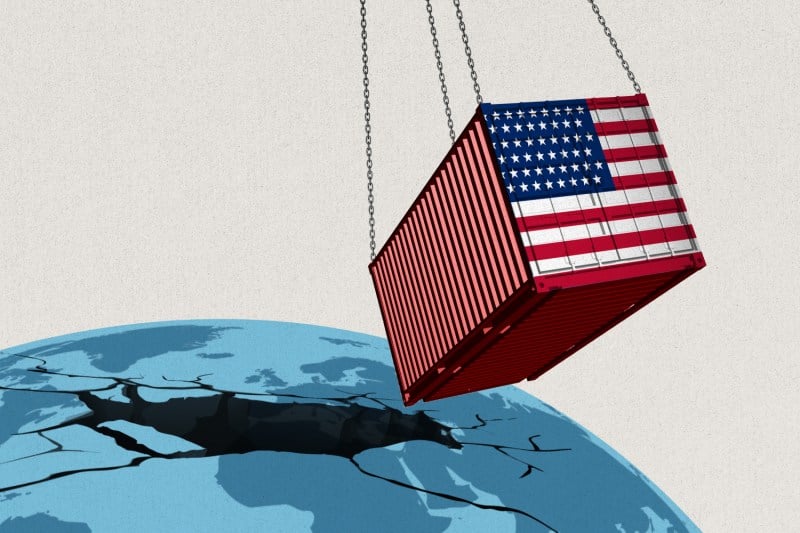
In the fall of 2010, a Chinese fishing boat was trawling off the coast of the Senkaku Islands, a territory given to Japan after World War 2 but never officially ceded by China. Upon being spotted by the Japanese Coast Guard, the trawler attempted to flee, but after being chased, it eventually rammed itself against the pursuing ship in a final act of desperation.
Two weeks later, in response to the fishermen’s arrest, China abruptly stopped all shipments of Rare Earth Metals to Japan, throwing their markets into turmoil. At the time, Japan sourced upwards of 90% of its rare earths from China (as did the rest of the world), as over the past few decades, China had gained near complete market dominance.
This ban, while scary at the time, ended up being relatively inconsequential to Japan, primarily because it was largely undercut by illiegal shipments out of China (a practice they have now harshly cracked down on), and due to a WTO ruling (which China publicly disagreed with, despite complying with it) which caused the ban to only last a few months. It did, however, wake Japan up to the danger of their reliance on China, causing them to diversify their mineral sources through massive investment in Australia, from which they now source close to 30% of their rare earths.
Despite the relatively small scope of China’s embargo, its potential danger at the time cannot be overstated. This group of 17 elements is the backbone of nearly all modern technology, from satellites to renewable energy to most modern weapons systems. Once refined, they are used to build magnets (necessary for wind farms and electric vehicles), catalysts (used for a wide variety of industries, but particularly useful to refine petroleum), and high-powered lasers used by the military.
Now, despite their name, these elements are not all that rare and are actually pretty abundant across the globe. They are, however, incredibly hard to extract in economically viable quantities, and even harder to refine (even this is not where the word rare comes from though, the name actually came about because, when the elements were discovered, they had never been seen before, which is a bizarre way to name new things, but I digress). Given the high upfront costs needed, it is now incredibly difficult to compete with China, which has a very well-established industry, near complete market dominance, and has been known to undercut other companies by cutting their own prices (making it impossible for new companies to compete).
Given the immense importance of these supply chains, how did we get here?

In 1980, following the short-lived rule of Mao’s successor Hua Guofeng, Deng Xiaoping emerged as the de facto leader in China, filling both the party and state apparatuses with loyalists, and maintaining his position as the vice chairman of the Chinese Communist Party. Amongst other divergences from Mao, his economy was opened to international markets, and allowed to be driven more by market forces, with more emphasis on centralized control rather than central planning. This era of Chinese history is thus marked with great economic expansion, and the birth of China as we see it today – as a manufacturing superpower.
Among these expansions was the birth of China’s rare earths industry. Blessed with somewhere around 30- 40% of the world’s known rare earth deposits (the most of any single country), China was uniquely poised to take over this market, but was far behind in the industrialization needed to take advantage of these reserves. In the decades following Deng’s ascension, three key factors allowed China to emerge as the sole superpower of rare earths.
The first is relatively simple, and the same reason why China was able to take over so much of global manufacturing within this same time period. Due to their low labor costs and relative lack of environmental standards, the costs of doing business in China were immediately much lower than anywhere else around the globe. That second part is key for rare earths – their extraction is absolutely horrible for the environment, which is a big reason why globally it takes on average 16 years to open a new mine. China’s lax regulation of environmental standards allows companies to dump waste products into the Yellow River, generate upwards of 10 million tons of wastewater a year (which is subsequently discharged without being treated, contaminating agricultural and potable water), and dump radioactive material. From 1990 to 1997, the cancer mortality rate in Bayan Obo (a rare earths mining district in Inner Mongolia) went up 50%, and the three leading causes of death were cancer, poisoning, and child mortality. Despite the human costs, however, the disregard for environmental consequences allowed China to skyrocket its production and attract investors from all over the world.
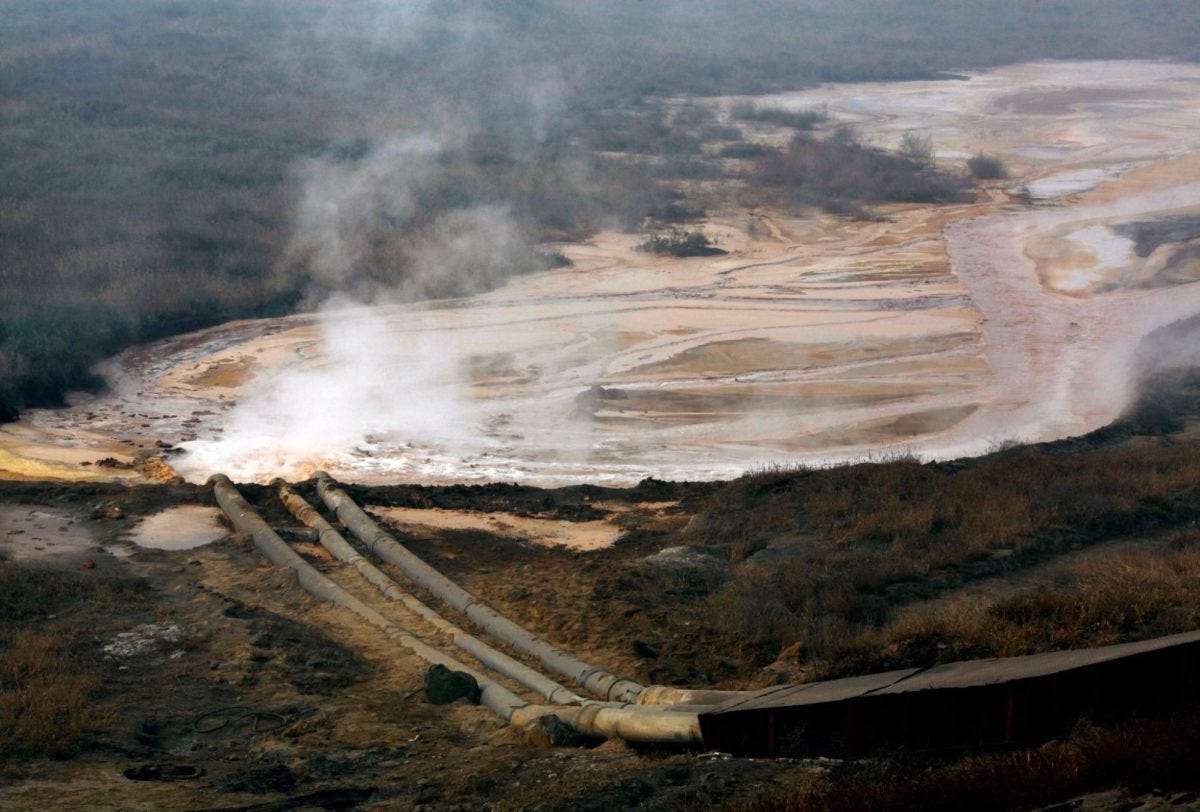
Baogang Tailings Dam in Inner Mongolia.
China then put its central planning to work, recognizing that rare earths were of vital importance to the global economy, and heavily subsidized its domestic industry, pouring money into it, and giving a 17% tax rebate for exporters. This heavy subsidization was accompanied by pouring money into R&D, pushing China forward in terms of extraction and refining technology, which was coupled with weak IPR enforcement, allowing the new technologies to proliferate amongst Chinese companies. These practices gave China a first mover advantage in rare earths processing and refining, eventually giving them the complete market dominance we see today.
The last part of China’s rare earths policy laid the foundation for the retaliatory export controls we are now seeing. Once China gained control over the market, it became very protectionist, distorting the global supply of minerals and limiting international cooperation. Whereas before, they had incentivized international cooperation and investment (particularly with Japan and the US) to facilitate the inward flow of technology and research, they now began to restrict it to limit the outward flow of their technology and research, having gained primacy.
Simultaneously, in the 90s and 2000s, China began to set lower and lower export quotas for rare earths, going from 65,000 tons in 2005 and just 30,000 by 2010. See, by this point, China was mining close to 100% of all rare earths globally, no country could compete, so by lowering the global supply, while keeping their domestic supply high, they made critical metals much cheaper for their own companies. This move allowed China to effectively vertically integrate the entire supply chain. It was now much cheaper to just buy the refined and finished products from China as well, where the cost was substantially lower. Though they would later abolish these export quotas (after the WTO ruled they violated free trade), this, however, only helped China, as it flooded the market, undercutting most other distributors of rare earths. Unsurprisingly, within this time, the two American companies capable of mining and refining rare earths, Magnequench and Molycorp, went out of business (the former was bankrupted by the supply squeeze and bought by Chinese firms, and the latter was undercut by the supply increase and crushed by debt).
In the following years, other countries have been able to regain a bit of a foothold in the actual mining process, and as of 2023, China mined around 70% of the world’s rare earths.

The damage, however, had already been done. China now controls somewhere between 85-90% of all heavy magnet production (by far the most used and profitable application of rare earths), and produces close to 100% of all heavy rare earths. Despite the fact that mines are opening up around the world, they all still send their rare earths to China to be refined and turned into usable products.
Now, this next section was supposed to be a prediction, saying that the past few decades of increasing market manipulation and retaliatory export controls meant our current tariff debacle would have the hidden unintended consequence of more expansive export controls. Unfortunately, it seems Xi Jinping (in an obvious attempt to undermine me specifically) beat me to the punch by putting bans in place this week, just a few days before I was going to publish this. So instead, let’s look at the implications of the ban China has implemented.
On April 4th, in response to further tariff hikes, China placed licensing restrictions on six medium and heavy rare earths, as well as on heavy magnets. All of the elements and magnets they have placed licensing restrictions on have a wide variety of both civilian and military applications (which likely makes this restriction WTO compliant), and are produced and refined in negligible quantities outside of China. While this is not exactly a ban, it just requires companies to now get licenses to export, it is likely to function as a ban similar to those that have come before it.
Before this last week, there had been two bans put on specific rare earths. The first came in 2023, when China banned exports of graphite (not a rare earth, but still an element critical for batteries and with a wide range of both civilian and military technology) to Sweden. The ban came as Chinese investment in battery factories across Europe (Poland and Hungary specifically). Now, one of the biggest companies in Europe’s nascent battery industry, Northvolt, just so happens to be based in Sweden. This ban, similar to the one we’re seeing now, was not an official ban, but a tweak to the export licensing system. The second ban was on the US in 2023. Following Biden’s semiconductor ban, disallowing our biggest chip companies like Nvidia to sell their best semiconductors to China, they responded by cutting off global Gallium and Germanium supplies (also not rare earths), two elements key in the manufacturing of said semiconductors.
Lastly, during Trump’s first trade war in 2019, Xi Jinping visited one of China’s cutting-edge heavy metal magnet factories, in a move that was widely perceived to be a threat to cut off their global supply. While this was not followed through on, likely due to the tentative agreement reached in 2020, this time the threat was followed through on.
These instances, as well as the policy surrounding all of China’s history with rare earth mining, refining, and production, show that they know how to protect their own industries and undercut the rest of the world. At some point, it no longer makes sense for China to continue to match our tariff level, because our trade deficit means they will always hurt more from that than we will, but what they can do is cut off our ability to actually build the products we need.
To their credit, Trump and his admin appear to understand the vital interest we have in securing this supply chain in a way I don’t think other presidents have before.
To their discredit, however, the way they’re going about it is fucking insane.
Even ignoring the fact that his trade policy has begun to cut off supplies in the short run, his incorporation of them into the center of his foreign policy is terrifying.
Specifically, his threats of annexation of Canada, taking over Greenland, and conditions to Ukraine aid all seem to have the throughline of shoring up our supply chains. When it comes to Ukraine, the cards are already on the table. The deal for Ukraine aid (which now may fall through anyway) was contingent upon the US getting to extract rare earths from Ukraine. Now, there is no credible evidence (save for some Soviet reports from the 60s) that there are rare earths in Ukraine, and even less evidence that whatever deposits they have could be worth anything (remember, the elements are everywhere, it’s about finding deposits big enough to justify the exorbitant costs). Ignoring that teensy detail, however, replacing one land-grabbing power in Ukraine with another is repugnant in my eyes. I can understand the arguments for it, that we ought to “get something out of” our aid to Ukraine, and I strongly disagree with this point of view. However, I am not going to go into the whole Ukraine debate here, and think the logistical challenges are reason enough that this plan is bad.
The even more clear-cut examples of bad policy towards the end of securing our supply chain are Canada and Greenland. For Greenland, the Trump admin has very explicitly said that they want to annex our ally for its mineral deposits. While it’s true that Greenland seems to have viable deposits, large questions remain surrounding the feasibility and cost. Annexing Canada, meanwhile, exists in this nebulous gray zone of being a joke when the idea is criticized, and being a serious policy proposal. While Trump and his admin are yet to comment on it, Trudeau has openly said that he believes Trump wants Canada for its vast mineral deposits.
Now, I don’t think the US will take over these countries any time soon, but the rhetoric surrounding American expansion is incredibly dangerous. Much of this administration seems to be reliant upon this pernicious attempt to shift the Overton window on American values, pushing us further and further towards an incredibly dangerous world. We may not invade our neighbor to the north in the next four years, but what happens when the formative political years of future politicians are filled with the idea that expansion and imperialism are key to our national security?
Outside of Trump’s foreign policy delusions, however, there is some potential good news for our supply chains and security, as we do have some prospects for companies that may be able to combat Chinese market dominance. The first is Lynas, an Australia-based rare earth mining company that produces medium and heavy metals, which was the result of Japanese investment following the embargo in 2010. The second, and more promising in my mind, is MP Materials, an American company that operates the only functional rare earth mine in the US. MP, however, is not solely a mining company, and in 2022 received grants to build up factories to process and refine rare earths, and to produce NdFeB Magnets. It is now poised to produce around 1000 tons of these magnets this year, with plans to ramp up production down the line.
A couple months ago, I invested a little in both these companies, and they have weathered the tariff storm decently well.
While the market looks something like this:

My money has looked a bit more like this:


This is not to brag or show off, but to offer what is likely going to be some of the only investing advice I ever give (in addition to telling you that you should consider buying low and selling high). I believe these companies will likely increase greatly in value over the next few months and the next few years, as the West has begun to wake up to the fact that we need to decouple this industry from China. Following the export bans on the 4th, both of them jumped about 25%, and have continued to grow. They aren’t without their drawbacks, however. Lynas is likely never going to be worth all that much, as it is just a mining company, which means it’s going to be relatively stable. MP, on the other hand, is subject to the ever-changing whim of Trump. Following its initial 25% increase on day one, it has sunk a bit and is likely to sink more on Monday, now that it has stopped selling to China due to their retaliatory 125% tariff. Despite these drawbacks, I do believe that both of these have a high potential in my mind of seeing tremendous gains over the next few months and years.
You can also access the latest news at this address: www.whatfinger.com
-
A Timeline of the End Game For Human Civilization

Humanity has constructed a doomsday Deadman switch that threatens civilization. Climate destruction will make it increasingly difficult to avoid the looming global nuclear catastrophe we’ve created.
Here’s how our future might unravel:
Late 2020s: Climate Red Alert and Infrastructure Strain
By the late 2020s, Earth’s climate is in unprecedented turmoil. Global average temperatures are consistently 1.5 °C above pre-industrial levels. Each year brings record-breaking heatwaves, “freak” floods, and droughts that batter infrastructure. Coastal cities flood more frequently, roads buckle in extreme heat, and power grids strain under surging demand for cooling.
This cascade of climate disasters sets the stage for a systemic collapse: as societies grapple with runaway warming, the resilience of critical infrastructure (power, water, transit) erodes.
Energy systems enter a crisis even before 2030. Nuclear power, which in 2025 still provided about 9% of the world’s electricity from ~440 reactors, becomes increasingly unreliable. Many nuclear plants struggle with climate stresses: cooling water sources heat up in summer, forcing reactors to reduce output or shut down to avoid unsafe temperatures. For example, a 2028 European heatwave pushes river and sea temperatures above 25 °C, triggering emergency shutdowns at multiple reactors that cannot be cooled effectively.
At the same time, stronger storms and floods threaten reactor safety. Dozens of reactors worldwide are unprepared for extreme flooding, meaning a dam failure or storm surge could lead to a Fukushima-scale accident. Worrisome reports emerge of power plants in floodplains and coasts where defenses are overtopped by rising seas and torrential rains.
By 2029, global carbon output remains high, and natural feedback loops are kicking in. In the Arctic, permafrost thaws and releases methane creating a vicious warming cycle where initial warming triggers more emissions, leading to even more warming. Scientists caution that a tipping point is near, beyond which climate change becomes self-perpetuating (a true “runaway” scenario).
Society approaches 2030 in a precarious state: aware of looming catastrophe yet unprepared for its speed. The stage is set for the coming collapse, with power grids and nuclear facilities – the backbone of the industrial world – already under severe strain.
I highly recommend this book! Here’s just a small glimpse of what you’ll find in The Lost SuperFoods:
The US Army’s Forgotten Food Miracle And 126 Superfoods That You Can Store Without Refrigeration for Years
The video below will shock you because you will be among the first to watching this secret!

Early 2030s: Blackouts and the First Reactor Crises
2030 marks the breaking point.
A confluence of climate catastrophes collapses power grids across multiple continents. A severe global heatwave in the summer of 2030 brings record electricity demand while many power plants (nuclear and coal alike) are derated or offline due to overheating coolant water.
Then powerful Category 5 storms strike in succession: one hurricane inundates the U.S. Eastern seaboard, while an unprecedented typhoon swamps Southeast Asia. These disasters knock out transmission lines and flood key substations, leading to prolonged blackouts in dozens of major cities. Emergency systems are overwhelmed. With communications down and transportation paralyzed, manpower shortages become acute – many operators and engineers cannot reach their stations.
Nuclear power plants are among the first to feel the emergency. Grid failure triggers automatic reactor SCRAMs (rapid shutdowns) at plants from Florida to France. Control rods halt the fission reactions, but decay heat in reactor cores still needs cooling for days to prevent meltdown.
Normally, backup diesel generators would power the cooling pumps, but the scale of the blackout means diesel resupply is uncertain and some generators fail in flooded facilities. In a grim reflection of 2011’s Fukushima disaster, several coastal reactors lose all power as storm surges drown their backup generators.
Within hours to days, the first meltdowns occur.
In 2031, a reactor in South Asia becomes a flashpoint: its cooling pumps falter after the grid collapse, leading the core to overheat. The reactor’s heart melts through containment in a matter of days, releasing a plume of radioactive steam and debris.
Nearby, an even greater danger unfolds: the plant’s spent fuel pool, packed with years of highly radioactive spent rods, boils dry without cooling. Exposed to air, the zirconium cladding of the fuel ignites, triggering a fire that belches long-lived radioisotopes directly into the atmosphere. This nightmare scenario – once narrowly avoided at Fukushima by heroic ad-hoc measures – now plays out in full.
Local and regional consequences are immediate and harrowing. Authorities, already struggling with disaster response, hastily order mass evacuations around stricken plants. In the South Asia incident, a radius of 30 km is declared a no-go zone as radiation levels spike. Over one million people are displaced in this region alone, fleeing what swiftly becomes a nuclear dead zone. Many receive significant radiation doses during the chaotic evacuation, trapped by traffic jams under drifting fallout.
Comparisons are made to Chernobyl’s 1986 evacuation – there, 130,000 people were permanently resettled and a 1,000-square-mile exclusion zone established – but the 2031 event affects an even larger population in a densely settled area.
Photo by Dasha Urvachova / Unsplash Nearby countries track the radioactive cloud as it crosses borders. Within days, radioactive iodine and cesium are detected in cities hundreds of kilometers downwind. Governments distribute iodine tablets to help block uptake of radioactive iodine in thyroid glands, recalling measures taken after Chernobyl and Fukushima. Farmers in downwind regions watch in despair as cesium-137 contaminates soil and crops, knowing from past accidents that those lands may be unsafe for farming for decades. (After Chernobyl, for instance, radio-cesium lingering in soils kept pastures in parts of Europe under restriction for over 20 years.)
Globally, these first reactor crises send a chilling signal. Airborne radiation from the fires and vented steam reaches the upper atmosphere and begins circling the planet. Within weeks, trace amounts of cesium-137 and strontium-90 are found in faraway monitoring stations.
While the initial fallout poses the greatest danger locally, the global dispersion of radionuclides raises alarms. Public health experts warn that even low-dose fallout on crops could, when multiplied across the world, elevate cancer risks and contaminate food supplies. International markets are rocked as nations ban produce and grain imports from entire regions. The economic shock compounds the physical destruction: already destabilized by climate disasters, the global supply chain further fractures under fear of radiation in goods.
Perhaps most critical for what comes next, these early accidents erode the capacity to respond to future crises. Emergency workers who heroically battled the first meltdowns (hosing overheating reactors, attempting improvised cooling) have suffered radiation exposure or exhaustion. Large swaths of power grid remain offline, making rolling blackouts the new normal even in areas not directly hit by climate events. This energy shortage slows recovery efforts and undermines the cooling and monitoring systems at other nuclear sites. By 2032, the world faces a stark reality: roughly 10% of nuclear reactors worldwide are in some stage of crisis – either already melted down, or scrammed and struggling to keep their hot cores and spent fuel safe. What was once unthinkable now seems inevitable.
Mid-2030s: Cascading Meltdowns Across the World
As 2035 approaches, the situation spirals into a cascade of nuclear calamities. Ongoing climate chaos keeps hammering human systems. Year after year, megastorms, wildfires, and heatwaves pummel regions before they can recover. The compounded infrastructure damage means many areas have only intermittent electricity and scarce supplies.
In this environment, about half of the world’s nuclear reactors are effectively left unattended or unserviceable – some due to direct disaster impacts, others because manpower and resources have collapsed in the region. Governments in relatively stable areas attempt to initiate orderly shutdowns of reactors as a preventative measure, but even a shut reactor needs years of active cooling and oversight. In many cases, those best efforts falter.
By 2033–2035, a wave of reactor meltdowns unfolds on nearly every continent.
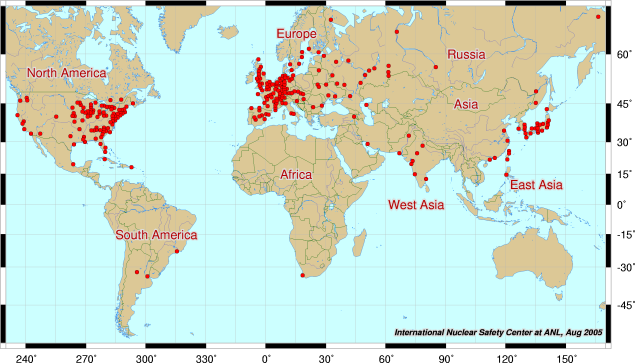
Nuclear reactors around the world The numbers are staggering. What started with a few isolated accidents in 2030–32 explodes into dozens of sites in crisis. Older nuclear stations prove especially vulnerable: lacking passive cooling features, they succumb quickly when grid power and backups fail. Newer reactors touted as “meltdown-proof” also face unforeseen challenges – coolant reservoir tanks run dry when maintenance crews vanish, or hydrogen explosions (like those that blew apart Fukushima’s reactor buildings) occur due to unvented pressure.
Spent fuel pool fires add to the nightmare at many sites; analysts later estimate that these pool fires released even more radiation than the reactor core meltdowns in several cases, since pools often contained decades of fuel assemblies (holding up to 10× the long-lived radioactivity of a reactor core in each pool).
Each collapsing plant creates its own radiation footprint. By the mid-2030s, a patchwork of radioactive exclusion zones scars the Northern Hemisphere. In Eurasia, multiple zones – from Western Europe through Russia, South Asia, and East Asia – dot the map where reactors have failed. Some of these zones begin to overlap, forming a virtually continuous swath of contaminated land in parts of Europe and Asia.
In Western Europe, for example, meltdowns at two French reactors and one German reactor in 2034 force evacuations that cover large parts of the Rhine valley. Later, a catastrophe at Ukraine’s Zaporizhzhia plant (already endangered for years prior) adds to the chain, rendering areas along the Dnieper River highly radioactive once again.
North America is not spared: a meltdown at an aging Midwest U.S. plant sends radiation across several states, and Canada’s Ontario reactors – shut down due to power loss – suffer a fuel pool fire that spreads contamination through the Great Lakes region.
In total, roughly 50% of the world’s 400+ reactors are now either destroyed or abandoned. Humanity suddenly finds itself living with hundreds of Chernobyl-sized disasters at once.
Local and regional consequences reach an apocalyptic scale. Hundreds of millions of people become actual or potential refugees from high-radiation areas. Major cities near failed plants are emptied: by 2035, regions like the French Riviera, the North China Plain, and the U.S. eastern seaboard have pockets that resemble Pripyat – ghost cities left to wild animals.
All Americans Will Lose Their Home, Income And Power By April 27, 2025
Watch the video below!

The contamination of land and water is immense. Isotopes like cesium-137 and strontium-90 settle into agricultural soils. Just as Chernobyl’s fallout once contaminated 200,000+ square kilometers of Europe to some degree, the 2030s meltdowns contaminate vast expanses of the globe. Agricultural experts estimate that a significant fraction of the world’s breadbaskets are now tainted by radioactive fallout.
For example, the Punjab region and the American Midwest both see cesium levels in soil far above safe farming limits, threatening global grain supplies. In many countries, the choice is stark: eat potentially contaminated food or starve.
Livestock that graze on fallout-blanketed pastures accumulate radionuclides in their meat and milk, as British sheep did for decades after Chernobyl. Governments impose strict bans on food exports from these zones, and global food prices skyrocket. Famine looms for countries that relied on imports from now-irradiated farmlands.
Photo by Ian Cylkowski / Unsplash Beyond human habitations, ecosystems suffer radiological damage layered on top of climate stress. Forests downwind of reactor accidents turn brown and silent as foliage and wildlife absorb heavy doses of radiation. In some intensely contaminated zones, an eerie calm prevails – reminiscent of how the core area around Chernobyl became an accidental wildlife refuge, but one where many organisms die young or show mutations.
Initially, high radiation kills or stunts many plants and animals. Forests die and animal populations plummet. Over the later 2030s, some wildlife returns to abandoned zones, benefiting from the lack of humans. However, in areas of very high contamination, biodiversity remains lower and animals show signs of chronic radiation exposure.
The web of life is poisoned: radioactive cesium and strontium work their way up food chains, affecting predators and prey alike. Combined with the ongoing climate upheavals (heat stress, wildfires, habitat shifts), the added burden of radiation pushes many species to extinction in contaminated regions. Aquatic ecosystems are also hit – radioactive runoff flows into rivers and seas, causing fish kills and long-term mutations in fish reproductive cycles.
The global consequences of this mid-2030s nuclear cascade are profound. Atmospheric circulation transports radioactive pollution around the world. By 2035–2036, background radiation levels have risen noticeably above 2020s norms in both hemispheres. Radioactive particles from multiple meltdowns are detected in the Arctic and even the Antarctic, having been carried by air currents. Although concentrations far from accident sites are low, no corner of the planet is truly untouched.
In the Northern Hemisphere, intermittent waves of fallout descend whenever rain clouds scavenge particles from the upper atmosphere – a phenomenon similar to the fallout patterns observed after nuclear weapons tests and Chernobyl, but now sustained by ongoing reactor fires and spent-fuel blazes. Public health experts warn that long-term cancer rates will climb worldwide; every additional becquerel in our food and water increases risks.
By the late 2030s, the world’s socio-economic order has largely disintegrated. The combination of climate catastrophe and radioactive contamination fractures the globalized economy. International travel is nearly nonexistent both because of infrastructure breakdown and fear of radiation exposure on long journeys. Trade in food and goods has devolved into ad-hoc local barter, since centralized distribution is impossible under constant disaster.
Regions that remain habitable form “safe zones” – relatively less contaminated and with tolerable climate – mostly in the far southern hemisphere and a few remote northern areas. For instance, parts of New Zealand, Patagonia, and Siberia (far from any meltdown sites and somewhat buffered by distance) become refuges for those able to relocate. Even so, these areas face their own challenges from extreme weather and inflows of refugees.
Humanity’s population shrinks precipitously due to famine, conflict, and radiation-related illness. What was roughly 8 billion people in 2020 falls by at least hundreds of millions (edit: more likely billions) by 2040. Those losses stem not only from immediate disaster casualties but also from secondary effects: hunger, lack of medical care, and weakened immune systems in a ravaged environment.
2040s: The Toxic Legacy Settles In
By the 2040s, the frantic pace of new catastrophes slows somewhat – not because the crises are solved, but because so much has already collapsed. Most of the vulnerable nuclear reactors have already broken down by this point or were pre-emptively shut. The ones that survived the 2030s are primarily in regions that remained functional enough to manage a safe cold shutdown or have newer designs with passive cooling. However, the world now faces the long aftermath of what has happened. The 2040s are a bleak decade of enduring fallout (literal and figurative), where humanity grapples with the toxic legacy of hundreds of reactor failures amid a climate that remains hostile.
One grim reality sets in: the radioactive contamination is far from a short-term problem. Many of the isotopes released have half-lives measured in decades or longer, meaning the radiation will persist for generations. For example, cesium-137 (half-life ~30 years) and strontium-90 (half-life ~29 years) remain abundant in the soils of meltdown zones and downwind regions.
These isotopes mimic vital nutrients (cesium behaves like potassium, strontium like calcium), so they continuously cycle through plants, animals, and water. Crops grown in contaminated soil uptake cesium; grazing animals concentrate it in their flesh; humans who consume those foods further concentrate it in their bodies. In the 2040s, scientists document how radioactivity has infiltrated the global food chain. Traces of cesium-137 show up in grain and milk even in “safe” zones, due to minute fallout that has spread worldwide.
In harder-hit areas, food contamination remains a severe obstacle to resuming agriculture – even when farmers attempt to cultivate, their produce often exceeds safety limits imposed in the old world. Consequently, hunger continues to stalk populations: arable land might be available, but not all of it can be used without slowly poisoning those who eat from it.
Another challenge is the management of radioactive waste and materials. The reactor meltdowns and fires have dispersed a lot of the radioactive inventory into the environment, but significant amounts still reside in the wreckage of power plants.
Spent fuel rods that did not burn sit in cracked pools or dry casks at sites now too hazardous for people to approach. The reactors themselves hold tons of uranium and plutonium in their ruined cores. In the 2040s, these wreckage sites are largely uncontained.
Unlike Chernobyl, where a concrete “sarcophagus” was built over the destroyed reactor, many 2030s accident sites have been simply abandoned mid-disaster. Some have rubble or sand piled by drones or remote machines to try to smother fires, but no comprehensive containment. This means groundwater leaching becomes a major concern. Rain percolating through the wrecked reactors carries radioactive contaminants into aquifers and rivers.
For communities downstream (if any remain), water sources are compromised. In coastal plants, continued leakage of radiation into the ocean is observed. By 2045, marine biologists report increased contamination in sea life far from any direct fallout, indicating that ocean currents have spread the pollutants. Strontium-90, for instance, known to accumulate in fish bones, is found in fish thousands of kilometers from any reactor site. The Pacific Ocean, already contaminated by the Fukushima incident in 2011, now receives orders of magnitude more radionuclides from multiple Pacific Rim reactor failures.
Ocean fisheries, already stressed by climate-driven acidification and overfishing, are now additionally burdened by radioactive pollution – many fishing zones are closed due to cesium levels, pushing more coastal communities into protein scarcity.
The climate crisis continues unabated in the 2040s, though its character has changed. With industrial civilization greatly diminished by mid-decade, greenhouse gas emissions from human sources have plummeted. Oil consumption is a fraction of what it was, and many coal plants are offline (some destroyed, some simply without supply lines). This initially gives a glimmer of hope that anthropogenic warming might slow.
Indeed, by the late 2040s some climatologists note a slight stabilization in CO₂ levels. However, the damage is already done in terms of triggering feedback loops. Warming continues due to inertia and feedback emissions (like methane from permafrost). By 2040 the world breached +2 °C (edit: likely more like 3) warming, and by 2050 it may be heading toward 2.5 °C (edit: quite possibly approaching 4.5) despite the collapse in human emissions.
The ongoing extreme weather further complicates the radioactive legacy. For example, wildfires in contaminated forests have become a recurring nightmare. Each summer in the 2040s, large wildfires ignite in areas with dry, hot conditions – some of those areas include the evacuated zones dense with dead trees and dry brush (around former reactor sites). When these fires rage through radioactive forests, they loft radionuclide-laden smoke into the sky.
In 2043, a massive fire in the abandoned parts of Eastern Europe (fueled by a drought and heatwave) burns hundreds of thousands of acres, re-mobilizing cesium and plutonium deposited in the soil. Soot and ash carrying these particles travel far; monitors as far away as northern Scandinavia register spikes in airborne radiation. What was effectively “locked” in the soil is thus released anew by fire – a horrific feedback where climate-induced fire boosts the spread of nuclear contaminants.
Similarly, intense storms cause flooding and dust storms that redistribute radioactive sediments. Rivers that flow through meltdown zones periodically flood and deposit radioactive silt onto downstream plains. The environmental contamination, therefore, is not a static situation; it worsens in pulses whenever climate disasters strike the polluted zones, creating secondary fallout events throughout the 2040s.
Human society in this decade adapts in grudging, hardscrabble ways. In relatively uncontaminated regions, people develop new habits to minimize radiation exposure. For example, rooftop farming and hydroponics indoors become crucial to grow food in controlled environments, to avoid contaminated soil. Water is filtered through improvised means (layers of charcoals and resins to trap radioactive isotopes). People often wear personal dosimeters and masks when venturing outside, especially on windy days that could carry dust. The specter of radiation sickness and cancer is a constant part of life.
Medical knowledge from past nuclear accidents is applied where possible. For instance, Prussian blue pills (which bind radioactive cesium in the digestive tract) are prized treatments to reduce cesium uptake; potassium iodide pills are stocked to pre-dose the thyroid in case of new radioactive iodine releases. However, these medications are in short supply as global production capacity and supply chain infrastructure is decimated.
Despite these measures, the health toll is severe. Cases of cancers (thyroid, leukemias, solid tumors) skyrocket, and with healthcare systems devastated, many go untreated.
There is also a rise in birth defects in regions that were exposed to higher radiation during the 2030s – a tragic echo of what was observed in some areas after Chernobyl, now magnified by the wider scale. Mental health is another casualty: whole generations grow up under the dual shadow of climate apocalypse and invisible radiation hazard, leading to widespread psychological trauma and “eco-radiation anxiety.”
By the end of the 2040s, some stabilization occurs in the sense that no new major nuclear disasters are unfolding (simply because so few reactors remain operational or intact). What remains of organized governments and international institutions focus on containment and mitigation. There are projects, for instance, to entomb certain high-risk reactor sites in concrete (as was done with Chernobyl) now that radiation levels around them have decayed enough to allow heavy machinery to approach for short periods. One such international effort in 2048 finally encases the remains of a major U.S. reactor that melted down 15 years prior, using robotic builders to minimize human exposure. These efforts are slow and cover only the worst offenders, but they at least aim to prevent further leakage.
2050s and Beyond: A Transformed and Radioactive World
Earth is a fundamentally altered planet. Human civilization has been gutted; what remains is a patchwork of survivor communities and a few stable enclaves attempting to rebuild amid the ruins. The climate is hotter (approaching +2.5 °C), seas are higher, and seasons are unreliable. On top of this, the planet’s surface carries the wounds of the nuclear collapse. Even as some dangers gradually subside with time, others will persist for centuries.
Radioactive decay has slightly improved conditions in the decades since the meltdowns. By 2060, it will have been ~25–30 years since the peak of the disaster. Isotopes like Iodine-131 (which caused acute thyroid exposures in 2030s) are long gone – with an 8-day half-life, they decayed away within months of release. The most intense short-term radiation from the accidents (which came from these short-lived fission products) has thus faded. Even some medium-lived isotopes like cesium-137 and strontium-90 have seen about one half-life pass. Areas that were extremely contaminated by cesium in 2035 might register roughly half the cesium levels by 2065, simply due to radioactive decay (not counting redistribution). This means that radiation levels in some exclusion zones are lower in 2060 than they were in 2040, potentially allowing limited access with protective gear.
In a few zones on the periphery of disasters, radiation has decayed enough that authorities consider letting people return with precautions (much like parts of the Fukushima exclusion zone were gradually reopened after a decade). Wildlife begins to reclaim many regions more fully as human absence continues; in moderately contaminated areas, animals have multiplied (albeit some with shorter lifespans or health effects). The paradox seen in Chernobyl’s exclusion zone – where wildlife thrives despite radiation because human pressures are removed – is now playing out on a larger scale. Some scientists in the 2050s cautiously talk of certain abandoned areas becoming de facto wildlife reserves, albeit radioactive ones.
However, other hazards will essentially be permanent on human timescales. One is plutonium. Many reactor explosions and fires spread particles of plutonium-239, an alpha-emitting isotope with a half-life of 24,000 years, into the environment. These particles are extremely dangerous if inhaled or ingested, as they can lodge in lungs or bones and irradiate tissue for a lifetime. Plutonium is heavy and tends to deposit near accident sites, but the fires and smoke did carry some of it regionally. This means certain hotspots (within, say, a few kilometers of the worst meltdowns) will remain lethally radioactive essentially forever as far as human planning is concerned.
Even after cesium decays, these areas will be unsafe to inhabit without serious cleanup (removal of topsoil, etc.). Another enduring issue is the spent fuel and waste that remain. By 2070, the fuel assemblies that did not burn up in fires have cooled radiologically (their short-lived fission products gone), but they are still highly radioactive and contain long-lived isotopes. Ideally, they would be secured in geologic repositories to isolate them from the biosphere. But with the collapse of industrial capacity, most of this waste is simply sitting wherever it was last stored. Some is in dry cask containers that can last a few decades. By the 2070s those casks may be deteriorating, potentially releasing their contents if not maintained. Thus, the world faces a slow seepage of radionuclides for centuries.
The habitability of the planet is dramatically reduced compared to pre-2030. Large regions are effectively off-limits due to radiation – especially parts of mid-latitude North America, Europe, and Asia where population was once highest. The tropics, meanwhile, suffer extreme heat and humidity that push human heat tolerance to the limit (some equatorial zones regularly see wet-bulb temperatures above 35 °C, unsurvivable without A/C).
The “safe zones” by the 2050s are those rare places with a combination of tolerable climate and minimal fallout. These tend to be in the southern hemisphere or isolated islands. Portions of South America (southern cone) and Africa (extreme south or highlands in East Africa) see clusters of survivors who have organized small agrarian societies, carefully selecting crops and livestock that can grow in changed conditions and relatively uncontaminated soils. Australia and New Zealand, which had no nuclear plants of their own and were distant from most fallout, become crucial harborages of technological memory – although Australia’s interior is severely hit by heat and drought, its southern coasts remain livable. Antarctica and the Arctic islands, free of radiation but harsh in climate, see some interest as refuges (some communities attempt to live in domed biomes on the Antarctic Peninsula, leveraging the cooler climate and abundant marine life, despite the logistical difficulties).
The collapse of industrial emissions has a small silver lining for climate by 2070: atmospheric CO₂ has finally plateaued, possibly even dipped slightly as the oceans and regrowing forests draw down carbon. But this comes at the cost of global societal collapse and mass mortality. In essence, the Earth system reset itself in part by a brutal reduction of human impact, while locking in a radioactive legacy. The climate remains warmer and more volatile than the Holocene average, but without continuous fossil fuel burning it may avoid worst-case 22nd-century projections. Nonetheless, sea levels by 2070 are higher (many coastal former cities are now tidal marshes littered with ruins), and superstorms still occur (though fewer targets remain to damage).
The surviving humans have adapted to a nomadic and subsistence lifestyle in many places, always mindful of avoiding radiation hotspots identified by their Geiger counters. The world population is a fraction of what it was, industrial civilization is dead alongside billions of humans, and those who remain are scattered and isolated.
Gone Viral! The most shocking videos in the world… 7 Hidden Signs That Martial Law Will Be Declared
Many of these signs point to an increased risk of the government preparing to declare martial law.
The video below will shock you because you will be among the first to watching this secret!

-
Criminal Biden Regime Classifies Americans Who Oppose Illegal Immigration and Support Gun Rights as ‘Potential Terrorists’

Are you a conservative, libertarian, Christian, or gun owner?
Do you oppose abortion, globalism, Communism, illegal immigration, or the UN?
Believe in conspiracy theories or the “end times”?
If so, U.S. government documents have classified you a “potential terrorist.”
Once, the term “terrorist” referred narrowly to those using violence for political goals, like Osama bin Laden. But under the Obama administration, references to Islam were removed from terror materials, and the label expanded to include American citizens who oppose the far-left ideology that has taken over our institutions.
Being labeled a “terrorist” strips away rights, and peaceful citizens and patriots are now being demonized by a tyrannical government that has sold its soul to the globalists.
72 Types of Americans That Are Considered “Potential Terrorists” In Official Government Documents
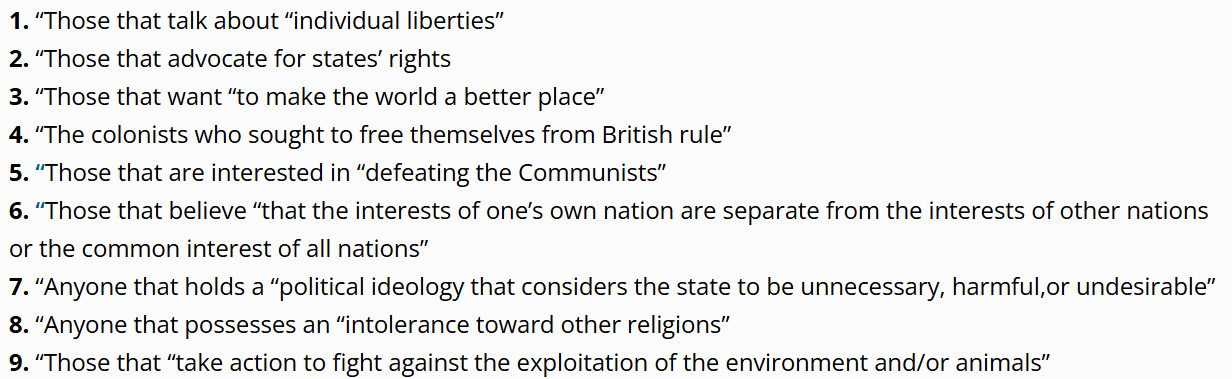
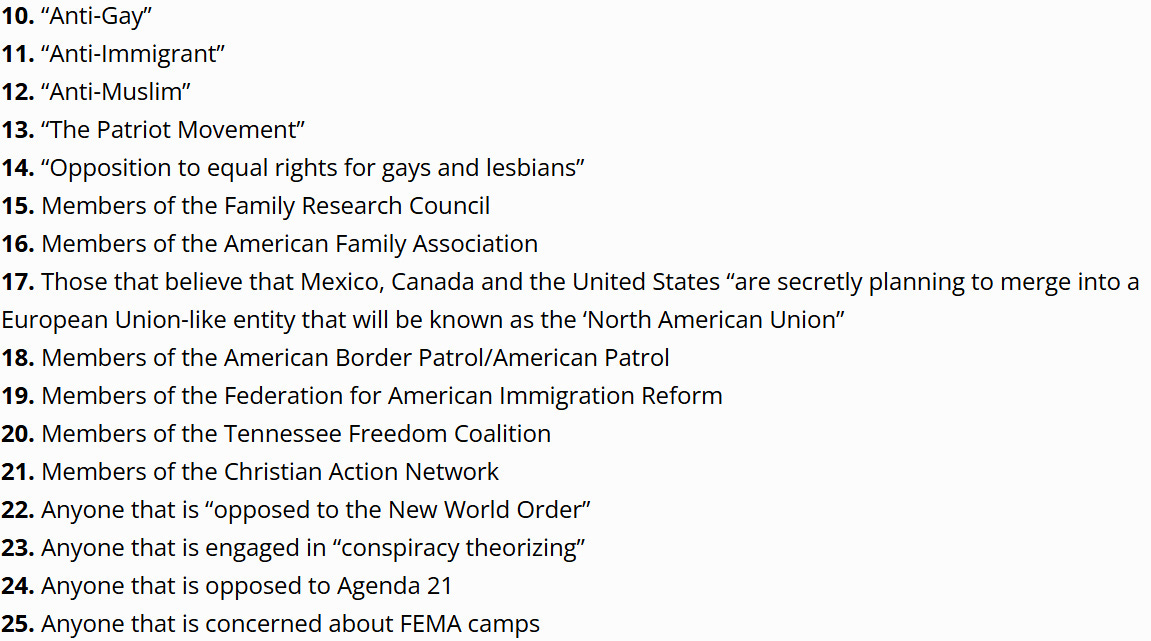
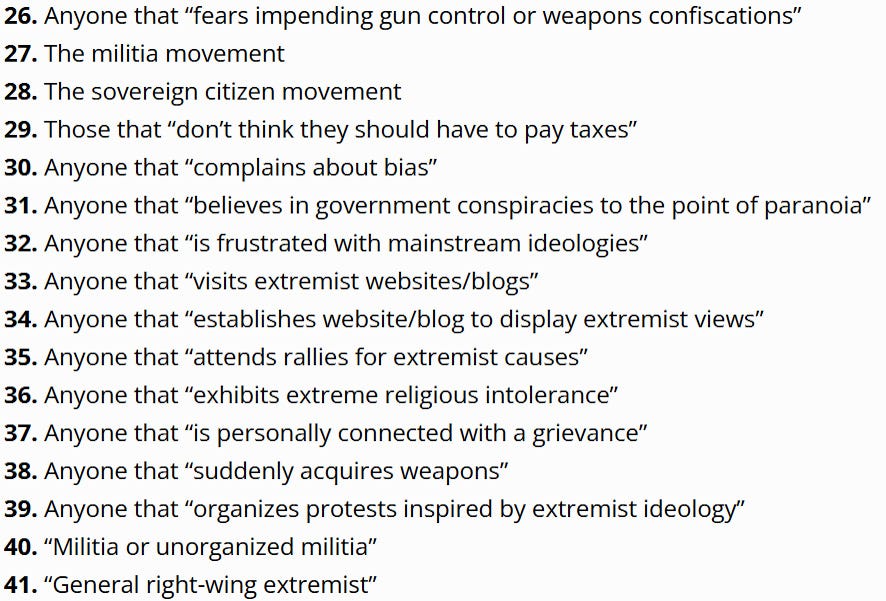
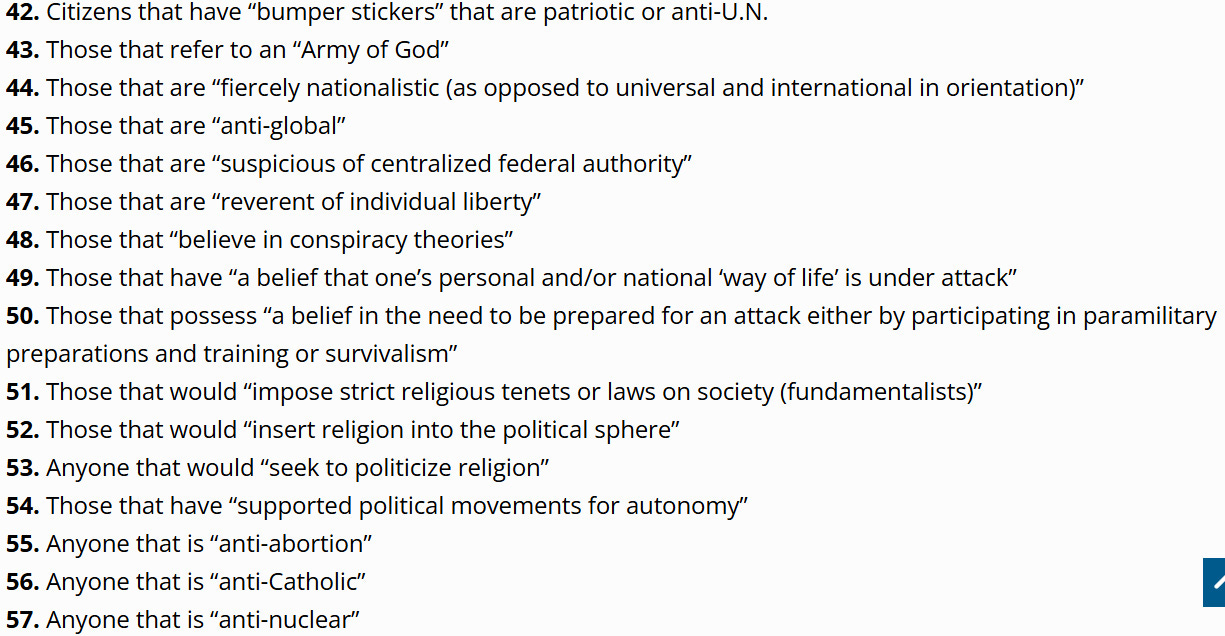
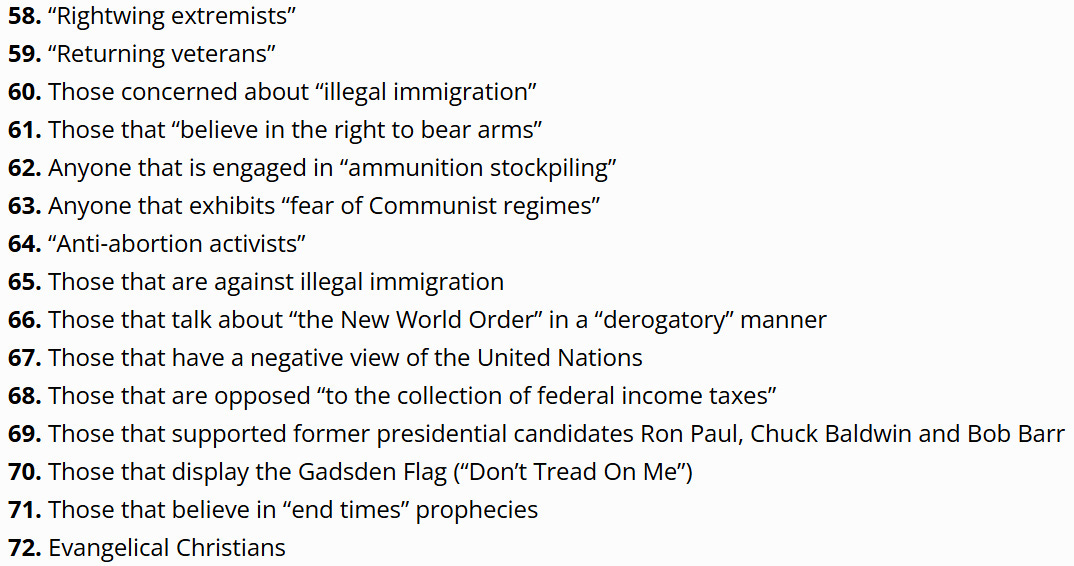
The groups of people in the list above are considered “problems” that need to be dealt with. In some of the documents referenced above, members of the military are specifically warned not to have anything to do with such groups.
We are moving into a very dangerous time in American history. You can now be considered a “potential terrorist” just because of your religious or political beliefs.
Free speech is becoming a thing of the past, and we are rapidly becoming an Orwellian society that is the exact opposite of what our founding fathers intended.
-
The Day Of The Apocalypse- 8 Steps to Prepare For The End Of The World

What will happen if society collapses? What would you do if there’s no one to help you or your family? Disaster preparedness is more than worrying––it’s also about being practical, preparing for realistic scenarios and being ready for the unpredictable. An apocalypse is unlikely, but you’ll need to know what to do in case it happens.
Below is 8 steps to prepare for the end of the world.
Education
The new prepper often goes straight to the question, “Where would I go.” and almost invariably answers that question with “to Walmart!” A better question to ask would be “Where would I meet?” It is hard to understand the difference at first. When we all start down this path of readiness, we often consider ourselves as either the lone wolf; traveling from place to place, surviving on the scraps of humanity, doing what is necessary to survive.
Some consider themselves to be the leader of a group of survivors; single handedly keeping our friends and family alive, and restoring order to (at least a small piece) of a world in chaos. While this might be true, in some select few circumstances, overwhelmingly it will not be the case. For every leader of a group of fifty survivors, there must be forty-nine followers. If your goal is to be the leader, there is an entire set of leadership skills and personality requirements that the majority of people do not have. In this case, learning to be an effective leader is much more important than having a bug out bag, or an alpha site, and should be the primary focus of the new prepper’s education.
The average, every day survivor may in fact be better served by asking the question, “What can I do that provides value to the group?” This question will help guide the new prepper and help them to assess their strengths and weaknesses in a way that is not driven by ego and the stereotypes we all enjoy on our favorite zombie books and movies. As the author of the best-selling What Zombies Fear series of books, and the owner of a massive zombie survivalist website, I spend a lot of time working under the assumption that I will lead a group of survivors.
If you are a leader, you will naturally and organically move into that position within a group, even if the group originally chooses a different person.
There are hundreds of topics relevant to zombie preparedness. The survivor with the most breadth of knowledge will have the easiest time. Education is the key to survival. Read and practice skills in a wide variety of areas.
Creating a Plan
The first step towards getting prepared is to make your plan for the initial upheaval. In any EOTWAWKI (End of The World As We Know It), WROL, (Without the Rule Of Law), or Apocalyptic scenario, the situation will likely escalate very quickly. Any slow moving outbreak would be controlled by the government. Anything that’s going to clearly end the rule of law is going to happen very quickly, quickly enough to catch law enforcement, the CDC, the National Guard, etc before they can react. This is why zombies make such a great “best case scenario” for the end of society.
Your plan should include the people who you expect to survive with. Detailed information about their skills and liabilities. For instance, I am very proficient with firearms, a skill most people would consider an asset during the apocalypse. Unfortunately, I have had multiple knee surgeries. My knees are a definite liability to a group. Consider whether the survivor group is going to bunk in or bug out. Are you going to stay right where you are, fortify your position and wait out the apocalypse in your current location, or are you going to grab your gear and head for an alpha site.
When deciding to bunk in, there are a number of points to take into account. The defensibility of the home or current location, the comfort of the people in the group, the stores in place, and the location of the home are primary points.
In some situations, where people live in the city or major suburbs, and/or if a prepper decides their house is not defensible, and will make the call to bug out. For some people, this means heading out into the wilderness by themselves, and for others it means heading for a pre-determined Alpha Site. An alpha site is the first fallback position. It’s a place where everyone in a survivor’s group knows to meet. It is advisable to choose an alpha site that is away from major population centers, with accessibility to land, water, and security.
Gather Supplies
Once the survivor has a plan for surviving the apocalypse, it becomes necessary to gather the supplies to do so. Weapons are often the first things that preppers look to for survival, although it is the opinion of this author that weapons are among the last items a prepper should obtain. Guns have their uses, and are a tool that every survivor should (where legal) have in their toolbox, but it is not the only or most important tool.
Security
In an apocalyptic event, materials for fortifying a house will become scarce. During hurricanes, there is often no lumber to be found for miles, well outside the forecasted storm track. Gather and keep on hand the lumber and/or materials necessary to secure your location. In the event of a zombie apocalypse, you not only need security from zombies, but from those who would take what you have. If you look “too” prepared, you can make yourself into a target. Having hurricane rated, automatically controlled steel shutters on your house is likely to keep you very safe from zombies, but also make it a target for desperate survivors. Human beings often resort to violence in chaos. Examples of this are abundant throughout history, most recently in the violence that ensued in the days after hurricane Katrina in the United States, and in Haiti after the earthquake there. The time to gather, assemble, and store fortifications and supplies is before anything goes wrong.
Water
After security, the number one concern is water. Having enough water, one gallon per person, per day, is fairly easy to do if the prepper is staying in one location. Water storage containers are fairly inexpensive, and if stored in a cool, dry location, bottled water will stay potable almost indefinitely. Knowing where water can be reliably found is a skill that will save your life. In most American houses for example, between fifty and eighty gallons of water can be found in the home’s water heater. Another two gallons can be found in the holding tank of the toilet, although that water would need to be boiled before consumption. Streams and creeks with watercress growing in them can be considered safe to drink straight from the source. Although here is some risk of parasitic infection, watercress only grows in very clean water. If in doubt, always boil water prior to drinking, although it is reasonable to consider that human beings lived for tens of thousands of years before modern water treatment. It is better to risk parasitic infection or water contaminants than to die of dehydration.
Food
Many survivalists know, and it has been detailed on this page, that many foods are perfectly edible and contain adequate nutrition well beyond their expiration date. Examples of rolled oats, stored in airtight containers for thirty years, and canned foods a decade after their expiration date being edible abound on the internet. As always, use your nose. It exists almost solely to tell you if a food is edible or not. Use it and trust it. For the new prepper, food storage can be a major undertaking. This site advises that the survivalist purchase extra food over a long period of time, for cost reasons as well as to give variation in expiration dates. Chances are that a preppers stored food stocks won’t last beyond the expiration date, so the main reason is cost. Purchasing an extra 2 – 3 long lasting food items per week won’t break the bank. Purchasing a six month supply of food for five people all at once will. It’s better to make survival prepping a lifestyle, and do a little every week.
Medicine
Prescription drugs and other supplies should be stocked at all times. There are many online pharmacies that will allow ninety day supplies, and most doctors will adjust prescriptions to allow for that. Some people stockpile medications by skipping a day every now and then. This can have serious health ramifications, and is not recommended. Talk to your doctor, and tell him your plans.
Build a Bug Out Bag
Building your first BoB can seem like an expensive prospect. Most people who post their bug out bags online have been building, tweaking, adding to and removing from them for years. For the new prepper, it can be difficult to know where to start. Every member of the group should have a bug out bag, even if the plan is to stay put. A Bug Out Bag, also called Get Out of Dodge Bag or GOOD bag, or sometimes even a 72 Hour Bag is usually designed to get you out of an emergency situation and allow you to survive on your own for up to three days. Many ZPI users plan their Bug Out Bag to sustain them for much longer than that, but there is always a limit to what you can carry on your back and the three day target is an adequate starting point.
There are seven types of gear that should go into a starter bug out bag.
- Water
- Water is a survival basic, and the first priority in any survival situation. Water quickly becomes the most precious commodity.
- One liter per day per person is the bare minimum for survival in most situations. So a three day Bug Out Bag should have at least three liters of water.
- To expand the capability or survive longer than a couple of days, a water purification system can be added . This can be as simple as boiling water and iodine tablets, or a serious water filter.
- A collapsible water bottle makes space efficient extra storage.
- Use Coffee Filters to extend the life of your water filtration system.
- Bottled water is heavy, but an easy solution for your bug out bag.
- Food
- For a three day Bug Out Bag, freeze dried meals and energy bars can be sufficient. Freeze dried meals are simple to prepare, just add boiling water to the pouch and let sit for three minutes. They are light weight and last a long time. The survivor will need a longer term food solution in any type of wide area catastrophe, but for a basic Bug Out Bag backpack meals are a good set up, and are reasonably priced.
- Canned food is heavy, but often full of protein, fat, and carbohydrates.
- Ramen noodles should be avoided. They are extremely high in salt, and will require you to drink extra water.
- Clothing
- Clothing choices will be similar to what a hiker would pack for a weekend backpacking trip.
- A pair of sturdy boots or shoes
- A pair of long pants (preferably not blue jeans)
- 2 Pairs of socks (preferably not cotton)
- 2 Shirts (Maybe 1 long sleeve and 1 short sleeve for layering)
- A Jacket that is both warm and protection from rain
- Warm long underwear of some kind, depending on location.
- A hat
- A Bandana. There are millions of uses for a bandana.
- Shelter
- In order to survive for three days, the survivalist is going to need protection from the elements and a warm dry place to sleep. That means at the least, some type of tent or tarp and a way to set it up.
- A ground tarp for underneath your shelter to stay dry or a sleeping pad (Never underestimate the importance of this)
- Some type of Bedroll, preferably a good sleeping bag.
- First Aid Kit
- Trying to cover everything necessary in your Bug Out Bag First Aid Kit is another article entirely to itself, probably several more.
- It is my recommendation that the new survivalist start with a pre-packaged first aid kit. They’re cheap and fairly complete. It is advised, however, that the contents of this first aid kit be tweaked to suit location specific needs, and to remove some of the unnecessary filler they all come with. Also, many of the items inside the first aid kit are of dubious quality. Band-aids that won’t stick are worthless.
- Outdoor Gear
- Rain Gear – at least 2 ways to stay dry in the rain. Poncho and Coat are good coupled with your Tent/Shelter
- Fire – Three different ways to make fire. A primary, like a disposable lighter, a secondary like a Swedish Fire Stick, and a third, perhaps waterproof matches. Survival often comes in rules of three.
- Cooking – A small pot/large cup to boil water in for both drinking and freeze dried meals. A small backpacking stove and fuel are better
- Light – Two dependable flashlights and a backup set of batteries for each. Don’t skimp on the flashlight.
- Knife – A knife is essential. Human beings are not adapted to cutting or chewing through things.
- Cordage– Twenty feet of 550 Paracord. It’s inexpensive and super strong.
- Duct tape– Duct tape has thousands of uses, and at least a yard of it should be included in any bug out bag. Many members carry a dowel rod with tape wrapped around it. Several feet of duct tape can be wrapped around a bic lighter, without affecting the use of the lighter.
- Weapons
- In any end of the world scenario, people will get desperate. People will try to take what they need by force.
- A firearm (where legal) is a tool, and as stated before, has its place in the survivalist’s toolbox. It is not the only tool that will do the job, nor is it necessarily the best tool for every self-defense task. The type, caliber and configuration of gun that is ‘best’ is different for every person. Ultimately, the best weapon is the one you have in your hand, not the one you one day dream of owning.
- In a pinch, the crafty survivalist can create a spear by tying their knife to a branch with 550 cord. This extends the reach of the blade, and gives the user an advantage.
If you have any dissatisfaction with my content, you can tell me here and I will fix the problem, because I care about every reader and even more so about your opinion!
- Water
-
The Secret Movement Inside America- Freedom, Corruption, and the New World Order

Legendary award-winning filmmaker and political activist turned freedom fighter, Aaron Russo, left us an explosive legacy before his passing. In a never-before-seen interview that challenges official narratives and lays bare the hidden threads of power, this award-winning filmmaker and freedom fighter offers a chilling glimpse into how the global system operates from the shadows. In this 2007 interview with Alex Jones, conducted shortly before his passing after a prolonged battle with cancer, Russo offers a deep and revealing analysis of the conversations he had with his friend Nick Rockefeller. Throughout the conversation, he unravels an intricate web of corruption, financial control, and government manipulation that has subjugated not only the United States, but also the rest of the world.
Thanks for reading Cov – Id Project Substack! Subscribe for free to receive new posts and support my work.Subscribe
An Unexpected Journey Toward Truth
Aaron Russo’s story begins as a successful entrepreneur and creative visionary. He pioneered the women’s fashion industry, creating the first bikini bottoms for women in 1963, and later founded the Electric Theater in Chicago, a nightclub that became a haven for hippies during the turbulent 1968 Democratic Convention. But it was precisely there that Russo experienced what he calls “my awakening.”
Russo, a man who always championed individuality and freedom, tells us how his awakening was not a singular event, but a progression of realizing the growing inhibitions of the government. One key incident, the senseless raid on his Chicago nightclub, opened his eyes to systemic corruption, although he initially thought it was a local problem. The falsification of facts by authorities and the subsequent extortion by the police were a brutal education in the true nature of power. “That was my awakening,” Russo confesses. “I thought this was America. I thought we lived in a country where there was justice.”
This incident marked the beginning of a personal transformation that would lead Russo to question everything from tax policies to the very structure of the American government. “At first, I thought it was just Chicago,” he reflects. “But then I realized this wasn’t local; it was systemic.“
But Russo’s insight transcended local corruption. Through his research for the film “America: Freedom to Fascism,” he exposed the core of the system:
- The Federal Reserve is a private bank that controls the issuance of money, forcing the government to borrow and tax the labor of citizens to pay interest to these private bankers. In 1980, Ronald Reagan stated that not one cent of income tax would go to the nation, but directly to the Federal Reserve.
- The IRS (Internal Revenue Service) is a symptom of this problem, and although Russo acknowledges that the Supreme Court has ruled it lacks the authority to tax labor and wages based on the 16th Amendment, he advises paying taxes for fear of retaliation, comparing it to paying the mob.
- We are led to believe that we live in a democracy, but this is an orchestrated lie. The Founding Fathers abhorred democracy, envisioning us as a constitutional republic where individual rights are protected from the will of the majority. Democracy is the rule of the 51% over the 49%, while in a republic, the 99% cannot take away the rights of the 1%.
But Russo’s vision delves even deeper into the shadows, revealing a sinister agenda for the future, directly from an insider: Nick Rockefeller. According to Russo, the banking industry’s ultimate plan is the creation of a one-world government, controlled by them, through of stages such as the European Union and the attempt at the North American Union.
A Look Inside the Elite
According to Russo, Rockefeller contacted him after seeing one of his videos critical of the establishment. What followed was an unusual relationship: while they enjoyed dinners and philosophical conversations, Rockefeller attempted to recruit him as part of the global elite, offering him business deals and even membership in the Council on Foreign Relations (CFR). The real intention was to silence his dissenting voice and make him part of his plan.

Aaron Russo and Nick Rockefeller However, this closeness gave Russo access to chilling information. In one of the most explosive revelations, Rockefeller confessed to him eleven months before 9/11 that there would be a catastrophic event that would justify military invasions in Afghanistan and Iraq, as well as the implementation of massive control measures under the pretext of fighting terrorism.
“He told me there would be an event, although he never specified what it would be,” Russo recounted. “From that event, we would invade Afghanistan to build pipelines from the Caspian Sea, invade Iraq to seize the oil fields, and establish bases in the Middle East.”
According to Russo, it was clear that the alleged terrorist act was a massive hoax without a tangible enemy, part of a carefully designed strategy to establish a regime of fear and control over both the American and global population. He maintains that 9/11 was carried out by individuals within the government and banking system to instill terror and subjugate citizens.
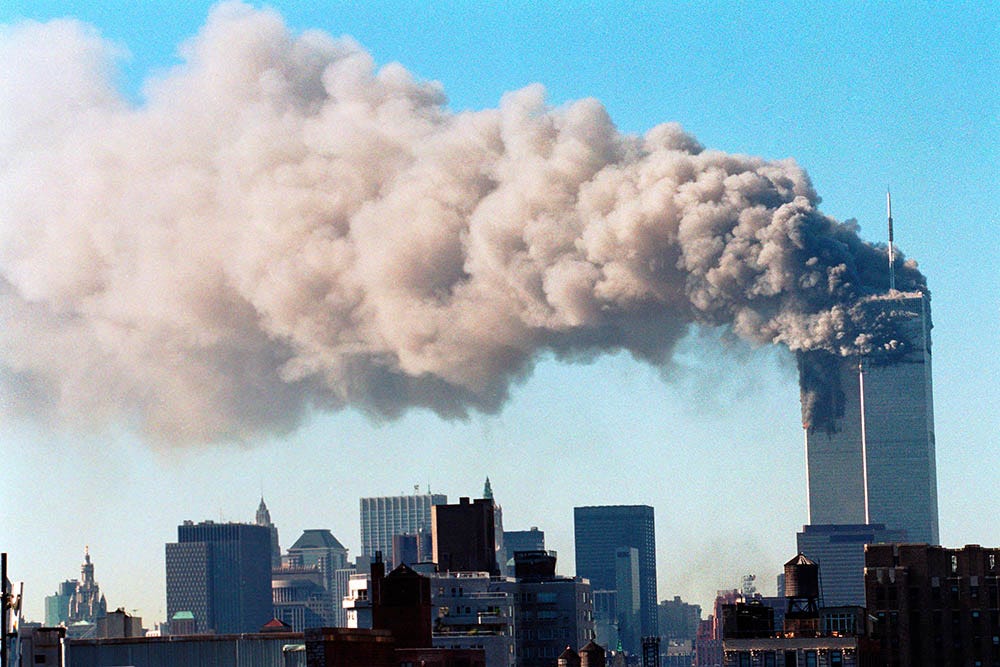
“The war on terror is a total fraud,” he stated emphatically. “There is no one to defeat. It’s endless because it’s designed to be. That way they can do whatever they want to the American people.”
Another disturbing aspect of the interview is Rockefeller’s portrayal of women’s liberation as a deliberate tool to break up families and increase tax revenue. According to Russo, Rockefeller admitted that the Rockefeller Foundation funded feminist movements not for noble ideals, but to achieve two main goals:
- Taxing the half of the population that previously didn’t work outside the home.
- Disintegrating the family structure by sending children to school at an early age, where they could be indoctrinated to view the state as their primary guardian.
This strategy, according to Russo, has had devastating effects on marginalized communities, especially among Black families in the United States, where illegitimacy rates have jumped from 10% decades ago to 90% today due to welfare policies that discourage men from being in the home.
Rockefeller also openly discussed with Russo the elite’s ultimate agenda:
- The reduction of the world’s population. He expressed concern that there was an excess of people on the planet and advocated for a drastic decrease in population, suggesting it should be cut in half.
- The implantation of microchips to control society. This chip, he explained, would serve as a universal identification system that would allow bankers and rulers to monitor and regulate every aspect of our lives. “It’s part of their plan to establish a centralized world government.”
- The elimination of physical money. These chips would store all of an individual’s financial and personal information, allowing absolute control over the population. “If you protest or rebel, they simply turn off your chip,” he warns. “Without access to money or basic resources, you instantly become a pariah.”
It’s astonishing to see how his 2007 predictions are materializing today. Indeed, all of these points have been fulfilled since 2021. People continue to die by the thousands around the world as a result of vaccines; microchips were already implemented in 2021, with the introduction of graphene-based nanotechnology; and the elimination of cash and the introduction of a currency are gradually being implemented in all countries.
Continuing the interview, Rockefeller hinted that those who possess certain privileges within this new order would have immunity from common laws. For example, he mentioned that there are special cards (“KMA,” or “Kiss My Ass”) that guarantee legal protection for members of the elite, exempting them from fines, arrests, and other legal consequences.
Perhaps Russo’s most forceful criticism is directed at the Federal Reserve, the central bank he claims is responsible for the United States’ massive debt and loss of economic sovereignty. He denounced the government’s borrowing from private bankers when it could issue its own interest-free currency.
The Origin of the Modern Crisis
Russo begins by pointing to a pivotal point in American history: 1913, the year the Federal Reserve was founded. According to him, this event marked the beginning of an economic and moral collapse that has brought the country to the brink. Before the creation of the Fed, Russo asserts, the United States lived in an era of economic stability without significant inflation. A dollar had the same value for decades, allowing families to plan their lives with confidence. However, since 1913, everything has changed.
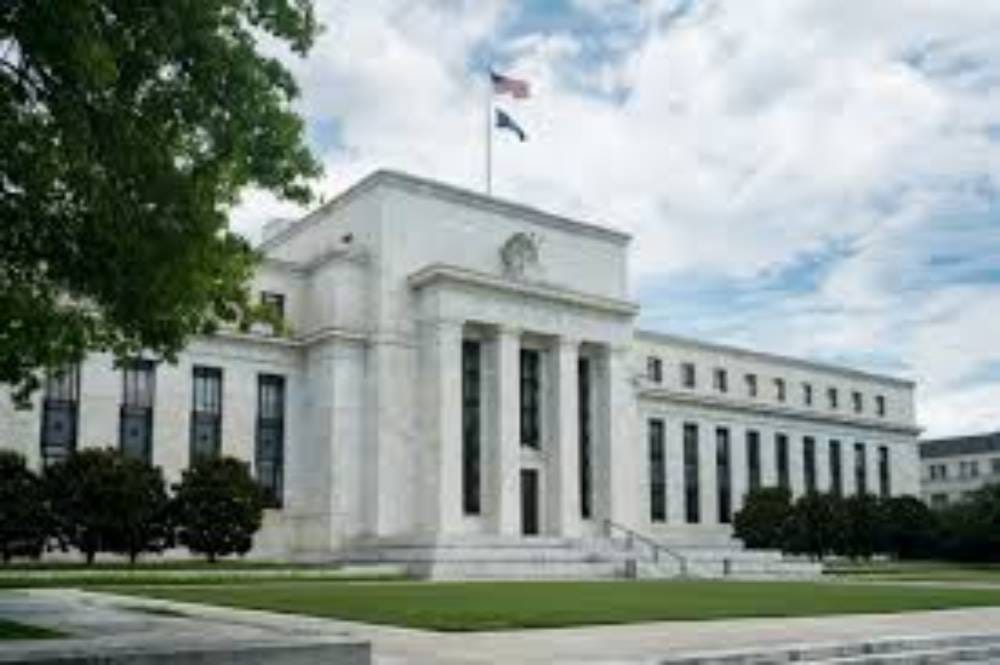
And make no mistake, this inflation is no accident. It’s a deliberate tool! By printing unbacked money, these bankers have devalued our currency, forcing the working class into deeper debt and becoming less competitive globally. This is a war on the middle class!
Russo doesn’t stop at criticizing only the Federal Reserve; he goes further, pointing out how this institution is interconnected with other global central banks. “The bankers own the United States Congress,” he declares, quoting Senator Dick Durbin, who publicly admitted that bank lobbyists have absolute control over Capitol Hill. But the dominance of these actors is not limited to the US. According to Russo, the Bank for International Settlements in Switzerland acts as the “central bank of all central banks,” coordinating efforts to establish a world government under the control of a financial elite.
This elite, made up of families like the Rockefellers, uses its influence to control and manipulate both the economy and politics, creating false divisions between left and right so that we don’t see the true puppet masters who are above all else. “It doesn’t matter if a Republican or a Democrat wins; both parties are bought,” Russo asserts. His vision is clear: to create a world where institutions replace people as the dominant actors, eliminating any vestige of individual sovereignty.
A Call to Action
The Rockefellers’ intention to promote a New World Order is not surprising to many. Their connection to the Rothschilds, who founded the Illuminati in 1770, suggests a continuity in a strategy that seeks to divide non-Jews (goyim) through political, economic, social, and religious conflicts, in order to weaken governments and institutions.
The Rothschilds played a crucial role in the formation of both communism and capitalism, fostering division and conflict among people. Currently, they appear to be moving toward the creation of a One World Government. They have penetrated Masonic society and instigated conflicts over the past 200 years, including significant events such as the French Revolution and both World Wars. They are also involved in the founding of organizations such as the European Union, the UN, the WHO, and the World Bank, as well as the World Economic Forum and the Bilderberg Club. In fact, they have influenced virtually every social movement throughout history. It is naive to think that such movements emerge spontaneously in the streets. A contemporary example of this is the current trend in which some women choose to grow mustaches or adopt features such as bushy eyebrows. This shows that fashions can be driven by much deeper interests than simple public whims.
They control virtually the entire world: the global economy, politics, and education through UNESCO, as well as the media, including major publications like The Economist. Their goal, since the 18th century, has been to establish a World Government controlling all aspects of society.
Their true purpose is not the pursuit of money, as they possess the ability to generate it at will. As Russo has pointed out on several occasions, their goal is absolute control, seeking to limit people’s freedoms in order to consolidate their power.
For Russo, the reality is clear: what we are experiencing is not a democracy, but a tyranny. He denounces that the American citizen—and, given that we live in a globalized world, all citizens of the planet—no longer enjoys individual freedom. We have been transformed into slaves of a deceptive system.
Despite the darkness of his revelations, Russo offers a message of hope. He firmly believes that change is possible if the American people decide to rise up against tyranny. “We must stop cooperating with the government and all the rules and regulations that oppress us,” he urges.
Russo also emphasizes the importance of educating the masses. His documentary, “Freedom to Fascism,” is a key resource for understanding how the system really works. In it, he exposes income tax fraud, judicial corruption, and the conspiracy behind the creation of the Federal Reserve.
We have been saying for five years that to understand what has happened and is happening in the world, we only need to view reality through the prism of the E Factor, a perspective that, like Russo’s revelations, helps us recognize that this world is run by a different species. When you understand this, you understand everything.
On the other hand, the dissenting voices in Europe should not be underestimated. Economists like Laiman and Ern Wolf, as well as MEP Christina Anderson, are speaking out. Anderson, in particular, has warned of the danger of progressive measures, claiming they seek to establish a technocratic regime where decisions come not from the people, but from unelected bodies. Her words are forceful: “We are facing the most dangerous totalitarian movement in history.” She represents a breath of fresh air in this bleak landscape.
Figures like Aaron Russo have been fighting to expose this truth. Let us follow his example! Let us not be afraid of being ridiculed for speaking the truth. Freedom is at stake, and silence is complicity. Remember the words of Edmund Burke, quoted by Russo: “Evil can only prosper when good men do nothing.”
Meanwhile, Russo’s warnings resonate louder than ever in a world plagued by economic crises, fake pandemics, wars, and invasive surveillance technologies. How far are we willing to let them go? It’s up to us to decide whether we accept remaining pieces on THEIR chessboard… or whether we take control of our destiny.
Full interview:
You can also access the latest news at this address: www.whatfinger.com
-
How Much Emergency Food Should You Keep at Home?

How Much Emergency Food Supply Do You Currently Have?
Calculating How Long Your Food Stockpile Will Last
To get the total number of days your stockpile will last, you need to take the:
Total calories in your stockpile ÷ Calories your family needs per day
Let’s start with the top half of the equation.
Calculating How Many Calories You Have
Ideally, your pantry is well organized, making the process much faster.
But if it’s not…perhaps this will allow you to do so…?!?
Because you’re about to take inventory.
Yup. Just like ALL successful retail businesses do regularly.
Now you may ask, “Should I count EVERYTHING” on my shelves?
If it’s shelf stable and you replace it regularly, then YES, count it.
Sure, some items will fluctuate as you use them up and then buy more.
But a snapshot of the shelf life stable calories in your pantry is “close enough” …
Obviously count all freeze-dried foods, MREs, canned meats, and #10 Cans.
Also, don’t count ANY calories in your refrigerator or freezer.
Power outages make freezers highly vulnerable disaster appliances.
The only exception is if you have a robust backup energy plan or you are already living off the grid.
A robust backup energy plan means having a Power station (or a generator with a few weeks of fuel).
Otherwise, I DON’T count your refrigerated and frozen goods.
I used a simple spreadsheet for this to help make the calculations easy. Plus, I can sort and filter as needed later with a spreadsheet.
MUST WATCH BELOW!!!
Food Confiscation: How to protect your food stores and production from government confiscation
Take Advantage of Our 40 Years Experience Living Off The Grid and Turn Your Home Into a Self-Sufficient Homestead
(Step by Step)The Only Video You Need to Become Self-Sufficient on ¼ Acre


Start by making a few columns titled:
- Food – Brand
- Number of items (pouches, bags, containers)
- Servings Per Container
- Calories per Serving
- Total Calories
Once you fill out an entire row with that info, multiply the “number of items” by the “servings per container” by the “calories per serving.”
This will give you the number of calories you have in your inventory for THAT specific food item.
Now, you need to be careful here.
I added the Brand to the first column because not ALL brands use the same servings/calorie info.
For example:
Separate Brands of canned beans may seem identical but often are not.
The difference can add up, especially if you have a lot of dried beans…
Now, IF the foods are the same, AND the info per serving is the same, you can put them in the same line.
Otherwise, if any of those numbers are different, add a new line item.
Now keep going and inventory everything that makes sense for you.
Once done, you should add up all the calories.
And now you know exactly how much non-perishable food you currently have.
This calorie number may seem massive if you’ve got a decent-sized stockpile.
Perhaps even a few hundred thousand calories, like 358,753 or something like that.
WOW. Massive, right? Not so fast…
Having your total calories may seem like an important number to know, but it’s not all that helpful…yet.
Why? Because it’s relative to the size of your family, right?
For example, 358,753 calories is a stellar long term food storage for a retired couple of 2.
But what about a growing family of 5? Not so much.
That’s why we need to figure out how many calories YOUR family consumes each day…
How Many Calories Does Your Family Need Per Day?
At first, this may seem like a difficult task, but with the proper tools, it’s easy.
You must figure out how many replacement calories each family member needs daily.
- And this is NOT the same for males and females.
- It’s also NOT the same for babies, kids, young adults, adults, or mature adults.
- And it’s NOT the same for those who live an active or sedentary lifestyle.
You need to consider ALL 3 of these variables to make an educated guess.
The good news is I created a simple chart to do just THAT.
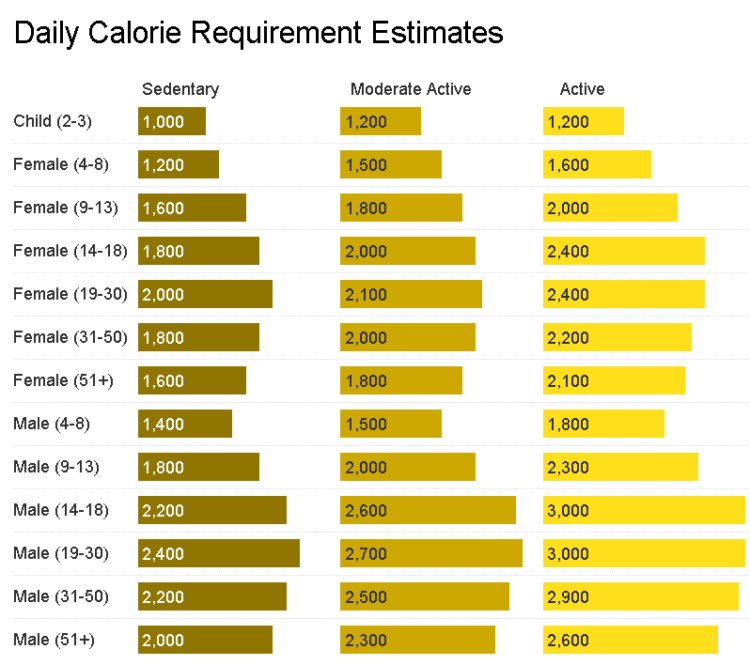
You can use this chart to determine your sex, age, and activity level for each family member.
Then add up each number.
The TOTAL is how many calories you’re family needs per day.
Now, THIS is a very good number to know!
This is the number you need to figure out how long your food stockpile will last.
Your Final Calculation
Take your total calories and divide by your family’s daily calorie requirement.
Viola! THAT new number is a very good approximation of How Long Your Current Food Stockpile Will Last.
Perhaps your number is 58.63 days?
That means you’re very close to having 2 months’ worth of food in your emergency stockpile.
Now, of course, you may be able to ration those calories a bit in a longer-term emergency.
But I don’t recommend “rationing” your calculation.
Why? Because I’d rather underestimate the duration of my stockpile by a few days and NOT the other way around.
Said another way, I’d rather be pleasantly surprised…
You now know how long you have before starvation begins after the grocery store shelves go bare.
I highly recommend this book! Here’s just a small glimpse of what you’ll find in The Lost SuperFoods:
The US Army’s Forgotten Food Miracle And 126 Superfoods That You Can Store Without Refrigeration for Years
The video below will shock you because you will be among the first to watching this secret!
We can now finally circle back around to the original question:
How Much Emergency Food Should I Have?
Ok, are you ready for YOUR answer? Do you have a pen and paper ready?
A minimum of 2 weeks and a maximum of 1 year…
I can hear you booing at me already…
You were probably hoping for something a bit more specific, weren’t you…
Like most things, everyone’s situation, risk tolerance, and resources vary.
I can hardly give a more specific answer for everyone.
But I CAN do better than THAT.
So let’s break things down into a few different categories.
Only then can we zero in on something more meaningful.
Here are a few categories:
- Those ONLY Worry About High-Frequency, Short Term Natural Disasters
- Those Who Worry About Medium Term Disasters (natural and/or manmade)
- Those Worried About an Extensive Lawless, SHTF Type Event…
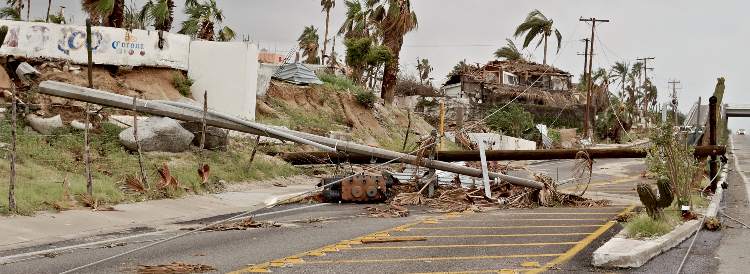
1. Those Worried About Shorter-Term Natural Disasters
Some folks are mainly concerned with short-term natural disasters.
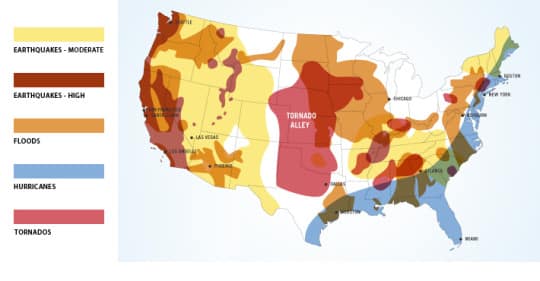
They don’t accept that the world is becoming less stable and more uncertain by the day.
They deny the risk of major societal upheavals is rising.
That’s NOT me, but hey, perhaps that’s you.
Well, in this case, you need to get 2 weeks’ worth of survival food in place.
That’s the bare minimum, in my opinion.
Any less, and you’re not living up to your primary adult responsibilities.
I recommend 2 weeks as the first target for 2 reasons:
- It’s meaningful – gives you a basic level of resiliency
- It’s achievable – everyone can hit this mark in a short period of time
Sure, some folks will scoff at only 2 weeks of emergency food.
But it’s actually a solid start, good for MOST likely emergencies we’ll all encounter year in and year out.
And it’s way more resilient than MOST people…
53% of Americans admit to having less than 3 days’ worth of nonperishable food and water.
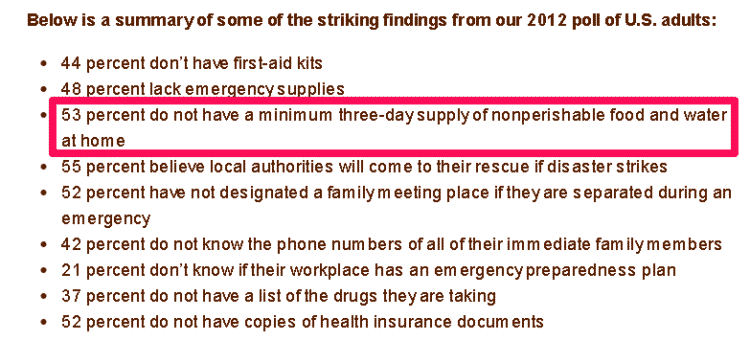
That’s gross negligence!
Sorry but if you have only 2 or 3 days of short term food, you’re completely fragile.
You’re dependent on handouts in a crisis.
This is unacceptable and irresponsible.
So, get 2 weeks, and then I’ll stop the name-calling…
And perhaps I can encourage you to shoot for a month.
A month is so much more resilient than 2 weeks.
At a month’s worth, you’ll be able to ride out 99.9% of natural disasters.
And you’ll also have a bit of extra resiliency to civil unrest, chaos, famines, etc.
2. Those Worried About Medium-Term SHTF Disasters
Ok, this category is for those who don’t feel like 1 month is enough,
But also think a SHTF-type event way worse than the recent pandemic is zero…
I mean, the more widespread and the longer the emergency crisis, the LESS likely it is to occur, right?
It’s simple statistics.
Yet, I believe there’s a greater than zero chance we do have a SHTF event in our lifetimes.
Why? Because the world is getting more vulnerable as:
- technology advances at a breakneck pace
- the world becomes more and more interconnected.
So, what’s “reasonable” for someone who sits between the two extremes?
I recommend somewhere between 3 and 6 months.
That solid supply of calories will keep you fed for ALL but the most unlikely doomsday events.
3. Those Worried About a Worst Case-SHTF Type Event…
Well, here we are…the resilient few.
Those of us who think there’s a non-zero chance of life as we know it coming to an end in our lifetimes.
We tend to see our emergency food stockpiles as cheap self-insurance.
A policy you own that lasts up to 25 or 30 years if done right.
So why not go big and sleep really well at night, even as the world continues to crumble?
To enter this realm, you’ll be targeting at least 1’ year’s worth of emergency food…
Now perhaps we’re NOT there yet, but that’s ok; 1 year is an excellent goal.
You can do more if you’d like, heck, 2 years if you’re really dedicated.
But after you hit 1 year, your time and energy are better spent elsewhere.
At that point, I recommend focusing on skills to bring more calories into your storerooms.
I’m talking about:
- Canning, Gardening & Seed Saving
- Foraging and Gathering
- Hunting & Fishing
- Farming & Raising Farm Animals (chickens, rabbits, goats, etc.)
- Aquaponics
These more advanced prepping techniques.
Why? Because they not only give you a runway should grocery store foods go bare.
They extend your calorie runway into the future.
If all you do is stockpile (without adding any new calories), then your time to starvation is on a countdown clock.
You keep adding calories back into your stockpiles.
This helps to extend that time to starvation even longer into the future.
If you ever get to more calories in than out, you’ll never starve, right?
Dispelling The 5 Most Common Stockpiling Amount Myths
I’ve heard a lot of misconceptions about this topic.
Let’s set the record straight:
Myth #1: “I only need a month’s supply.”
A one-month stockpile just won’t cut it.
Emergencies can last longer than that, and you don’t want to be caught with empty shelves.
Aim for at least three to six months’ worth of food to be truly prepared.
Myth #2: “Canned goods will last forever.”
While canned foods have a long shelf life, they don’t last indefinitely.
Over time, the quality and nutritional value can degrade.
Rotate your canned goods regularly and check expiration dates to ensure you have fresh supplies.
Myth #3: “I’ll survive on MREs and freeze-dried meals.”
While these are convenient options, relying solely on MREs and freeze-dried meals can get expensive and monotonous.
Diversify your stockpile with staples like rice, beans, and pasta to create a balanced and sustainable food reserve.
Myth #4: “I’ll catch or hunt for food during an emergency.”
Hunting and fishing can be great survival skills, but they’re not guaranteed sources of food.
Wildlife can be scarce, and fishing might not yield results every time.
Stockpile food as your primary source and use hunting and fishing as supplementary options.
Myth #5: “I’ll just grow my own food.”
Gardening is a valuable skill, but it takes time and effort to yield a significant harvest.
Plus, it’s season-dependent.
Don’t rely solely on your garden; have a well-stocked pantry to bridge the gaps.
Final Thoughts
Everyone reading this needs to build a stockpile a food (and gallon of water) that will last at least 2 weeks
No excuses!
Once you get there, I recommend you keep building for up to 1 month.
And if you want even more protection, try to get to the 3 – 6 months window.
Or perhaps you want lots of food security.
A nice long runway to give you ample time to let the post-modern world sort itself out – then go with 1 year.
After that, move to advanced skills such as farming, raising animals, aquaponics, etc.
Ok, if you’re ready to get started, you should check out my review of Valley Food Storage or watch the video below:
Remember, folks, it’s better to have more food than you need than to come up short during an emergency.
Plan and prepare for the unexpected, and you’ll have peace of mind knowing your family is well-fed.
Imagine it’s 2019 and someone told you that a worldwide pandemic was going to start soon… A Coronavirus would spread around the world, overwhelming hospitals and causing quarantines, lockdowns, and millions of deaths
You would have thought the person was completely crazy, right?
The video below will shock you because you will be among the first to find out the truth!
-
Gray Man- In The Immediate Aftermath of a Disaster or in a Post-apocalyptic Scenario, The Ability to Conceal Yourself as a Gray Man Can be an Extremely Useful Survival Skill.

The gray man theory is a way of disappearing into the crowd so you can move unnoticed when disaster strikes. The idea is that you can conceal your preparedness by blending in with the crowd before or during an emergency.
While it is generally referred to as the ‘gray man theory,’ this theory can, of course, be applied to anyone, man or woman, of any age, who needs to blend into a crowd amidst a disastrous situation to conceal the fact that they have survival skills and/or are carrying tactical gear.
When you think of ‘blending in with the crowd’ it’s generally a negative, right?
Nobody wants to be just like everyone else. You want to be unique, to stand out – that is, until there’s an emergency and you’re the only one prepared. As a prudent prepper, you’ll be ready when disaster strikes, but what will everyone around you be doing?
Panicking, most likely.
In states of panic, people become desperate, and desperation can lead people to do whatever it takes to stay alive – at this point, you certainly don’t want to be singled out as the one person prepared for survival.

Why Use the Gray Man Theory?
There are lots of advantages to blending in with the crowd when disaster strikes.
For starters, by not drawing attention to yourself, you’ll be able to move more quickly and easily through the crowd without alerting others to the fact that you are prepared to handle the situation.
Also, by blending in and appearing to be among the unprepared, you are less likely to make yourself a target of those in desperation who may try and take your survival gear off you by force.
The gray man theory is really about protecting yourself and your family by concealing the fact that you are indeed prepared to survive in the face of disaster.

The Benefits of Being a Gray Man
In a true disaster situation, your primary objective will be to move yourself and your loved ones as quickly as possible to a safe place – be that your home or bug-out location.
In a disaster, everyone around you will have the same goal – get somewhere safe – but most will not have a sound plan in place, leading to frantic behavior and desperate attempts for survival.
In this situation, disappearing into the crowd and not drawing attention to yourself or your state of preparedness can greatly increase your chances of survival.

As most around you will be unprepared for disaster, you will undoubtedly feel the urge to help those in need. However, your number one priority needs to be your own survival, and you should only help others if you can do so without endangering yourself.
By blending in, or becoming a gray man, you will be less likely to be approached by others seeking assistance and, more importantly, less likely to be targeted by opportunists looking to prey on those with the forethought to pack essential items for survival situations.
How To Be a Gray Man
The best way to not leave a lasting impression is to not leave any impression at all.
This is the concept behind the gray man theory, and it sounds simple enough, but execution can be challenging.
This guide will cover the basic concept behind the gray man theory and provide some key tips and tricks for effectively making yourself ‘invisible’ in a disaster scenario.

Steps to Becoming a Gray Man (or Woman)
The ultimate goal of becoming a gray man or woman is to camouflage yourself into appearing as though you are just part of the crowd to prevent others from identifying you as a potential gold mine of supplies or information. By exuding confidence and preparedness, you will draw in opportunists who will attempt to capitalize on your resourcefulness to the detriment of your own survival.
To conceal the fact that you are prepared with survival gear and skills from others, there are four key areas you will want to focus on: how you act, how you move, how you look, and how you carry your gear.
How You Act
The key to acting as a gray man is to appear average and non-threatening. Be careful about what you say and to whom you say it – being known as strongly antagonistic or too outspoken about your political beliefs can lead others to make assumptions about you and mark you as a prepared individual.
Maintain conversation topics within the norm of the group. If small talk seems to be the normal thing to do, engage with others to not draw attention to yourself.
While a good understanding of your surroundings is paramount in a disaster, be careful to play down any attempts to scan areas for escape routes or possible problems with security. This type of behavior will be noticed and lead people to question what you’re looking for, or worse, what you’re trying to protect.

One important skill to learn in adapting a gray man persona is maintaining your privacy without appearing overly private or obviously standoffish. When speaking with others, keep eye contact to a minimum as someone is more likely to notice you if they look in your eyes. Even brief eye contact when passing on the street can form a connection, making you more memorable than those around you.
How You Move
Knowing the local landscape can be a tremendous advantage as the better you know local streets and landmarks, the better able you will be to navigate them and alter your route to avoid troublesome areas. When moving, appear as much as possible to go with the flow, walking with purpose but not urgency. Any rapid motion will draw attention to you and raise suspicions as to your motives.

When navigating a crowd, make gradual progress – cutting through a sea of people at sharp angles will draw attention to your movements and make you appear suspicious. Whether others perceive you as a savior or threat, either one can slow you down.
Unless it would impede your own safety, always appear to follow the herd. For instance, if everyone around you turns towards an explosive sound and gasps, join them. You don’t ever want to be the one person who is unaffected by an out-of-the-ordinary event.

If you need to break away from the crowd, try and make your exit alongside a small group of people, keeping enough distance so that they know you’re not with them but close enough that you don’t appear to be alone, which makes you appear less vulnerable.
When observing your surroundings, be as discreet as possible. Leverage your peripheral vision as well as decoy objects, such as a piece of paper, to give the impression your attention is focused on the object as you survey the area. If appropriate, wear reflective sunglasses that hide your eyes, allowing you the freedom to scan rapidly without drawing attention.

If you need to engage in activities that will make noise and draw attention your way, try to take advantage of predictable noises to help mask the sound of any breaching you may need to do. Predictable noises include ‘white’ noises that people are accustomed to hearing and therefore raise little suspicion.

For instance, wait for a loud bus to pass before climbing into a dumpster or synchronize busting a window with a loud siren. If you need to get into a building, choose a door near a noisy HVAC condenser. These preparations may take a little bit of extra time to execute, but those few moments of patience will ensure your activities go unnoticed and may save your life.
How You Look
It goes without saying that when trying to appear less prepared than you are, camo prints or other outwardly tactical-looking clothing are not the best choice, unless of course, you are in a situation where that type of dress is the norm, such as a hunting trip.
While you don’t have to dress head-to-toe in gray, subtle color choices blend best into crowds and make it easier for you to move unnoticed.

Ideally, you will want to keep any tactical gear concealed. This means packing your pockets and bags strategically to allow for quick access to key items. Reflective objects and bright colors will draw visual attention so ensure items such as your knife are tucked inside your clothing or bag, not hanging from your belt.
Avoid having any reflective materials or highly visible colors on your clothing and accessories, as well as any large text or memorable insignia. Any focal points can draw attention to you and hinder your attempts to blend in.

If possible, carry an additional item with you that can instantly change your look, such as a hat, sunglasses, or jacket, as this can be quite helpful. If someone does happen to peg you as a target, you can use the item to slip under their radar as they scan for you in a crowd.
One last word of caution – be mindful of the way you smell. Yes, smell. Believe it or not, scent is a major memory trigger, so try not to have a noticeable scent about you when trying to blend in.
How You Carry Your Gear and What You Carry
The simplest solution to carrying your gear unnoticed is to find a discreet every day carry bag that blends well with your typical daily routine. Backpacks and messenger bags commonly seen on commuters are good choices as these tend to be less obvious. You can also find pocketbooks with compartmentalized interiors that can make it quick and easy to access your gear.

Another good choice that lends itself well to blending is a jacket or vest with a streetwear outward appearance but hidden storage on the inside. Pants with pockets, especially cargo pants, are excellent for storing gear but may not be the most appropriate choice for people who work in an office with a formal dress code.
The gear you carry with you daily should also be discreet if you want to be a gray man. For example, for self-defense, you may opt for a tactical pen or a discreet folding knife such as the Boker Subcom folding knife, which can even double as a money clip.
A compact flashlight such as the Fenix E05 is so compact it can easily be carried on a keychain without attracting.
Conclusion
In the immediate aftermath of a disaster or in a post-apocalyptic scenario, the ability to conceal yourself as a gray man can be an extremely useful survival skill. The last thing you want is for all your time and effort put into prepping to be for naught by having your supplies taken off you by someone less prepared and more desperate.
To improve your gray man abilities, observe the way people dress and act as you go about your day – what stands out, what makes various people noticeable? This can help you hone in on the objects and behaviors that draw attention.
Combining this knowledge with the four key steps to becoming a gray man will put you well on your way to being able to ‘disappear’ into any crowd and increase your chances of survival when disaster strikes.
-
U.S. Crisis! What is Now Happening to America’s Farms and Food Supply…

For decades, the United States has been a global leader in agriculture. Yet, troubling trends are emerging that put the nation’s food security and independence at risk. As highlighted in a recent interview with Zack Wyatt, Founder, President, and CEO of Carolina Farm Trust, America is growing less of its own food and becoming increasingly reliant on imports. Here, we unpack the challenges, contributing factors, and what Carolina Farm Trust is doing to rebuild resilience in the food system.
Alarming Trends in U.S. Food Production
The U.S. Department of Agriculture (USDA) reports a significant decline in fruit and vegetable production over the past two decades. Fruit production has dropped by a staggering 36%, and vegetable production has decreased by over 6%. These declines are not just numbers on a chart; they represent a growing vulnerability in our food system.
So, what is driving this shift? Wyatt points to the complex economics of farming. “Fruit and vegetable farming is very difficult,” he explained during an NTD Newsroom segment. “With Hurricane Helene coming in and really kind of wiping out a lot of the western North Carolina… it’s very challenging to rebuild something that was already almost broken.”
Why Are Farmers Leaving Fruits and Vegetables Behind?
Small-scale fruit and vegetable farmers face immense challenges, including:
- Perishability: Produce spoils quickly, requiring costly logistics and labor-intensive handling.
- Market Competition: Foreign imports, often cheaper, undercut local growers.
- Economic Disincentives: Government subsidies favor commodity crops like corn, wheat, and soybeans, which are less labor-intensive and more profitable.
“It feels like the system incentivizes small farmers to go out of business,” Wyatt remarked. As these farmers exit the market, the U.S. becomes more reliant on imported fruits and vegetables—primarily from Mexico. This reliance not only affects our economy but also increases our vulnerability to global supply chain disruptions.
Historical Policies and Their Impact
The North American Free Trade Agreement (NAFTA) and its successor, the United States-Mexico-Canada Agreement (USMCA), aimed to streamline trade. However, they also made it harder for U.S. farmers to compete with imported goods. Combined with inflation and rising operational costs, many small-scale producers find it nearly impossible to survive.
Why It Matters: Food Security and Sovereignty
Wyatt articulated a critical point during his interview: “The more reliant we are on importing food, the more we’re reliant on power. If we can’t feed ourselves, what happens next?” This growing reliance on imports jeopardizes America’s ability to independently nourish its population. In times of crisis, such as natural disasters or geopolitical tensions, the consequences could be catastrophic.
Carolina Farm Trust: Building a Resilient Food System
Amidst these challenges, Carolina Farm Trust (CFT) is stepping up to protect the future of American farming. Guided by four pillars, CFT addresses systemic issues head-on:
- Urban Farm Network: Establishing accessible, community-focused farms that bring fresh produce to urban areas.
- Farm Apprentice Program: Training the next generation of farmers to sustain agricultural knowledge and practice.
- Food as Left Program: Partnering with senior nutrition initiatives and transitional housing programs to provide nutritious, locally sourced meals.
- Distribution Platform (CFT Market): Creating a streamlined way for local farms to get their products to market, ensuring fair compensation and reducing food waste.
Each initiative works toward the shared goal of restoring trust in local farming while empowering communities to prioritize nutritious, sustainable food sources.
Local Farms Are Key
Regional farms in the Carolinas are the cornerstone of Carolina Farm Trust’s work. Partner farms like Barbee Farms and Boy and Girl Farm are pivotal in producing fresh, high-quality food. Supporting these farms means more than providing meals; it means safeguarding a vital part of the region’s food independence.
The Power of Community
Carolina Farm Trust relies on the collective efforts of farmers, volunteers, and donors to create a sustainable, community-driven food system. Your contributions directly support initiatives like the CFT Market’s innovative distribution platform, which connects regional farmers with the Charlotte community. This platform not only provides a reliable market for farmers’ products but also strengthens the local food ecosystem by reducing dependence on imported produce. Every dollar donated ensures that fresh, local food reaches underserved communities while empowering farmers to thrive in a resilient, regional network.
The challenges facing American agriculture are daunting, but they are not insurmountable. Carolina Farm Trust’s innovative programs and unwavering commitment to regional farmers are paving the way for a more secure food future. However, none of this is possible without your support.
Join Us in the Fight for Food Security
Your donation today can ensure that farms thrive, communities are nourished, and America retains its ability to grow its own food.You can also access the latest news at this address: www.whatfinger.com
-
Extreme Starvation Triggered Food Lines Miles Long… “Honest” Citizens Transformed Into Criminals… And Demonstrations And Looting Became An Every Day Threat!
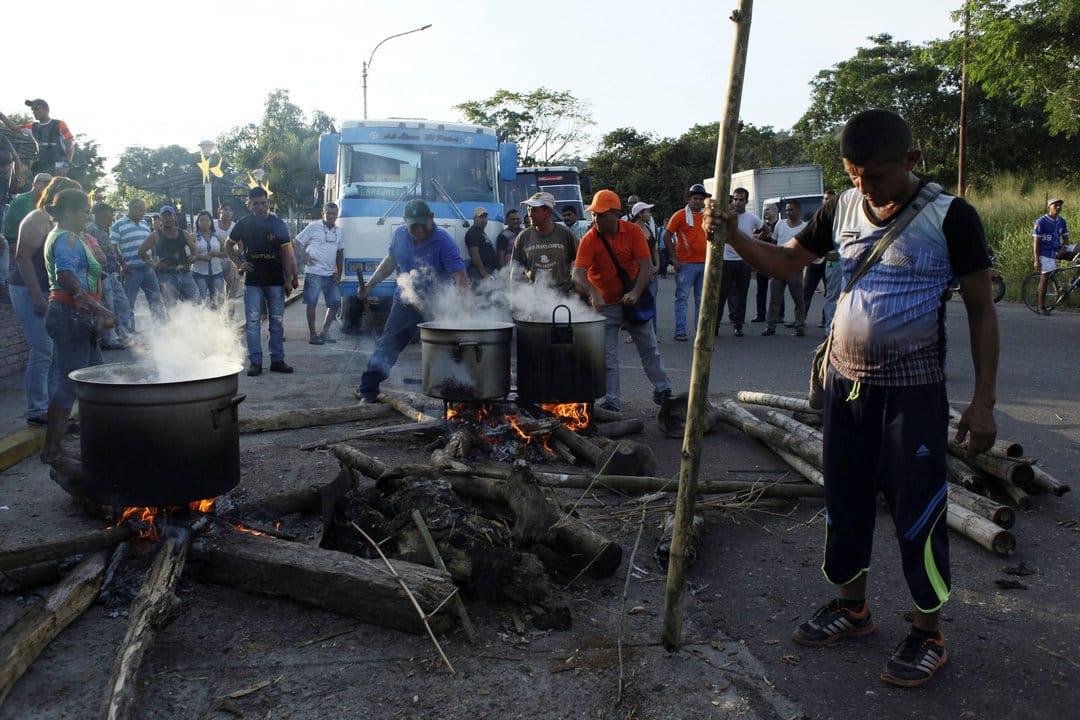
As a prepper, I’m continuously looking for “intel” that can help me be more self-reliant and a better protector of myself and my family.
Truth is, it’s all around us – but often invisible to those who are blind to see the subtle lessons that real life makes available for us.
Take Venezuela for example…
By now, it’s become one of the most humorous (or humorless) comments ever suggested on national television…
Trump’s debate comment about Haitian immigrants “eating dogs and cats” – thrown out as political “fear-porn” – first shocked, and then amused, a head-scratching American public.
But while many may laugh at this shocking statement as “extreme” and residents of the Springfield, OH town deal with the fallout of the political theater, the background to this concept is more real than most even know about.
Gone Viral! The most shocking videos in the world... The US is Facing The BIGGEST Threat Of The Century

The video below will shock you because you will be among the first to watching this secret!
You see…
Eating Dogs And Cats Isn’t A “Culture” Thing – For Venezuelans During Their Economic Collapse, It’s Been A “Forced Survival” Thing, And…
Here’s What The American Public Will Never “Get” About Doing The Unthinkable When Your Life Is On The Line…
It’s no secret that Venezuela has been a petri dish for observing the various stages of “collapse”.
Once an oil-rich country, a combination of factors – including poor leadership, government corruption, and economic mismanagement – triggered a downward spiral that began in 2010 and has affected the life of the average Venezuelan on all levels…
- More than half of Venezuelans didn’t have enough income to meet their basic food needs.
- By 2021, 95% of the population was living in poverty
- 77% of these lived under extreme poverty
- 20% of Venezuelans (5.4 million) had left the country just to find a way to feed themselves and their families
Chants of “We are hungry!” echoed through the streets of Venezuela and in front of barren supermarkets.
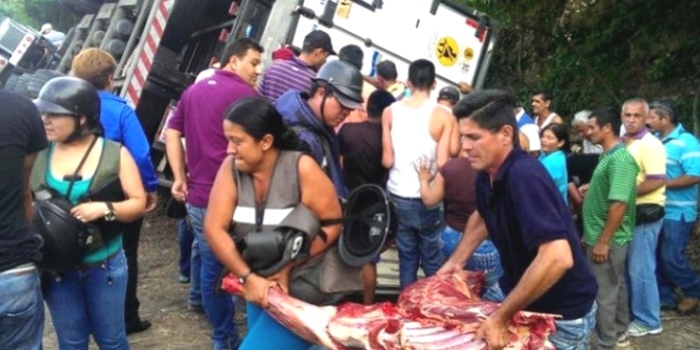
Photo: solo-clic.com People resorted to hunting dogs, cats, pigeons, and anything they can capture in order to put food on their family’s table.
Delivery trucks were stopped at rogue checkpoints and looted for the food and other supplies they contained.
There were even verified reports that citizens were “hunting” zoo animals as these wild beasts started to waste away behind the fences of public attractions that could no longer care for these animals.
In our modern society where hot meal is just a cellphone call away for a fast delivery, extreme poverty and hunger is a foreign concept for most Americans.
It’s easy to say what you “would” do under such extreme circumstances – but the fact is, you don’t know, until you HAVE to know.
And Venezuelans know what this life looks like…
By 2017, Almost 75% Of Venezuela’s Population Had Lost An Average Of Over 19 lbs Due To Lack Of Food!
Extreme Starvation Triggered Food Lines Miles Long… “Honest” Citizens Transformed Into Criminals… And Demonstrations And Looting Became An Every Day Threat!
The ultimate end-result for Venezuela’s collapse comes down to “survival” at its most basic nature.
The secrets of a woman who decided to live in the wilderness!
By watching the video below you will come across: 40 Bizarre Home Remedies Our Grandparents Taught Us That Actually Work

Food at supermarkets went from insanely expensive… to scarce… to gone.
Looting of grocery stores pharmacies, shopping malls, and food delivery trucks have become common as food supplies have dried up into a state of emergency.

And while looting grocery stores has been “accepted” by the citizens, stealing from individuals has turned violent.
In one case, a man who was caught robbing fellow citizens was the victim of “mob justice” when passers-by beat him and set him on fire before police could arrive.
Not only is this a stern warning sign that hard times are ahead… but it also gives you a glimpse into how people, governments, and “security” will react in the absence of basic resources.
Now, if you’ve made it this far in the story, you may be thinking that this could never happen in the good ‘ol US of A, right?
Well Warrior, think again…
The Fact Is, The U.S. Is Always Just One “Trigger” Away From Being Neck-Deep In Our Own “Collapse”, And The Question Is…
How Far Would YOU Go To Feed Your Family When You’re Watching Them Starve Right Before Your Eyes?
Most people have no clue that most American cities and towns operate on a 3-day resupply cycle of food.
That means that during any disruption in our supply chain (from financial collapse, blackouts, disasters, etc.), it only takes 3 days to go from calm… to complete chaos!
Grocery store shelves will be cleared out in a matter of hours when people realize food is scarce.
Endless “food lines” will pile up at markets and distribution points handing out smaller and smaller portions.
If your children or grandchildren were hungry and there were no resources to feed them…
Would you resort to stealing in order to keep them alive?
Would you join the throngs of protesters demanding the government “do more” to ensure you’re not going to bed hungry?
Would you eat a dog? A cat? A pigeon? A lion?
You may say “Of course not!”
But how do you know?
If You’re A Carrying Parent Or Grandparent Like Me, There’s Only ONE Answer When A Collapse Transforms Life As We Know It And It’s “Every Man For Himself”…
Fortunately, The #1 Thing You Can Do To Safeguard Your Family From “Venezuelan-Like Starvation” Is ALSO The Absolute EASIEST To Plan For…
The bottom line reality is that, if you don’t have food to feed your family, you are guaranteed to suffer the same fate as the unprepared citizens of Venezuela.
But if you take care of this very simple survival factor now, then you’ll NEVER have to worry about having to steal for your family… begging for handouts… being attacked at the grocery store… or forced to eat dogs and cats.
You can start out small and build from there.
Even just simply buying “one more” item of canned food your family already eats at each trip to the grocery store can quickly fill your pantry with life-saving nutrition.
A better option is to invest in a small chest freezer to buy more foods in bulk that will make stockpiling your food cheaper and make it last longer.
Of course there are some “cons” to this as well, because if you’re forced to leave your home when things heat up in your area, you won’t be able to take an entire freezer of food with you.
And if there’s a significant power-outage (such as a grid-down blackout “trigger”), that food will spoil over time.
This is why the best strategy I absolutely recommend is to set aside at least some of your budget for long-term “survival food” that’s more mobile, tastes great, and has the nutrition you and your family need during hard times.
Your Neighbors Will NEVER See This Coming (But YOU Will…)
It’s true – Everyone you know probably thinks their local grocery store has an endless supply of food for our future.
You and I both know that’s a dangerous belief – but it’s even worse than you realize…
In fact, recent news reports have uncovered a sinister plot by our enemies (happening right under our noses!) and it’s about to be the downfall of every American who doesn’t see it coming!
Whichever route you take, I can’t stress enough that this is the very first thing you need to take care of to keep your family safe during a crisis or collapse.
The scenes that came out of Venezuela’s collapse are very real… and should be a serious wake-up call to every American as the threat of our own financial collapse looms in the near future.
The key is to start NOW so it’s not a huge expense all at once… and you don’t wait until it’s “too late”.
All Americans Will Lose Their Home, Income And Power By March 27, 2025
Watch the video below!

What Prepping Strategies Have You Found To Be The Most Helpful In Building Up Your “Survival Food Pantry”?
Please Share Your Best Tips, Tricks, And Tactics Below Now…


-
Subscribe
Subscribed
Already have a WordPress.com account? Log in now.
 Site Title