-
lesson For the New Generation- First causes of the Asian economic crisis that led to the denouncement of the Fixed Exchange Rate in 1997

Lessons from the Asian Financial Crisis brings together the leading minds in the worlds of finance and academia to dissect the crisis. Divided into three comprehensive sections-The Subprime Crisis; The Global Financial Crisis; and Law, Regulation, the Financial Crisis, and The Future-this book puts the events that have transpired in perspective, and offers valuable insights into what we must do to avoid future missteps.

The Asian Financial Crisis began when the Baht was faced with significant speculative pressure resulting from imbalances within the Thai economy at the time. Prior to the crisis, there was significant inflow of private capital into Thailand, stemming from loans for investments, particularly investments in the real estate sector. This created an asset price bubble, which led to increased capital and debt. At that time, Thailand carried out monetary policy under a Fixed Exchange Rate Regime. Although such policy created stability for financial markets; however, it also led lenders and borrowers grossly under estimated the risks associated with capital inflow. This led to an imbalance between the banking sector’s financial instruments and debt and an imbalance between the amount of foreign currency in the private sector’s balance sheets. Such excessive borrowing turned into a vital weakness in the economic system. Importantly the imbalance in the banking sector’s financial instruments was “short term loans and long term investments”. In other words, short term borrowing of foreign funds but providing long term loans to domestic infrastructure projects. Such imbalance exacerbated the risk to the economy to capital outflows.
On the other hand, persistent high economic growth (i.e. the Golden Era) of the Thai economy contributed to the banking sector’s inability to adequately assessed risk and credit regulations lacked robust considerations of various risks. This included rules and regulations for Financial Institutions that were not restrictive enough. For example, easily providing approval license to establish financial institutions, which resulted in abundant bankruptcies or forced shut downs of such financial institutions once faced with liquidity issues from foreign outflows. This led to a financial crisis that impacted the economy and general public on a wide scale.
The TomYam Kung crisis was the worst crisis in Thailand’s modern economic history. Despite occurring 25 years ago, the Thai economy still has remaining “scars” from TomYam Kung. Therefore, deciphering and passing on the lessons learnt from the crisis will not only help the “new generation” learn to avoid and prevent a similar crisis to occur to the Thai economy, but will also alleviate current economic problems as well.
Cause of the Crisis
The cause of the economic crisis that led to the denouncement of the Fixed Exchange Rate and led to a float in the Baht in 1997 are as follows:
1. Persistent Current Account Deficit
1987-1996 was a period where the Thai economy expanded continuously and the Current Account deficit consistently increased and stood at 14,000 million USD prior to the crisis. This was a result of significant decrease in exports in 1996 (where exports only grew by 1.9%, compared to 24.82% the year prior, and was the first significant deterioration in exports since Thailand changed its economic development strategy in 1977 that emphasized production for exports).
2. Foreign debt
Between 1989-1994 Thailand went through financial liberalization which allowed the country access to foreign capital with ease, without any exchange rate risks since the Baht was pegged at 25 Baht/USD. Borrower could take out and return loans as a result of Thailand’s acceptance of Article 8 of the International Monetary Fund in 1990 to open Thailand’s financial system to the international community. Furthermore, in 1991 Thailand announced the relaxation of foreign exchange. Finally, in 1992 the government permitted commercial banks to establish the Bangkok International Banking Facilities (BIBF). After which, in 1993, 46 commercial banks were granted operating licenses, resulting in an expansion of the country’s financial system leading to an increase in Non-Performing Loans (NPLs) within financial institutions and an increase in loans from foreign financial institutions for domestic purposes.
Towards the end of 1997, Thailand’s international debt increased to 109,276 million USD, particularly short term international debt which comprised 65% of total international debt and the ratio of international reserves to short term debt stood at only 70.4%. Furthermore, the majority of financial institutions had not managed their exchange rate risks.
3. Excessive investments and Real Estate Bubble
Between 1987-1996, real estate business expanded significantly both in terms of land, residential, offices, and expensive condominium, because producers borrowed funds from abroad and raised capital in Thailand’s booming stock market to invest in real estate across the country with ease. Furthermore, continued increased in real estate prices led to speculation and incentivized significant investors into the sector, such as sales of housing reservations, land, condominium until an economic bubble was embedded into the economy.
4. Lack of efficiency in Financial Institutions’ operations
At the end of 1996, Thailand severely lacked confidence in domestic financial institutions, such that the government had to close down 18 finance companies and 3 commercial banks. Afterwards, in March 1997, the Ministry of Finance ordered 10 finance companies to raise capital and on 27 June 1997 closed down 16 finance companies and 42 more finance companies on 5 August, for a total of 58 finance companies. The government utilized the Financial Institution Development Fund (FIDF), under the purview of the Bank of Thailand (BOT) to provide support and financial assistance to commercial banks and finance companies once customers were unable to pay off their loans. This is particularly true for the real estate sector which faced excess investment relative to market demand and created liquidity problems for commercial banks, with NPLs as high as 52.3% of total real estate credit on May 1999
Excessive NPLs reflected the fact that prior to the crisis, financial institutions’ credit approval process was too loose and didn’t accurately consider project feasibilities or the ability to repay debt. Moreover, credit was also given out to friends or individuals with ties to politicians on a wide scale.
5. Policy Inefficiencies
In 1993, Thailand resolved to establish the BIBF and permitted the free flow of capital; however, preparations and regulations were inefficient. This is particularly true as the country was still under a Fixed Exchange Rate System regime, leading to financial system and economic instability. In other words, in order to maintain the exchange rate, the BOT kept absorbing excess liquidity in the market resulting from capital inflow by issuing bonds; however, this only increased interest rates, which were already high, and attracted further capital inflow leading to a vicious cycle.
Furthermore, financial institutions’ standards in regulation were not efficient enough, thereby making them unable to audit the laxed nature of loans in an accurate and timely manner. Regulations were not strict enough to foster a strong foundation for financial institutions.
6. Currency Attack on the Thai Baht
Prolonged economic problems created an opportunity for foreign investors to speculate and attach the Thai Baht. These were large institutional investors who raised capital to speculate against or attack a currency that founded Quantum Fund (a world renowned fund managed by George Soros). Other investors, including domestic and international commercial banks also speculated against the Baht as well.
In their attack on the Thai Baht, investors would focus on destroying the currency’s credibility, by focusing on fragile economic fundamentals (excessive Current Account deficit and high levels of short term debt relative to international reserves) to create rumors of a currency devaluation. Once the market believes these rumors, this led to significant sale of the Thai Baht in exchange for the USD. The BOT therefore, had to utilize $24,000 million worth of its international reserves (2/3s of the total international reserves) to intervene in the market and defend the value of the Baht. Eventually, only $2,850 million worth of international reserves were left, which was extremely low compared to $38,700 million in 1996.
Finally, on 2 July 1997, the BOT announced the float of the Thai Baht, marking the first day of the worst crisis in Thailand’s modern economy.
Policies and Measures to resolve the Crisis
There were 2 main periods in resolving the crisis as follows:
1. During the crisis (2 July – November 1997)
1st Measure: Floating of the currency. On 2 July 1997, the BOT announced the cancellation of the Fixed Exchange Rate System with major trading partners and utilized a Floating Exchange Rate System.
2nd Measure: Loan negotiations with the IMF, whereby Thailand signed and accepted the loan conditions on 14 August 1997.
3rd Measure: Economic Recovery (the 13 October 1997 Measure) such as closing down 58 financial institutions, establishing the Financial Sector Restructuring Authority (FSRA), and Financial Institution Asset Management Corporation (FIAMC) to purchase NPLs from these 58 institutions.
4th Measure: State Owned Enterprise Reform
2. Post Crisis Measures (November 1997 – December 2000)
1st Measure: Increased interest rates to control inflation from escalating too high and prevent capital outflow as well as attract capital inflows to promote stability for the currency (if the Baht appreciates, then the amount of international debt decreases).
2nd Measure: Financial Institution restoration, whereby FSRA announced the restoration plan for the 58 financial institutions that were closed down. Only 2 institutions, Kiatnakin finance company and Bangkok Investment finance company (Public), were allowed to reopen for business. The other 56 finance companies were to enter into the process of selling their NPLs. Furthermore, in August 1998 (14th August 1998 Measure) the FSRA issued financial institutions restoration plan to raise capital in accordance with the Bank for International Settlement (BIS)’s standards. Capital was raised from public savings, selling shares to foreigners along with bond sales to the general public to raise funding capital for state owned commercial banks.
3rd Measure: Economic stimulus via fiscal policy (10th March 1999 Measure) whereby the government took out a 53,000 million Baht loan from Japan in accordance with the Miyazawa plan, economic injection, decreased Value Added Tax (VAT) from 10% to 7%, and decreased 23,800 million Baht worth of petroleum tax. Moreover, the government decreased import tax for production materials that were used as inputs for exports (10 August 1999 Measure). The government in cooperation with the International Finance Corporation, established a fund to restructure private sector debt to lower NPLs, increase capital for Small and Medium Enterprises (SMEs), and permitted the Government Housing Bank to issue housing loans worth 5,000 million Baht.
4th Measure: Other supportive measures to facilitate smooth operations of other policies, such as negotiations with the IMF and issuances of relevant laws.
Deciphering lessons from the crisis
After the TomYam Kung crisis, various studies, lessons, and structural reforms were made to protect and prevent such a crisis in the future. An important reform that helped foster resiliency and readiness to handle any impact in the country’s financial system was the establishment of the crisis prevention facility, both domestically and regionally as follows:
1. Chiang Mai Initiative : CMI
In 1999, ASEAN+ 3 governments (the 10 ASEAN member countries and China, Japan, and South Korea) agreed to create a self-help and support mechanism. Afterwards, the ASEAN + 3 Finance Ministers met in Chiang Mai and agreed to establish a project to provide regional financial assistance or the “Chiang Mai Initiative” (CMI), which was an agreement to set up a fund to lend international reserves within ASEAN economies to protect against possible currency attacks.
The creation of CMI was the result of lessons learnt during the economic crisis within the ASEAN region in 1997, particularly in East and South East Asia. Various countries had to request assistance from the IMF without any other alternatives. Therefore, members had developed strong and tangible economic and financial cooperation. Under the cooperation framework, ASEAN+ 3 Finance Ministers agreed to set up a fund worth 240,000 million USD. Originally, the cooperation framework was for bilateral swaps between member countries; however, it had evolved into a multilateral framework under the name “Chiang Mai Initiative Multilateralisation” (CMIM), with the aim of being a mechanism for regional financial cooperation. The framework elevated the provision of liquidity in case member countries are faced with Balance of Payment or short term liquidity problems, and acted as additional financial support to those received from the IMF.
2. ASEAN+3 Macroeconomic Research Office (AMRO)
On 19 February 2016, ASEAN+ 3 economies had officially established the ASEAN+3 Macroeconomic Research Office (AMRO) as an international organization in Singapore. AMRO is responsible for monitoring economic conditions, forecast the probability of economic and financial risks, provide policy recommendations to member countries, as well as supporting the CMIM operations, which was established as a mechanism to prevent a crisis when member countries are faced with Balance of Payment or short term liquidity problems.
By establishing itself as an international organization, AMRO is more efficient and flexible to analyze and provide macroeconomic warnings, fiscal sustainability, and regional financial sustainability. This will assist ASEAN+ 3 economies to better prevent and address economic crisis that may occur.
3. Asian Bond Markets Initiative (ABMI)
ASEAN+ 3 member countries foresaw that once a crisis occurs, member countries would need to rely on short term international currencies. Therefore, they focused on the development of a regional bond market to increase funding channels, which led to the creation of the Asian Bond Market Initiative (ABMI) on August 2003.
ABMI emphasizes the issuance of local currency bonds and development of the bond market infrastructure by promoting long term investment in the region. By developing regional bond markets to be resilient, credible, and a viable choice for investment and long term funding for both the government and private sectors, ABMI had promoted regional financial cooperation through tangible bond market development.
4. Utilizing Sufficiency Economy Philosophy
An important lesson from the TomYam Kung crisis is the implementation of economic policies in a non-careless manner in accordance with His Majesty King Rama 9th Bhumibol Adulyadej’s philosophy of sufficiency economy, which he had enlightened Thai people for over 25 years, before and after the crisis.
The key philosophy of sufficiency economy is economic development in a moderate and non-careless manner, while taking into account sufficiency, rationale, and building internal immunity. It also includes using your knowledge, awareness, morality, and adapting the impact of sufficiency economy philosophy to create sustainable development and being prepared and ready for all types of changes, whether economic, social, environmental, and technological.
“Heritage” and “Burden” for the new generation
The TomYam Kung crisis was a financial crisis that originated in Thailand and quickly spread to regional Asian countries. Despite having occurred over 25 years ago, the impact of the crisis are still deeply rooted in the Thai economy, both in terms of its “heritage” and “burden” for the younger generation (who were not born during the crisis).
An important “heritage” of the TomYam Kung crisis are the knowledge base, lessons, and risk prevention mechanisms that were created to prevent the Thai economy from having to endure another crisis again. This is particularly true in terms of enhanced regulation by the BOT and relevant authorities, in ensuring that domestic factors will not be the cause of the next crisis.
Nonetheless, an important “burden” that has fallen upon the new generation is the amount of debt that has been created from the FIDF which was used to repay depositors and creditors to foster confidence for depositors and financial institution debt owners, particularly financial institutions that were closed down post crisis.
Whether they like it or not, the new generation cannot deny these heritage and burden resulting from the TomYam Kung crisis. However, by understanding the causes and mistakes and deciphering these lessons, Thailand can live with these heritage and burdens.
-
You Have Been Warned! Three Massive Stories Unfold Before Your Eyes (In 2025 More Aspects Of Your Life Will be Controlled)

In 2025 you will watch three massive stories unfold before your eyes. Humanity is emerging out of its 2020 chrysalis right now. What takes flight might be the most terrifying form of society we have ever seen.
The three stories that are playing out are the collapse of the Old System, war at large, and the rise of global tyranny AKA the New System.
This could be your final warning. So, take heed. Get prepared to be on your own and in 2025 prepare like you never have before.
Supply Chain Disruption
Why isn’t the supply chain getting fixed? Why are we still hearing about supply chain disruptions?
That is because some parts are dying, some are changing, and some are under massive manipulation.
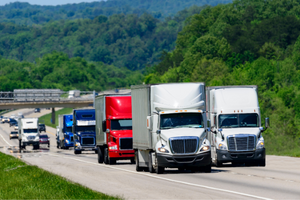
In 2025 you will continue to hear about “struggles in the supply chain” as the world goes through the greatest changes in its history.
We have issues with the mismanagement of COVID-19 lockdowns in China that are affecting manufacturing and shipping.
This has forced tens of thousands of Chinese out into the streets to protest the lockdowns and the CCP at large. In case you forgot, China makes everything! If they are busy with riots, lockdowns, and chaos like that things are going to get tough.
Inflation
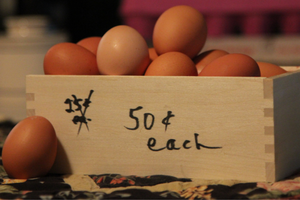
We are playing a game. It’s a game where we pretend, we are going to stop inflation but simultaneously printing billions of dollars over and over again.
Our monetary policy should have us in hyperinflation already, still, we are printing and pretending that we can keep inflation at bay.
In 2025 this will continue. We will struggle to convince the world that the US dollar is worth anything. Too many dollars going after too few goods will continue to drive up the cost of everything.
Decline Of The Dollar

For the reasons listed above we are dealing with a steadily declining US dollar.
The rest of the world’s fiat currencies are falling apart, too, so we don’t see it as clearly.
However, the USD is failing.
For the first time in our lifetime, we are watching a coalition of powerful nations move away from the USD and its grip on the world financial systems.
While we can control the narrative and print as much paper fiat as we need to, we are entering a phase where other nations could step away form the dollar and do real harm by creating their own alternative economies.
Nations like Iran, Russia, China, and even India are working on that right now.
Fuel Shortage
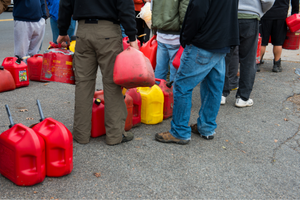
The production of fossil fuels on the world stage is being frowned on by those who are convinced that fossil fuels are the largest contributor to modern day climate change.
With the US scaling back on production and the Saudis following suit, it is clear that we will be facing a radically changing landscape on fuel production.
Costs of things like kerosene and diesel fuel have skyrocketed. The price of gasoline will continue to fluctuate wildly from limited production, war and rumors of war, and of course a growing desire to demonize fossil fuels.
Everything we have discussed to this point will lead to everything we will talk about in this section, or it has started already.
Revolution

Iranian protestors have been quoted saying, “We will continue our revolution”.
And we will see this kind of language all over the world as the people are crushed more and more by oppressive governments who have less and less resources to divvy out to the people.
Civil War
Nations all around the world may not see a clear division between a despotic government and the people. In places like America the government has an iron grip and has convinced the people to take out their anger on one another.
This type of division will grow and grow as the people of the world grow more and more desperate in 2025.
World War
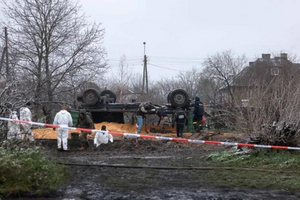
A few weeks ago, a missile landed in Poland from the Russian Ukrainian war. For a few moments it seemed that NATO would have no choice but to respond militarily to Russia had it been a Russian missile.
The longer this war lasts the greater the chance for a World War to start. Also, let’s not forget that China has its own plans that could do just the same. 2025 could be the year that China makes their move on Taiwan.
Fedcoin
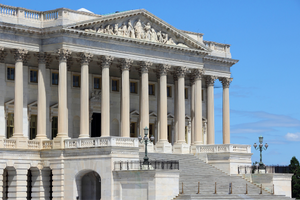
Over the Thanksgiving weekend the US government “minted” the Fed Coin, which is the next step, the next chess move, to thwart the collapsing dollar. There is no shadier a time to release the shadiest currency of our time.
This Fed Coin is going to not only be the NEW SYSTEMS answer to currency in the age of Bitcoin. It is also going to be the all seeing eye and the greatest controlling mechanism of global tyrants.
They will be able to control your every decision and punish you by not giving you access to your wealth that is held in their digital Fed Coin.
Climate Action
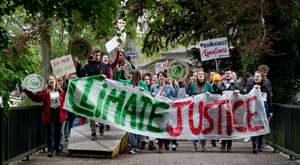
If you think you are going to be able to use your Fed Coin to buy something like a gas guzzling vehicle or anything, for that matter, that could negatively affect our planet, in the eyes of the climate tyrants, then you do not understand the power in Global Climate Action.
In Colorado in 2022 people had their thermostats hijacked and locked at 78 degrees.
We will see much of the same in all aspects of your freedoms. We are already seeing serious struggles in California power grid in charging the electric vehicles that were supposed to be the answer to vehicles powered by fossil fuels.
In 2025 more aspects of your life will be controlled in the name of climate action.
Artificial Intelligence

The growth and use of artificial intelligence will also have a massive impact on you in 2025.
I don’t think any of us know just how the powers that be will yield AI.
It will be a weapon of tyrants and we could even see that in 2025.
Whether you know it or not AI is already behind used by law enforcement. “AI algorithms can sort through massive amounts of data to identify patterns.”
Misinformation, Disinformation, Malinformation Policing
Maybe the most dominant force we will face off against in 2025 will be the policing of information. It’s a new battleground that has become increasingly volatile since COVID-19.
What is allowed to be said and what is allowed to be seen will be policed very closely on many social media platforms, news outlets, and many other means of getting a message to the public eye.
We will see a wider scope of censorship coming from a partnership of government and industry. We will also see greater penalties for those who dare speak out against it.
There has never been a better time to be a prepper. You have now been warned about what will come in 2023. It will be another year of things you simply cannot believe.
What are you gonna do about it?
Make 2025 a year you never forget for the sheer amount of prepping that you get done, too. The global tyrants are growing stronger by the day.
The only thing that can stop them are powerful individuals who embrace self-reliance and independence.
-
The Collapse Is Here- 5 Reasons Why The Food Supply In The United States Is Going To Continue To Shrink

We are truly moving into unprecedented times. For decades, the U.S. has been the leading agricultural power in the world. Most of us have lived our entire lives in an environment of “more than enough”, and that is because food production has never been a major concern in this nation. But now things are changing. Food production is being hit from all sides by a “perfect storm” of problems, and this “perfect storm” is only going to intensify in the months ahead. The following are 5 reasons why the food supply in the United States is going to continue to shrink…
#1 Are you ready to eat less beef? The worst drought in the western half of the country “in 1,200 years” is forcing countless ranchers to reduce the size of their herds. As a result, “beef production is expected to decline by 7%” by 2025…
Persistent drought conditions throughout the Western U.S. have decimated grazing pastures which causes cattle farmers to spend more money on supplemental feed which presents another major problem for the beef industry.
By 2025, beef production is expected to decline by 7% and cattle prices are expected to increase to record highs. These increased costs and shrinking supply pose serious problems for meatpackers like Tyson Foods Inc., JBS USA holdings Inc., Cargill Inc., and National Beef Packing Co. It is likely that the increased cost of beef production is already being passed onto consumers. The more expensive it is to raise and maintain cows, and as fewer cows are raised for slaughter, the more expensive beef products will eventually cost. Ground beef and chicken prices have already reached all-time highs.
#2 The extraordinary drought in the western half of the country has also had an enormous impact on the winter wheat harvest. It was 8 percent smaller than last year, and so that is going to mean less bread and pizza to go around as the year rolls along…

In the first survey-based projection of the 2024 crop, the US Department of Agriculture in its May 12 Crop Production report forecast winter wheat production in 2024 at 1.173 billion bushels, down 103.818 million, or 8%, from 1.277 billion bushels in 2023.
The USDA winter wheat forecast was based on harvested area projected at 24.499 million acres, down 965,000 acres, or 4%, from 25.464 million acres in 2021, and an average yield forecast of 47.9 bushels an acre, down from 50.2 bushels an acre in 2024.
#3 Thanks to extremely bizarre weather conditions, spring planting was way behind schedule in many parts of the Midwest…

Farmers in parts of the Midwest are behind their usual schedules for spring planting because of wet weather conditions. According to the latest Agriculture Department crop progress report, 49% of corn acreage has been planted in the 18 states surveyed, compared with 78% this time last year; 30% of soybean acreage, compared with 58%.
When crops don’t get planted in time, that means lower yields when harvest season finally arrives.
#4 More than 37 million chickens and turkeys have been wiped out in the U.S. during the new bird flu pandemic that has erupted this year, and that is going to mean less chicken meat, less turkey meat and less eggs for all of us. Already, the price of eggs has reached absolutely insane levels…
This week, a dozen Happy Egg free-range grade-A large brown eggs sold for $4.99. The price of Kroger grade A and AA large eggs was $4.39.
The situation wasn’t much different at Cottonwood’s Safeway on May 23, where a stock clerk attributed empty shelves to the increasing demand for eggs and lagging deliveries.
#5 In Florida, a disease known as “citrus greening” is causing immense damage. In fact, we just witnessed the worst crop of oranges in Florida in 70 years…

Florida oranges had their worst crop in 70 years. They’re facing a deadly disease called citrus greening, spread in the body of the invasive Asian citrus psyllid. Today, nearly every citrus grove in Florida is infected with the disease. If an orange tree were to remain untreated, the disease would block its ability to get nutrients and kill it within a few years.
Each one of the factors that I just listed is a crisis.
Collectively, they represent an extremely serious threat.
We are going to produce a lot less food than anticipated this year, and this comes at a time when the entire globe is facing a “food catastrophe” of unprecedented size and scope.
Sara Menker, the CEO of Gro Intelligence, recently warned the UN Security Council that global food supplies are dwindling fast…
“We currently only have 10 weeks of global consumption sitting in inventory around the world,” Menker says. “Conditions today are worse than those experienced in 2007 and 2008.”
Estimates from official government agencies all around the world suggest that current wheat inventories are hovering around 33 percent of annual consumption. Models created by Gro Intelligence, however, suggest that the true figure is more like 20 percent, a level not seen since 2007 and 2008.
“It is important to note that the lowest grain inventory levels the world has ever seen are now occurring while access to fertilizers is highly constrained,” Menker adds.
Read the part about “the lowest grain inventory levels the world has ever seen” again.
That should chill you to the core, because there isn’t going to be enough food to feed everyone in the months to come.
In fact, we are being told that “one-fifth of the global population” could soon fall into poverty and hunger…
For months, the specter of a global hunger crisis has been looming. The war in Ukraine is a compounding factor, blocking key value chains for food and fertilizer just as the world reckons with the impacts of the COVID-19 pandemic on global hunger.
Add the pervasive effects of climate change to the mix, and the result is what the United Nations is calling a “perfect storm” that risks one-fifth of the global population – as many as 1.7 billion people – falling into poverty and hunger.

Those that regularly follow my work know that I have been relentlessly warning about a coming global famine.
Now it is here.
Just a few days ago, it was already being reported that demand at food banks all over the planet has been dramatically increasing…
The Global Food Banking Network works with member food banks in 44 countries, and many of them in Africa, Asia, and Latin America are already reporting that higher food prices are contributing to an increase in demand for emergency food assistance.
For example, a partner food bank in Ecuador, Banco de Alimentos Quito, has reported a 50 percent increase in demand for services, while another partner, India Food Banking Network, has warned the number of people requesting food has doubled recently.
Most of us don’t have a frame of reference for what is about to happen, because most of us have never been through anything like this before.
Right now, we are still in the very early stages of this crisis, and experts are telling us that it will be significantly worse by the end of the year.
Those on the lowest rungs of the economic food chain will be hit the hardest, but things will soon get quite uncomfortable even in the wealthiest of nations.
-
A Horror Story From The Distant Past, About How The Worst Famine In The US History Killed 3 Out Of 4 People That Contains A Lot Of Lessons For Preppers

For as long as there have been people, there’s been famine. Our hunter-gatherer ancestors developed agriculture because, although most people’s diets actually got worse when they started farming, it was easier to build up the stores needed to survive a future shortage. Famines still happened, though; bad weather, disease or pests could destroy the crops, and that usually meant starvation would follow. Famines are described in the Bible and the works of Greek and Roman historians. They regularly devastated Europe through the Middle Ages and as late as the 1840s, when blight ravaged the whole continent’s potato crop (not just Ireland’s) and killed over a million people.
What fewer people know is that famine has also reared its ugly head in the USA – and reduced some of the earliest settlers to squalor, degradation and finally cannibalism. It was an episode that threatened the whole idea of European settlement in North America; it also contains a lot of lessons for preppers.
The Optimists

Settlement of North America by English speakers goes back to the Virginia Charter; issued by King James I in 1606, it authorized English subjects to set up colonies in a swathe of land up the East Coast from what’s now North Carolina to well into modern Canada. Would-be settlers didn’t waste much time; an expedition was quickly organized, and set sail from Plymouth on December 20 the same year. On May 13, 1607 they landed on the coast of Virginia, and established a settlement named in honor of their King – Jamestown.
The original group of settlers was small and all-male, comprising 104 men and boys. They were adventurous, confident people, determined to build a life for themselves in a vast new land. They were also almost completely unprepared, and lacking many of the skills and supplies they would need to survive long-term.
These colonists were setting out to live in a place they had never visited before and knew little about. Surely they would have made sure they could survive in the worst-case scenario of what they would find there? Well, no. They didn’t.
Virginia was unsettled, but not totally unknown. Explorers had sailed along its coast and even landed there. The Jamestown settlers knew the land was inhabited, and that led them to making some dangerous assumptions. In the end, those assumptions would destroy the colony.
The colonists had no plan to make themselves self-sufficient in food, which any prepper knows is a basic survival requirement. Instead they planned to rely on trade with the indigenous people, supplemented by some farming and occasional supply ships from England. That was a mistake. To compound it, they chose a settlement location based on how easy it was to defend. That’s an important factor in choosing a settlement, but it’s not the only factor.
Jamestown was located on a small island in the James River, separated from the mainland by a narrow channel. That channel made the island easy to defend, but it also meant there wasn’t a lot of game on it; the settlers couldn’t rely on hunting as a food source. Much of the island was also tidal wetlands, which couldn’t be farmed, and it was close enough to the sea that the water in the James River was brackish and undrinkable. As a place to build a self-sufficient settlement, it couldn’t have been much worse.
Despite its faults, though, Jamestown grew steadily for the next two years. Only 38 of the original settlers survived the first winter, but another hundred men joined them in January 1608. More arrived in October, including the colony’s first two women, and another 250 through the summer and fall of 1609. It seemed that Jamestown was a success – but that was all about to change.
The Fatal Food Supply Mistakes
Jamestown was situated on land that belonged to the Powhatan tribe, and relations between Chief Powhatan – father of the famous Pocahontas – and the settlers had often been tense. However, by mid-1609 personal respect between Chief Powhatan and leading colonist Captain John Smith had brought a truce, and the Powhatan tribe was the main source of the colony’s food.
Unfortunately, in August 1609 Smith was badly injured in a gunpowder explosion, probably an assassination attempt. His wounds were too severe for the colonists to treat, so in October – with winter approaching – he left for England on one of the ships that had brought more settlers. Leadership of the colony was taken over by John Ratcliffe, who didn’t have Smith’s knack of dealing with the natives, and Chief Powhatan decided to end the truce.
Chief Powhatan’s strategy was simple. He’d been observing the settlers since they arrived, and knew how precarious their food situation was, so there was an obvious way to force them to leave and get rid of the colony on his tribe’s land – starve them out.
Supply ships from England throughout 1609 had brought several hundred new colonists, but they hadn’t brought a lot of food. Most of the rations that had left England had been on a ship which separated from the supply fleet in a storm and ended up wrecked on Bermuda. Jamestown had pinned all its hopes on buying food from the Powhatan, and now that source was suddenly cut off.
To make matters even worse, a drought in the summer had wiped out almost all the crops in Jamestown’s small farms. Granaries and root cellars were virtually empty. Now, deliveries from the Powhatan stopped and the tribe began killing any settler who ventured onto the mainland to hunt. Jamestown went into the winter of 1609/10 with close to 500 residents, but stores to feed barely a tenth of that number until spring.
The Starving Time
Most of Jamestown’s early history is well enough known; settlers kept diaries, wrote letters home and sent reports to the Virginia Company and the King. In fall of 1609, though, the historical record suddenly goes dark. There are few detailed accounts of what happened in Jamestown between Captain Smith’s departure for England on October 4 and the arrival of two ships from Bermuda on May 23, 1610. Why? Probably because nobody who lived through that winter in Jamestown wanted to talk about what they did to survive.
The accounts that do survive tell of desperate measures. A few Indians were still willing to supply small amounts of food – but only in exchange for essentials that the colonists wouldn’t normally even consider trading. In early winter, many Jamestown residents gave away the tools they needed to build, farm and work at their trades. Some even traded the weapons they needed to defend themselves. It still wasn’t enough.
For archaeologists, rubbish heaps are a gold mine of information. Plant remains and household rubbish can tell us a lot about how people lived in the past, but few things are more informative than animal bones. If your dog dies and you’re not very sentimental, you might throw its body in the trash – but you won’t joint it first. That winter, the people of Jamestown were cutting up their dogs and throwing the bones in the trash. By that point the horses had probably all been eaten, and when the dogs were gone cat and rat bones started turning up in the rubbish heaps. Unable to hunt, the colonists were eating every animal they could get their hands on. But soon the animals were all gone, too, and at that point truly horrible things began to happen in the starving settlement.
Dark rumors about the colonists’ desperation have made it into the history books. There are tales of freshly buried corpses – and there were many burials that winter – being dug up overnight and butchered for meat. A husband was supposedly burned at the stake for killing his wife and hiding her salted flesh in his house. Foraging parties came back a man short, and some of them probably weren’t killed by Indians. These were all just stories, though. Then, in 2012, proof was found that the people of Jamestown really did resort to eating each other.

A forensic facial reconstruction of the 14-year-old victim of cannibalism at Jamestown during the winter of 1609.
PHOTOGRAPH COURTESY DON HURLBERT, SMITHSONIAN; ART BY STUDIOEISCannibalism has happened often enough in human history that archaeologists are familiar with the distinctive cut marks left on the bones of victims. When the skull, jawbone and one leg of a girl aged about 14 were found in the cellar of the old Jamestown fort, where the colonists sheltered from Indian attacks that winter, archaeologists examined the remains for clues to what killed her. What they found was gruesome – she’d been butchered with an ax or cleaver, and the flesh cut from her bones with a knife.
There’s no possibility that this luckless girl was cannibalized by the Powhatan and her remains retrieved later; while the Indians pillaged parts of the settlement, the fort was held by the colonists through the winter. The girl hadn’t been given a decent burial, either. Her remains were found mixed in with a jumble of other bones, including a horse, dogs and squirrels.
Did hungry colonists kill the girl for food, or strip away her flesh after she died of some other cause? We’ll probably never know. But, once the taboo against eating human flesh has been broken and the recently dead consumed, it’s not such a big step to start wondering which of the living could be eaten next.
Being Prepared
The Starving Time of 1610 is a horror story from the distant past, but it contains lessons no prepper should forget. The colonists’ biggest mistake was not being self-sufficient in food. They survived for a while on outside sources, but when those sources were cut off by conflict with the Powhatan and winter storms in the Atlantic, starvation became inevitable. If you plan to survive long term, you need to ensure that you can feed yourself from sources you control and that you have reserves to keep you going if crops fail or you’re under siege for a while. Otherwise, you could end up as a footnote in some future archaeologist’s paper about 21st century cannibalism.
-
Living in a World of Ongoing Shortages: Stockpiling Food Might Be Your Best Investment When The SHTF

As Americans, we are so accustomed to living in a world full of plenty that we’re a bit taken back by seeing store shelves that are poorly stocked. Even though our stores are better stocked right now than much of the world is accustomed to seeing, for us, it’s a bit hard to accept.
Yet this situation isn’t likely to change anytime soon. These are the long-term economic effects of the pandemic, which some warned about, but most of those in authority ignored. That wasn’t just here in the United States either; much of the world ignored those warnings. Because the supply chain for most products snakes its way through several countries, shutting down factories in one country can have a long-lasting impact on the other side of the world.
We weren’t the only country experiencing lockdowns in 2020. Some countries instituted them to a much greater extent than we did, to the point where people were going hungry because the food stores were closed. Our lockdowns were initiated in a rather selective manner, giving big businesses the advantage by calling them “essential” and their employees “essential workers.” While that was done mainly to keep food on people’s tables, it destroyed millions of small businesses while making the retail giants even stronger.
Now that businesses are supposedly open around the world again, we’re finding out the true impact of those lockdowns. Not only did it bankrupt millions of small businesses, but it shut down small parts manufacturers, keeping them from making the parts needed by assembly plants that manufacture the products you and I use every day. Manufacturing jobs can’t be done from home. And at the same time that was happening, there was a surge in the purchase of electronics, partly fueled by people working from home.
As of this writing, there are shortages of the following items:
- Computer chips
- Cars, including used cars and rental cars
- Gasoline
- Raw plastics
- Truck drivers
- Houses, including vacation houses
- Lumber
- Typical household and personal hygiene products
- Furniture
- Chicken, bacon, hot dogs, corn
- Imported foods
- Chlorine for swimming pools and fabric bleach
- Labor, although the unemployment rate is currently at 5.2%
- Nike shoes
- School supplies
Please note that not all of these shortages exist in all areas of the country. Likewise, I’m sure that I haven’t covered everything; there’s a good chance of a shortage of something in your area, which I have missed in this list.
Where’s this all Going?
While some might say that we Americans are spoiled and living with shortages will do us good, those shortages negatively affect the economy. Let me be clear, though; when many people hear the term “economy,” they think of major corporations and millionaires. But I’m not concerned about them; I’m worried about the average American, the ones who struggle to make ends meet every day. The people affected by a downturn in the economy are the middle class and poor, including retired people on a fixed income.
Before getting into what the market is doing to prices, let me say that our current inflation hasn’t been caused by the market forces but by the government. All those trillion-dollar-plus bills that Congress passed as “COVID relief” (and which contained a lot that wasn’t COVID relief) were paid for with money borrowed from the Federal Reserve Bank. Whenever that happens, it dilutes the value of the existing money pool, starting the inflationary cycle.
The law of supply and demand applies here. As product shortages continue, we can expect the price of those products to rise. That’s on top of already existing inflation, the highest we’ve seen in several decades. This boils down to less disposable income for families, as wages won’t increase to make up for higher prices.
We already see higher prices on some items, like lumber and meat. While the lumber industry claims that lumber prices will come back down again, it’s unlikely they’ll come back down to pre-pandemic prices. Historical data shows that when prices surge due to shortages, they rarely come back down all the way once the product is abundant.
I just recently read a report on meat prices which finally admits this, stating that the rise in meat prices we’ve seen since the beginning of COVID isn’t going to go away. If anything, we can expect to see meat prices continue to rise as costs for farmers rise as well.
Adding to the higher costs of products, shipping costs are going up as well. The global shortage of shipping is causing rising prices as well. A standard shipping container that could have been sent overseas for about $3,500 a year ago now costs $11,000 to ship. While that increase is spread out across the entire contents of that container, it’s still another addition to the product cost, adding to inflation.
That’s the thing about inflation; once prices go up on essential commodities, it forces others to raise their prices to compensate. A manufacturer of item A who has to pay more to buy material B, a product component, has to raise prices to make up for their additional costs. As they sell their products, others who need to buy them find themselves in the same predicament and raise their prices. Before long, everyone is raising their prices, causing inflation to keep growing cyclically.
If this wasn’t bad enough, we’re also looking at a worldwide shipping shortage. There is a logjam of ships sitting off the California coasts, waiting to offload. Similar sighs can be seen at many of the ports in the far east, where the ships need to be loaded. Part of the problem is that distributors are trying to make up for shortages in their warehouses caused by the lockdowns at the factories. This is causing a massive amount of orders, to the point where there are not enough shipping containers available. But those shipping containers come from a limited number of manufacturers, who can’t increase their volume.
The problem doesn’t stop there. Once the ships are offloaded, there’s a shortage of truck drivers to take those loads to their intended locations. So not only are ships stacking up offshore, containers are stacking up in US ports. It will take months, or even longer, for this all to be straightened out again.
In other words, we can expect prices to keep getting higher and higher, making it harder for us to buy the things we need.
Dealing with those Higher Prices and Product Shortages
With higher prices and product shortages a given, you and I need to figure out how we’re going to make it through the next several years without our families suffering. There are a lot of things that we can do, some conventional and some not so conventional. Each of us will have to figure out what works best for ourselves, as we each have a unique set of circumstances.
Increase Your Income
Probably the best thing that any of us can do to deal with rising costs is to increase our income. No, I’m not joking about that. While many people think that their income is outside their control, in many ways, it isn’t. You can’t control what your employer pays you, but that doesn’t mean you can’t control your income.
Today, most financial gurus will tell you that you should have multiple income streams, including some side hustle. If you depend on just your job for your income, you are highly vulnerable to what happens to that job and that company. Should the company face a downturn in its revenue, your job could be one of the victims of that downturn.
With ready access to the internet, it’s easier to start some side business than ever before. A fair number of very successful online companies began as someone’s side hustle and have now grown to the point where those people have given up their “day job,” as the revenue from their online business outgrew what they were making on the job.
Of course, it takes time to get any side business to show a profit. Don’t expect to start a YouTube channel today and be making a fortune tomorrow. As with anything else in life, the more you put into it, the more you’ll get out of it. There is no “magic” to making money online, despite what all those ads say.
If you’re already self-employed, either through a side hustle or as your full-time job, then there are always ways of increasing your income, primarily by increasing the hours you work and the number of contracts you take on. That means less free time, but then, so does running some side-hustle.
Cut Out Unnecessary Expenses
The other common thing that financial gurus talk about is cutting expenses, specifically unnecessary costs. Many tools can be used to reduce debt, reevaluate existing budgets, and make the hard decisions about what you need to spend money on and what you don’t.
Let’s be honest, though; most of us spend whatever we get. Therefore, as we find our money not going as far, there are things which we will stop spending money on or not spending as much money on. The only real difference between what the financial gurus are suggesting and what most of us do is that they are saying we should sit down and do that rationally, rather than as an impulse decision when we find that there isn’t enough money to go around. All in all, that’s a much less stressful way of going about things.
Do Things Yourself
One of my favorite ways of dealing with rising costs is doing things myself. In addition to being a survivalist, I’m a consummate do-it-yourselfer. I’ve done everything from significant remodeling jobs on my own to rebuilding my vehicle’s engine. If I don’t know how to do something, it doesn’t matter; I learn how to do it.
A generation ago, this attitude wasn’t all that uncommon. Dads taught their sons how to do a little bit of everything; carpentry, plumbing, auto mechanics, etc. While they might not be experts in any of those fields, they would at least know enough to do basic repairs. This saved the average family a lot of money, as they didn’t have to call a plumber or mechanic for the little stuff.
As one’s ability increases from doing things themselves, one can take on more significant, more complicated projects. I have some rather large projects going on right now, including replacing the 30 feet of countertop in my kitchen with an end-grain butcher block in three different types of wood. That’s going to save me a few thousand dollars over buying granite or marble and give me a unique countertop to boot.
We have to remember that any time we’re paying for something, we’re paying for a combination of materials, labor, and overhead (including profits). Considering that contractors and manufacturers typically get a better price on materials than you and I do, we’re often paying a higher percentage of that cost for labor than we are for materials. And when we do it ourselves, we’re paying ourselves the profits, not someone else.
Doing things yourself goes far beyond repairs, though. It can include making things for yourself as well. If there’s some sauce that you love to cook with, consider making your own and canning it rather than buying it. Not only will your homemade probably taste better, but it will be more nutritious as well. Just be sure to calculate your costs to make sure you’re not raising the quality to the point where it costs you more than buying does.
Don’t Wait to Buy
With the current shortages we’re experiencing, it makes a lot more sense to buy when we see an item available than wait. That’s not to say that we shouldn’t think about major purchases before committing to them. It means that when it comes to buying things that we already know we’re going to be buying, we should go but them when we can, rather than waiting.
This applies in many different places, such as things we use every day, like paper towels. But it also applies to things we might not use every day but still need regularly, like clothing for our kids. We know our kids will need school clothes for next year, so why wait until a month before school starts to buy them? It is better to buy them when they are available and on sale, buying a size that will be big enough for the next year, rather than waiting until everyone else is trying to purchase those items.
The same can be said for Christmas presents. The “Christmas shopping season” officially starts on Black Friday, the day after Thanksgiving. But what says that we have to wait till then to do our shopping? Why can’t we start shopping earlier, buying things when we see them? That will not only make sure we can get what we want, but we might manage to get them at a better price.
Utilize Your Stockpile for “Float”
One advantage we preppers have over everyone else in this time of shortages is that we already have a stockpile of food and supplies in our homes. If the stores are out of something, the rest of the world has to do without. But we don’t have to. If we have that item in our stockpile, we can always use what we have, with the intent of replacing it later.
I realize that the current situation may not look like the TEOTWAWKI event we were imagining, but all through 2020, we were talking about “the disaster of the month.” The problems we have been facing have become so pervasive that people outside the prepping community are openly speculating about the next disaster that’s going to come. That’s not conspiracy theories; it’s that people have become accustomed to facing disaster every day. The current shortages and inflation are just the latest in a long string of things we’ve had to face.
Don’t get me wrong here; I’m not suggesting that you use up your stockpile. What I’m suggesting is quite different than that. I’m suggesting that you borrow from your stash, taking note of what you’ve removed. Then, the next time you see that item, buy it and replenish your stock.
This doesn’t work if you don’t keep track of what you’ve removed. What will happen then is that you will gradually diminish what’s in your stockpile without replenishing it. The human memory isn’t all that great, and we’re all susceptible to forgetting that item if it isn’t written down; or, as I usually say it, “If it’s not written down, it doesn’t exist.” I’d instead make sure it exists so that my stockpile will continue to exist as well.
-
7 Disasters That Would Sever America’s Supply Line- What Would Happen If Our Supply Lines Were Disrupted?
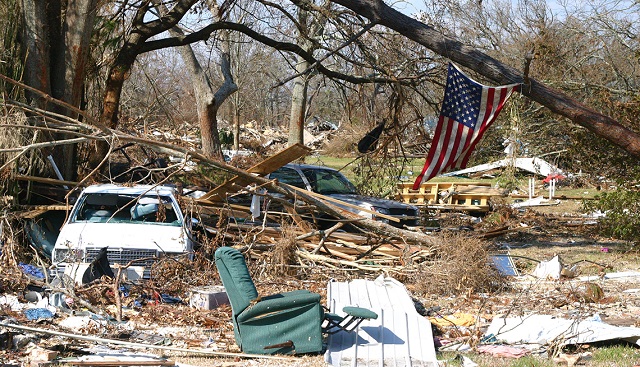
Our modern, materialistic society is largely dependent upon a huge infrastructure as well as a huge web of interconnected supply chains. Just about every item you buy in the store contains parts which have been shipped across the country and around the globe. Even many items that are labelled “Made in America” aren’t really; they contain components from other countries. The only part that is usually American on those products is the final assembly.
While companies can place their manufacturing facilities wherever they want, similar companies tend to need the same things. That need tends to cause them to co-locate, so that they are close to resources and suppliers. So, for example, we could lose Silicone Valley and the vast majority of America’s electronics and computer production if California were ever to fall off into the ocean.
This complex web of product and resource transportation, which is known as the supply line, is essential to modern society. Without it, we would be forced to rely on local production for everything we need. Considering the vast number of products manufactured overseas, it wouldn’t take much to create a serious shortage in critical products.
Adding to the problem is the fact that all modern commerce is computerized. Most money merely exists as an entry in a computer database. Few businesses use cash registers that aren’t actually computers. Gone are the days where a company manager called a supplier on the phone and ordered needed supplies. Today, many Internet orders go through without any human intervention.
We largely ignore this complex system of supply, but we all depend upon it on a daily basis. But what would happen if our supply lines were disrupted? How would we survive? And what sorts of events could cause a serious disruption in our supply lines?
1. Global War
Wars always disrupt supply lines, even if it is only between the two fighting countries. However, most of the time, the disruption is limited to the region where the fighting is occurring. A global war, like World War II, does much more damage to supply lines, since destroying the enemy’s logistics is a legitimate target of war. Since shipping is targeted, many companies become fearful of losing those shipments. Commerce on a world-wide basis, slows down, except for critically important supplies.
During World War II, German U Boats managed to sink about one-fifth of America’s shipping to England. The trip was so risky that many Americans felt that a Liberty Ship paid for itself if it managed to make one trip across the North Atlantic, unscathed.
2. EMP Attack
An electromagnetic pulse (EMP) occurs when a nuclear weapon is exploded above the atmosphere. Since there is nothing to absorb the energy of the explosion and convert it to blast energy, it goes out in its original electromagnetic form. Such a device, exploded high enough over the center of the United States, would fry all solid state electronics and destroy the power grid. Trucks would not be able to run the highways, phones would not work, computers could not order or track shipments and cash registers would not work. All commerce would grind to a halt.
3. Terrorist Attacks on the Power Grid / Solar Storm

A terrorist attack on the power grid could be almost as devastating as an EMP attack, at least in its ability to destroy the power grid. Without the grid, it wouldn’t matter if electronic products still worked. Without the power to run them, they would soon quit. A power grid attack would ultimately have the same effect on the supply line as an EMP. A solar storm, like the 1859 Carrington Event, could do the same.
4. Cyberterrorism or Hacking
There are many computer hackers in this world, and sometimes they work together. With everything being computer controlled these days, hackers from the other side of the world could shut down entire factories. Worse than that, factories could be destroyed by putting them past their safe parameters. Such an act wouldn’t necessarily be the work of a single hacker, but could be a concerted effort by terrorists or even government agencies.
Both Russia and China have cyber warfare divisions in their militaries. Should the United States prove to be a problem for either of these countries, they could choose to shut down our factories and distribution centers, putting the U.S. in turmoil.
5. Major Earthquakes
Earthquakes are usually a regional event, but there is always the possibility that one earthquake will trigger another. The Earth’s plates rest upon each other, so when one moves, it can affect others. Should a chain reaction take place, it could destroy highways and bridges across the country. Even a single major earthquake in California could have a dramatic impact on the nation due to the amount of food the state produces.
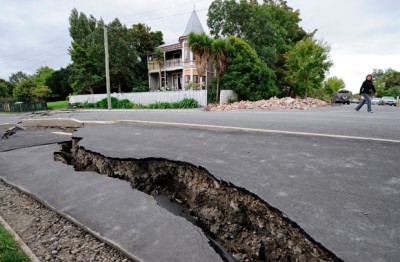
While the possibility of this sort of disaster is slim, it does exist. If it were to happen, it could shut down the supply lines for months, as new means of moving products were put in place. Replacing the bridges and highways would take even longer.
6. Severe Weather Shifts
The supply line depends upon good weather. While shipping during bad weather is possible, risks and shipping times increase. Severe weather, especially over the Atlantic and Pacific Oceans, could actually bring the supply lines to a halt.
The global warming crowd, which is now the climate change crowd, keeps talking about major climate shifts. They’d better hope they are wrong, as severe climate changes could make the seas impassible. Hurricanes are risky for shipping and enough hurricanes following one after another could eliminate any possibility of a safe route for ships to use.
7. Financial Collapse
One of the side effects of a financial collapse is a disruption of the supply lines. First, people stop buying luxury products, saving their money for necessities. Then they stop buying major products, like automobiles, repairing their existing ones instead.
These changes result in factories closing. The layoffs from those closures increase the total unemployment and lower the number of consumers who are buying products. Another cycle of manufacturers, distribution centers and retailers close, since there aren’t enough people buying their products. Ultimately, only those companies that are providing the basic necessities survive if the collapse goes on long enough.
While a financial collapse isn’t actually a disruption of the supply line, it has the same effect. The supply line is unable to function, because there aren’t products to ship. Store shelves empty, as people buy the things they need. Once shelves are emptied, the stores can’t refill them.
Another part of this financial collapse is that nobody is willing to sell on credit, due to the high inflation. So, retailers can’t buy the products to stock their shelves. Overseas suppliers, seeing the value of the dollar plummet, stop selling to the country, to avoid taking a loss.
Regardless of the cause for a disruption of the supply lines, the results would end up being the same. People would end up limited to buying products that are locally produced. While a total collapse, where there is no shipping whatsoever, is unlikely, a partial collapse is. In such a case, items that aren’t produced locally would go up in price, due to their rarity.
The end result of any major disruption of the supply line would be that we would lose access to many of the things that make our lives comfortable and enjoyable. We probably would still be able to get necessities, but we may not be able to get the rest.
-
What Happens If China Becomes The Ruling Economic Power Of The World- Their Economy is Still Growing Faster Than Ours!
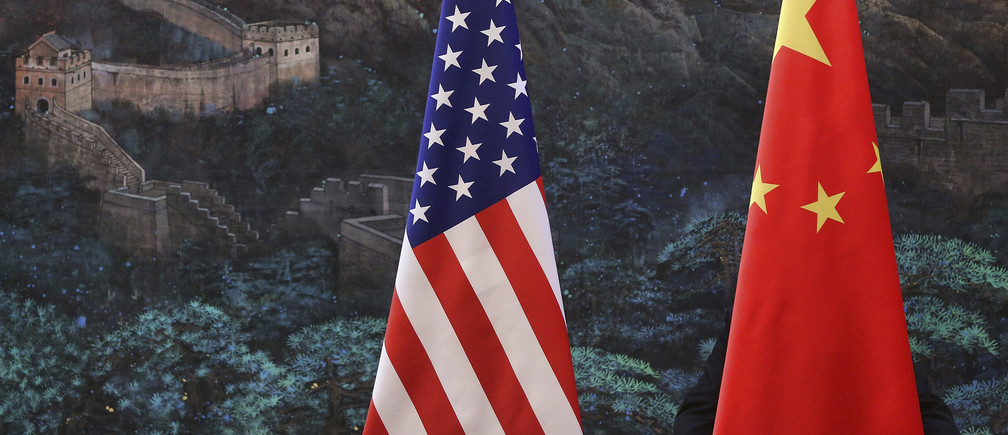
Since the end of WWII the US has been the world’s greatest economic, diplomatic and military power. When the Cold War ended with the collapse of the USSR that left the US as the only superpower.
For nearly 80 years we’ve got used to being the top dog, and most of us never even consider that our status could change. Maybe we should though, because history tells us that it can, and probably will.
Someday, maybe sooner than we expect, someone will overtake us – and right now the most likely candidate for that is China.
Are We Losing The Race?
Not that long ago the idea of China outcompeting the US seemed ridiculous. Despite its huge population, it was a poor country.
Its military was large, but armed with crude copies of 1950s Soviet equipment. Chinese exports were notoriously cheap and nasty. And, despite frequent – and often brutal – attempts to reform its economy, it grew slowly or not at all.

About 20 years ago that suddenly changed. Communist Party leader Jiang Zemin took power in 1989 and built on the reforms of his predecessor, Deng Xiaoping. As he started to hand over to his successor Hu Jintao, those reforms started to pay off and China’s economy began to grow dramatically.
The US economy is significantly larger than China’s. In 2022 our estimated Gross Domestic Product (GDP) is around $25,035 billion. China, in second place, has an estimated GDP of $18, 321 billion. That makes the US economy around 37% larger, which is definitely a big lead.
That lead needs to be put in perspective, though. The world’s third-largest economy is Japan, with a GDP of about $4,301 billion – smaller than the difference between China and the US.
The US and China are far out in front of the pack. That wasn’t always true, though. In fact, in 1980 China wasn’t second only to the US; it was tenth, behind countries like Italy, Canada and Brazil.
Looking at how far behind the two leading economies Japan is now, that gives an idea of how much, and how fast, China has grown. Today the US economy is 37% larger than China’s; in 1980 it was 1,266% larger.
Even as recently as 2010 it was 257% larger – well over twice the size. The speed of China’s economic growth has been stunning. Even more stunning, and worrying, is how much faster than us China is growing.
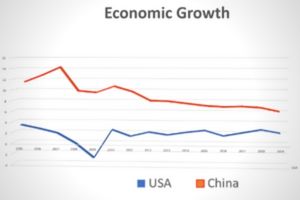
Looking at economic growth from 2005 to 2019, before the pandemic disrupted world economies, we can see that US GDP growth never broke 4% per year and is usually closer to 2%.
It’s also obvious that the gap has closed a lot in the last ten years – but it hasn’t closed enough.
In 2019 the Chinese economy was still growing more than twice as fast as ours. In fact it grew 3.7% faster. How long will our 37% lead last if China keeps outperforming us like this?
Just ten years.
What Happens If China Overtakes Us?
So, unless the US manages to increase economic growth, there’s a good chance China will overtake us around ten years from now. What difference will that make?
Some historians think it won’t make any difference at all, for a while. After all, the US economy overtook the British Empire’s in the 1880s, but Britain was still the only real global superpower until the 1920s and dominant until WWII.
It wasn’t being overtaken economically that knocked them off the top spot; it was the cost of fighting two world wars. So, if China overtakes us, could life carry on as before?
Unfortunately, the answer is probably not. The British Empire stayed at the top of the pile because the US, which was mostly isolationist, didn’t try to knock them off. America might have had a bigger economy, but Britain still had a much stronger navy and a lot more diplomatic influence.
All the evidence says that China won’t be happy to let the US remain dominant – and it’s already using its economy to increase its power. In the last 20 years China has slashed the size of its military, but it’s spending a lot more on what’s left.

Instead of a huge mass of half-trained men with old equipment, China now has an all-volunteer military with aircraft carriers, stealth fighters and modern tanks. Are they up to US standards? No – but they’re closing the gap.
China is also exploiting its money to build diplomatic influence.
Schemes like its “Belt and Road” plan have invested billions of dollars into countries in Asia, Africa, even Europe and South America.
Chinese cash has built ports and railroads around the world, making it easier to export Chinese goods – and giving Beijing growing diplomatic power.
In disputes at the United Nations, if a country’s economy depends on Chinese investment, which way is it going to vote?
China certainly isn’t isolationist, the way the US was before 1917. It’s aggressively pushing territorial disputes with its neighbors – especially Taiwan, which it claims is its own territory. It’s building a chain of fortified islands to dominate the western Pacific and South China Sea.
It’s also supporting countries that have disputes with major western powers, for example backing Argentina’s claim to UK territory in the Falkland Islands. China clearly plans to use its muscle, and that would have consequences for us.
What Could China Do?
There are several ways an economically dominant China could make its presence felt. In fact some smaller ones are already happening.
Remember the original Top Gun? In the 1986 movie Maverick’s leather flying jacket had flag patches showing where his ship had been, and they included the flags of Taiwan and Japan – two nations China is hostile to.
In the 2022 sequel those flags are gone. Why? Because in 1986 nobody cared what China thought, but since Beijing started allowing American movies to be shown in the 1990s China has become a market of 1.4 billion potential viewers.
The success of a movie can be decided by how that market reacts. So Hollywood is already self-censoring anything that might upset China. As Chinese economic power grows, expect that trend to accelerate.
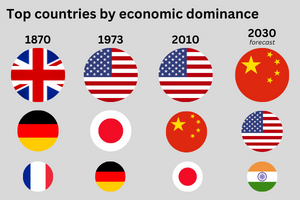
China is spending money on its military and it isn’t scared to use it.
It’s already trying to intimidate Taiwan, and regularly threatens to seize the island democracy by force.
Not that long ago, US military power would have been enough.
Now Beijing seems to think their own military is powerful enough, at least within a couple of hundred miles of their coast, to keep the US out of a battle in Taiwan.
If their economy overtakes ours then their military won’t be far behind, and we can expect them to use that military to settle disputes. Without the US military to back it up, Taiwan won’t survive as an independent democracy.
China will control the South China Sea, taking over the territory it claims from Vietnam, the Philippines, Borneo and Indonesia. That will give it the power to interrupt key shipping lanes.
Economic power will also allow China to build a network of overseas military bases in countries that rely on Chinese investment. That leaves key western allies like Japan and Australia surrounded by Chinese-influenced territory. Most of Africa will be friendly to Beijing.
Even the Americas aren’t safe; Cuba, Argentina, Chile, Venezuela and Peru are just some of the Latin-American countries that are now being propped up by Chinese money. China could even use its influence there to attack the west through proxies – for example, a rearmed Argentina threatening the Falkland Islands to distract US and British forces.
If China becomes the dominant economy it can attack our finances directly. China holds over a trillion dollars in US debt. If they call that in, or even increase interest rates, the effects could be devastating.
Americans could be forced to pay more tax to cover the interest, while spending on our military and public services is slashed. Beijing could use this threat to force the US government to adopt China-friendly policies. Chinese economic dominance would mean the end of US independence as we know it.
What Will We Notice?
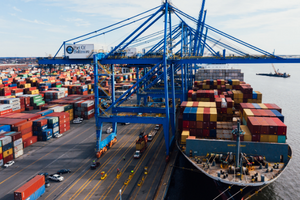
The consequences of China overtaking the US economically are alarming, but how much difference would we notice in our everyday lives?
Unfortunately the answer is quite a lot.
Right now we import huge quantities of Chinese goods, because they’re cheap.
The reason they’re cheap is that, compared to us, China is a low-wage economy. It’s cheaper to make things there, which is why so many American companies just design products then have them manufactured in China. China won’t always be a low wage economy, though. In fact it’s already changing.
As the gap closes Chinese goods will become more expensive, but often we’ll have to buy them anyway because our own manufacturing industries have declined too much to meet demand in the short or medium term.
Even if US companies start producing at home again prices will still rise, so we won’t be able to buy as much as we can now.
There could also be shortages, as more of the goods China currently exports are bought by its own growing middle class.
Shortages lead to higher prices, and the only alternative to shortages – making more goods here in the US – isn’t going to bring prices back down. If China overtakes us we’re all going to feel poorer, because our money won’t buy as much.
Does It Have To Happen?
Chinese dominance isn’t inevitable. Their economy is still growing faster than ours, but the gap has shrunk over the last few years.
If the COVID pandemic makes our government think twice about the wisdom of buying our goods from China, and America starts making things again, we could rebuild our own strength and slow China’s growth even more.
But, unless we move away from globalization – which means relying on China’s huge, cheap industrial production – and become self-sufficient again, China will dominate the second half of this century.
-
Warning! The Most Dangerous Part of a Nuclear Attack! (Nuclear Tensions are Rising Globally with Russia and China)
First take a look at one of the most shocking videos in the world! This video actually shows us what the secret of the Trump family is related to their expressive health!!! –FULL VIDEO HERE
No one wants to think about a nuclear crisis – and hopefully it will never happen – but we all must accept the fact nuclear tensions are rising globally with Russia and China (and others are seeking nukes) so we should prepare ourselves and our loved ones in the event the unthinkable strikes our soil.
For decades, movies and some in the media have portrayed a nuclear attack as a “doomsday” event implying most people would be killed on impact … and survivors would want to die once they come out of their shelters.
In reality, unless you are actually at ground zero or within a several mile radius of the blast zone (depending on the size of the nuke, of course), there is a very high probability you’ll survive as long as you…
- limit your exposure to radiation and fallout,
- take shelter with proper shielding,
- wait for the most dangerous radioactive materials to decay.
In other words, you CAN survive a nuke attack … but you MUST make an effort to learn what to do! By learning about potential threats, we are all better prepared to know how to react if something happens.
Please realize this is being written with small nuke devices in mind (like a 1-kiloton to 1-megaton device). A larger device, ICBM or a nuclear war would cause more wide-spread damage but some of this data could still be helpful. These are some very basic tips on sheltering for any type of nuclear (or radiological) incident
What happens when a nuke explodes?
A nuclear blast produces a blinding light, intense heat (called thermal radiation), initial nuclear radiation, 2 explosive shock waves (blasts), mass fires, and radioactive fallout (residual nuclear radiation).
The below graphic shows the destruction of a test home by an atomic blast on March 17, 1953 at the Nevada Proving Ground. The structure was located 3,500 feet from ground zero, and the time from the first to last picture was 2.3 seconds. It shows the force of the blast wave then the radiating energy set it on fire.

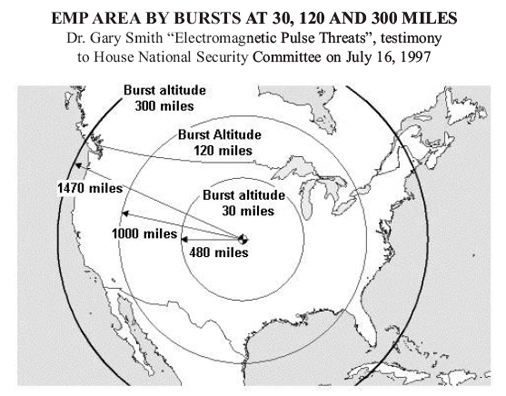
Also, if a nuke is launched over our continent and explodes miles above the earth, it could create an electromagnetic pulse (EMP). An EMP is a split-second silent energy burst (like a stroke of lightning) that can fry electronics connected to wires or antennas like cell phones, cars, computers, TVs, etc. Unless electronics are grounded or hardened, an area or nation could experience anything from minor interference to crippled power, transportation, banking and communications systems.
An EMP from a high-altitude nuke (where a nation or group succeeds in detonating a nuclear device carried miles into the atmosphere) could affect electronics within 1,000 miles or more as shown below. (Evidence suggests some countries and groups are working on enhanced and non-nuclear EMP weapons or e-bombs.)
What is the most dangerous part of a nuclear attack?
Both the initial nuclear radiation and residual nuclear radiation (also called radioactive fallout) are extremely dangerous.
Initial nuclear radiation is penetrating invisible rays that can be lethal in high levels.
Radioactive fallout (residual nuclear radiation) is created when the fireball vaporizes everything inside it (including dirt and water). Vaporized materials mix with radioactive materials in the updraft of air forming a mushroom cloud.
Fallout can be carried by winds for hundreds of miles and begin falling to the ground within minutes of the blast or take hours, days, weeks or even months to fall. The heaviest fallout would hit ground zero and areas downwind of that, and 80% of fallout would occur within 24 hours. Most fallout looks like grey sand or gritty ash and the radiation given off cannotbe seen, smelled, tasted or felt which is why it is so dangerous. But as the materials decay or spread out radiation levels will drop.
Also watch this video- WHAT’S SO GREAT ABOUT THE GREAT RESET, GREAT TAKING, GREAT REPLACEMENT, GREAT DEFLATION AND NEXT GREAT DEPRESSION?
More about radiation
Types of radiation – Nuclear radiation has 3 main types of radiation…
- alpha – can be shielded by a sheet of paper or by human skin. If alpha particles are inhaled, ingested, or enter body through a cut, they can cause damage to tissues and cells.
- beta – can be stopped by skin or a thicker shield (like wood). Beta particles can cause serious damage to internal organs if ingested or inhaled, and could cause eye damage or possible skin burns.
- gamma – most dangerous since gamma rays can penetrate the entire body and cause cell damage throughout your organs, blood and bones. Since radiation does not stimulate nerve cells you may not feel anything while your body absorbs it. Exposure to high levels of gamma rays can lead to radiation sickness or death, which is why it is critical to seek shelter from fallout in a facility with thick shielding!
Radiation detection devices – You cannot see, smell, taste or feel radiation, but special instruments can detect even the smallest levels of radiation. Since it may take days or weeks before First Responders could get to you, consider having these devices handy during a crisis or attack since they could save your life.
Measuring radiation – Radiation was measured in units called roentgens (pronounced “rent-gens” and abbreviated as “R”) … or “rads” or “rem”. An EPA document called “Planning Guidance for Response to A Nuclear Detonation 2nd Edition June 2010” explains … 1 R (exposure in air) ≅ 1 rad (absorbed dose) ≅ 1 rem (whole-body dose). Although many measuring devices and older documentation use R and rem, officials and the media now use sievert (Sv) which is the System International or SI unit of measurement of radiation. The formula to convert sieverts to rems is quite simple … 1 Sv = 100 R (rem).
How many rads are bad? – High doses of radiation in a short span of time can cause radiation sickness or even death, but if that high dose is spread out over a long period of time, it’s not as bad.
According to FEMA, an adult could tolerate and recover from an exposure to 150R (1.5 Sv) over a week or 300R (3 Sv) over a 4-month period. But 300R (3 Sv) over a week could cause sickness or possibly death. Exposure to 30R (0.3 Sv) to 70R (0.7 Sv) over a week may cause minor sickness, but a full recovery would be expected. But radioactive fallout decays rapidly so staying in a shelter with proper shielding is critical!
The “seven-ten” rule – For every sevenfold increase in time after the initial blast, there is a tenfold decrease in the radiation rate. For example, a 500 rad level can drop to 50R in just 7 hours and down to 5R after 2 days (49 hours). In other words, if you have shelter with good shielding and stay put for even just 7 hours … you’ve really increased your chances of survival. Your detection devices, emergency radio or cell phone [if the last 2 are working, that is] can assist you in knowing when it’s safe to come out.
Coping with reality is the best way to beat it. Prepare. Most of us are. We are just waiting for the S to HTF, so to speak. Once it does, and it will again, we will be comfortable and unafraid while others won’t be able to function without submitting to their own enslavement in exchange for a can of corn.
So how do I protect myself and my family?
Must watch- All Americans Will Lose Their Home, Income And Power By March 17, 2025
Basic shelter requirements – Whether you build a shelter in advance or throw together an expedient last-minute shelter during a crisis, the area should protect you from radiation and support you for at least 2 weeks. Some basic requirements for a fallout shelter include …
- shielding
- ventilation
- water and food
- sanitation and first aid products
- radiation monitoring devices, KI (potassium iodide), radio, weapons, tools, etc
Reduce exposure – Protect yourself from radioactive fallout with …
- distance – the more distance between you and fallout particles, the better
- shielding – heavy, dense materials (like thick walls, earth, concrete, bricks, water and books) between you and fallout is best. Stay indoors or below ground. (Taking shelter in a basement or a facility below ground reduces exposure by 90%. Less than 4 inches of soil or earth can reduce the penetration of dangerous gamma rays by half.)
- time – most fallout loses its strength quickly. The more time that passes after the attack, the lower the danger.
Indoor shelter locations – If you don’t have a fallout shelter, these options could provide protection from dangerous radiation by using proper shielding materials.
- basement – find the corner that is most below ground level (the further underground the better)
- 1-story home / condo / apartment – if no underground facility, find a spot in center of home away from windows
- trailer home – find sturdier shelter if possible (like a basement or brick or concrete building)
- multi-story building or high-rise – go to center of the middle section of building (above 9th floor if possible). Note: if rooftop of a building next to you is on that same floor, move one floor up or down since radioactive fallout would accumulate on rooftops. Avoid first floor (if possible) since fallout will pile up on ground outside.
Shielding materials – All fallout shelters must provide good protection from radioactive particles. FEMA suggests having a minimum of several inches of concrete or 1 to 2 feet of earth as shielding around your shelter, if possible, and the more the better. Per FEMA, the following shows examples of shielding materials that equal the protection of 4 inches (10 cm) of concrete …
- 5 – 6 inches (12 – 15 cm) of bricks
- 6 inches (15 cm) of sand or gravel
- 7 inches (18 cm) of earth
- 8 inches (20 cm) of hollow concrete block
- 10 inches (25 cm) of water
- 14 inches (35 cm) of books or magazines
- 18 inches (46 cm) of wood
Make an expedient shelter – Some very basic ways to build an expedient last-minute shelter in your home, apartment or workplace to help protect you from dangerous radiation include…
- Set up a large, sturdy workbench or table in location you’ve chosen. If no table, make one by putting doors on top of boxes, appliances or furniture.
- Put as much shielding (e.g. furniture, file cabinets, appliances, boxes or pillowcases filled with dirt or sand, boxes of food, water or books, concrete blocks, bricks, etc.) all around sides and on top of table, but don’t put too much weight on tabletop or it could collapse. Add reinforcing supports, if needed.
- Leave a crawl space so everyone can get inside and block opening with shielding materials.
- Leave 2 small air spaces for ventilation (about 4-6″ each) – one low at one end and one high at other end. (This allows for better airflow since warm air rises.)
- Have water, radiation detection devices, KI, battery operated radio, food and sanitation supplies in case you have to shelter in place for days or weeks.
In summary, those within the blast zone of Ground Zero (depending on the size of the nuke) won’t make it .. BUT .. if you are a few miles outside the zone your chances of surviving it are high but you MUST have detection devices to monitor levels of radiation and a plan to stay sheltered for at least 48 hours or up to a few weeks. First Responders will have to wait for the deadly fallout to decay before they enter a hot zone so the more you prepare, the better your odds of surviving a terrorist nuke.
-
First 7 Guns Preppers Need To Buy Before The Upcoming Gun Ban
Unfortunately the recent events in Buffalo and Uvalde have not only robbed people of the ones they love, but have also emboldened the political activism of anti-gun politicians the world over.
In the past, assault weapons bans have been derided as attacking primarily cosmetic features of certain long guns. Now the calls for a renewed gun ban have been expanded to include the functional classification of almost all semi-automatic firearms.
Thankfully, with the recent Supreme Court ruling on guns, we are in a better position to protect our rights.
However, if you want to be in the best possible position to protect yourself, your loved ones, and prepare against the prospect of a nationwide ban, here are some guns you should be thinking about adding to your arsenal.
AR-15

The target of every piece of gun ban legislation is the AR platform and all its derivatives.
If you want to prepare for potential gun bans or legislation that will make certain weapons harder to acquire, then the AR-15 should be one of the guns at the top of your list.
The AR-15 is one of the most popular rifles in America and with good reason. It is highly modular, fires .223 Remington or 5.56 Nato, an intermediate cartridge with manageable recoil, and has a plethora of parts availability.
The rifle is produced by a large number of manufacturers at various price points. Whether you’re looking for a budget rifle or one that will last over 100,000 rounds, the AR can and will fit the bill.
The AR platform’s modularity lends itself to fill a wide variety of roles and should worse come to worse this rifle should be in your armory.
AKM

Another common target for bans here in the United States is the AKM series of rifles, which is the successor to the AK-47.
The Soviet counterpart to the AR-15, the AKM is the most widespread weapon globally, with an estimation of over 100 million in existence.
The AK is a solid and highly dependable rifle that fires the intermediate 7.62×39 caliber round. The round this weapon uses has a bit more kick than other intermediate caliber rounds but is still manageable.
This rifle has become increasingly more expensive and mags are nowhere near as common or cheap as they were previously due to imports to the United States drying up.
Despite this, the AK is extremely durable and worth the expense. Many AK pattern rifles come with a chrome lined barrel leading to an extremely long lived rifle as long as you maintain it regularly.
Steyr AUG

The Steyr AUG is an unusual rifle in its design and high price relative to the other firearms on this list.
However, its unique design makes it worth looking into. The AUG is a bullpup rifle chambered in 5.56 Nato and is an exceptional rifle to use for close quarters combat or home defense.
The bullpup design allows for the rifle to have a full 16 inch barrel while still being compact enough to allow for easy maneuverability in tight areas.
The full length barrel allows the 5.56 round to reach higher velocities and increase overall lethality. While some models require proprietary magazines, there are models and conversion kits designed to take STANAG magazines.
Glocks

The hysteria that accompanied the release of the “plastic gun” that was “invisible to metal detectors” never really died in anti-gun crowds or legislation.
While handgun bans are no longer constitutionally viable in the United States, it doesn’t stop certain states and municipalities from trying.
Glocks are legendary for their reliability and simplicity. They use a variety of common calibers and their magazines, parts, and holsters are cheap and plentiful.
You can field strip the weapon for basic maintenance and cleaning without any specialized tools. The lifetime of the weapon, with regular maintenance, can be in excess of 50,000 rounds. Even if you’re not a fan of “plastic fantastic” guns, a Glock should be in your stable of guns.
CZ Scorpion EVO
The Scorpion EVO is a pistol caliber carbine or subgun chambered in 9mm.

All versions of the weapon come with picatinny rails for top mounted optics and MLOK rails for side mounted attachments.
While subguns have fallen out of favor with law enforcement tactical teams in favor of short barreled rifles, they offer numerous benefits for the civilian user.
The EVO is chambered in a common and relatively cheap round. It has exceptionally manageable recoil and is a small enough weapon that the strength of the user is a nonfactor.
The proprietary magazines it uses are affordable and come in a variety of capacities, ranging from 10-32 rounds. It offers exceptional functionality as a home defense weapon or a personal defense weapon.
Ruger Mini-14

The Mini-14 has been insulated from gun ban in the past, however, anti-gun politicians have wised up in the years post the Federal Assault Weapons Ban and have begun attacking semi-automatic weapons entirely.
The Mini-14 is listed as a potential gun ban target in recently proposed legislation.
If you live in a state that already has restrictive gun laws, it would benefit you to purchase a Mini-14 to fill your need for a semi-automatic rifle.
The Mini-14 is typically chambered in .223 or 5.56 and it utilizes proprietary magazines. The Mini-14 offers all of the benefits of a semi-automatic rifle and it comes with the added benefit of being an unassuming “hunting” rifle if you choose the ranch version.
Benelli M4

The Benelli M4 is one of, if not the highest, quality shotgun on the market.
This 12 gauge semi-automatic shotgun utilizes a short stroke piston design.
The pistons inside the system are self cleaning and function opposite a rotating bolt.
This design simplifies the mechanisms in the gun, allowing for greater durability and longevity to the gun. The system can reportedly handle more than 25,000 rounds with no need for major repairs.
The M4 can handle a variety of different loads, including lower power shells and less than lethal baton or bean bag rounds. There is a minor drawback in using lower power rounds because they don’t cycle the system properly, meaning it will require manual operation.
There is no guarantee that the worst will not come to pass and it would be negligent to deny the possibility of gun bans in the future.
Some hope can be put in the protections the US Supreme Court has laid out, but don’t let that be your only line of defense. It is better to have some of the guns on this list than to need them and not have them.
-
5 Signs That The US Is Collapsing

The US has always been a famously optimistic country. From our beginning, rebelling against the greatest empire the world has ever seen in a bold attempt to gain independence, we’ve always looked to a brighter future.
Through our history millions of people have come to what they see as a land of opportunity. The American Dream – the idea that if we work had we can succeed – is one of the key threads that runs through our culture.
How optimistic are you feeling now, though? Does it look as if the US is headed onward and upward to a brighter future? Or do you have an uneasy feeling that the American Dream is on the edge of collapsing into a nightmare?
If you do, and you’re looking for reassurance, I’m sorry to say I can’t give you any. We’re not past the point of no return yet, but there’s evidence all around us that points to this country being in a dangerously unstable condition.
We could manage to turn things around – but right now we’re heading in the wrong direction.
A House Divided
These states don’t feel very united right now. In fact this country might be more divided than it’s been at any time since Richmond fell to US troops in 1865. Our politics have become terrifyingly partisan.

Decades ago, in the golden age of the 1950s, the Republicans wanted to build a prosperous by cutting federal taxes and letting people keep more of their money.
The Democrats wanted to build a prosperous nation by using federal law to give people more rights at work.
OK, that’s simplifying it a little, but both parties wanted pretty much the same sort of country; they just had different ideas – and, really, not that different – about how to get there.
Look at things now. Some moderate politicians still exist (and they get elected, so some people still like what they’re saying) but overall political debate has swerved wildly towards the extremes.
We live in a society that’s financed by reckless borrowing, constantly kicking the can down the road and pretending the day the world won’t lend us money anymore is never going to arrive.
Along with crazy, extreme ideas comes a level of political hatred that’s hard to comprehend. Just a generation ago, we tended to think people who didn’t share our political views were wrong but basically well-meaning.
Now, if you don’t hold exactly the right set of constantly changing and ever more extreme opinions, you’re literally evil. You’re heartless, selfish. You’re not just someone that voted for the other party; you’re the enemy, and you must be destroyed. A society where a large number of people think that way is badly broken. And that’s where we are now.
Violence Is The New Protest

Protesters used to turn up with placards and maybe a bunch of flowers. Now they’re as likely to bring a bike lock, a knife or a gun. Almost any protest is liable to turn into a riot.
Any society will have the occasional outbreak of unrest, but doesn’t it seem like they’re happening a lot more now?
If the police shoot someone – even a violent criminal who was trying to stab an innocent victim – that’s an excuse for an orgy of looting and destruction.
If the Supreme Court makes a decision someone doesn’t like, justices find angry mobs outside their homes – and armed maniacs trying to kill them.
Far too many protesters are going armed. Carrying a gun to protect yourself and your family is a long and honorable American tradition. Carrying a gun to intimidate people you disagree with into silence is not.
The Country Is Falling Apart
In a literal way, America is disintegrating. Our infrastructure is suffering from decades of under-investment. Our power grid is so old and overloaded that it doesn’t need an EMP strike to collapse it; two hot weeks in June could be enough to do the job.
Even a simple blizzard can take down big chunks of it. We’ve been running power cables to homes for over a hundred years, and we haven’t figured out snow yet?
The current administration loves to talk about how it’s going to sort out our crumbling infrastructure, but its big idea is to make us all buy electric cars – then recharge them from the grid that already can’t cope with the load. Everyone knows our infrastructure is in a mess, but nobody has a serious plan to fix it.
Morals Are Decaying
Too many people want something for nothing – whether it’s cynical corporations that want a monopoly, or corrupt politicians that want to exploit their position for money.
Tens of millions of Americans still do believe in earning (or paying) an honest wage for honest work, but a terrifyingly large number don’t. Far too many people have rejected the idea that money is something you need to earn.
A lot of people just don’t seem to have any standards at all. Addicts buy, sell and use drugs in the streets of major cities, and local politicians just let it happen. District attorneys abolish cash bail and work to keep violent criminals out of prison.
There are 340 million people in this country. If we don’t have a shared idea of what’s right and wrong, a set of moral standards we all agree to live by, the US is going to become a very unpleasant place. Without a unifying morality, societies fall apart.
We’re Going Broke
The US is still the world’s biggest economy, and it’s still growing – but most Americans aren’t seeing the fruits of that growth. Wages are stagnating.
Instead of making our schools and colleges go back to teaching useful skills, and protecting workers from cheap illegal labor, our politicians are just trying to borrow and spend their way to re-election.
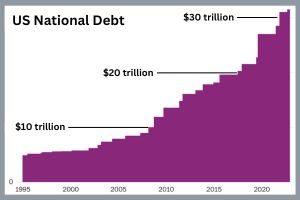
Look at the US national debt clock.
Right now we owe over $31.8 trillion, and that amount is increasing so fast that the last five digits on the clock are a blur.
Our government is burning through tens of thousands of dollars faster than you can keep track of the number changing.
A million dollars every 36 seconds – well, about that anyway; I couldn’t press the buttons on my stopwatch fast enough to get within $30,000 or so.- Watch video!
There are less than 128 million income tax payers in this country and there’s no way we can finance all the spending the government wants to do.
Yes, some people talk about taxing the rich or the one percent or the big corporations instead of regular taxpayers, but it doesn’t matter; the money always comes out of the pockets of ordinary working Americans in the end.
A big corporation might have legal personhood, but it isn’t really a person. It’s a collection of people that sells goods or services to other people – ordinary people – and if the corporation has to pay more tax, those ordinary people end up paying for it through higher prices or lower wages.
The government has to stop spending so much, but it won’t, because it’s scared of losing votes. So, instead, it borrows the money and hopes that somehow, by some miracle, the world will keep lending to us and we’ll never have to pay it back.
The problem is, the day when taxes won’t even cover the interest on our debt is coming over the horizon. In the next ten years we’ll spend $10.5 trillion on interest payments – while borrowing trillions more, that our government has no idea how to pay back.
Sooner or later the world will realize that we’re never going to repay the money we owe, and they’ll turn off the lending tap.
And, when that happens, the final collapse is just days away. When every federal employee doesn’t get paid, and every welfare check and Social Security payment fails to arrive, the US will be blown apart.
We’re not past the point of no return – yet. But we’re getting very, very close.
You can also access the latest news at this address: www.whatfinger.com
-
Subscribe
Subscribed
Already have a WordPress.com account? Log in now.
 Site Title