-
The Total Tipping Point Also Involves A Cold War! (No One Wants to Think About A Nuclear Crisis – And Hopefully It Will Never Happen – But We All Must Accept The Fact Nuclear Tensions Are Rising Globally With Russia)

No one wants to think about a nuclear crisis – and hopefully it will never happen – but we all must accept the fact nuclear tensions are rising globally with Russia and China (and others are seeking nukes) so we should prepare ourselves and our loved ones in the event the unthinkable strikes our soil.
For decades, movies and some in the media have portrayed a nuclear attack as a “doomsday” event implying most people would be killed on impact … and survivors would want to die once they come out of their shelters.
In reality, unless you are actually at ground zero or within a several mile radius of the blast zone (depending on the size of the nuke, of course), there is a very high probability you’ll survive as long as you…
- limit your exposure to radiation and fallout,
- take shelter with proper shielding,
- wait for the most dangerous radioactive materials to decay.
In other words, you CAN survive a nuke attack … but you MUST make an effort to learn what to do! By learning about potential threats, we are all better prepared to know how to react if something happens.
Please realize this is being written with small nuke devices in mind (like a 1-kiloton to 1-megaton device). A larger device, ICBM or a nuclear war would cause more wide-spread damage but some of this data could still be helpful. These are some very basic tips on sheltering for any type of nuclear (or radiological) incident.
What happens when a nuke explodes?
A nuclear blast produces a blinding light, intense heat (called thermal radiation), initial nuclear radiation, 2 explosive shock waves (blasts), mass fires, and radioactive fallout (residual nuclear radiation).
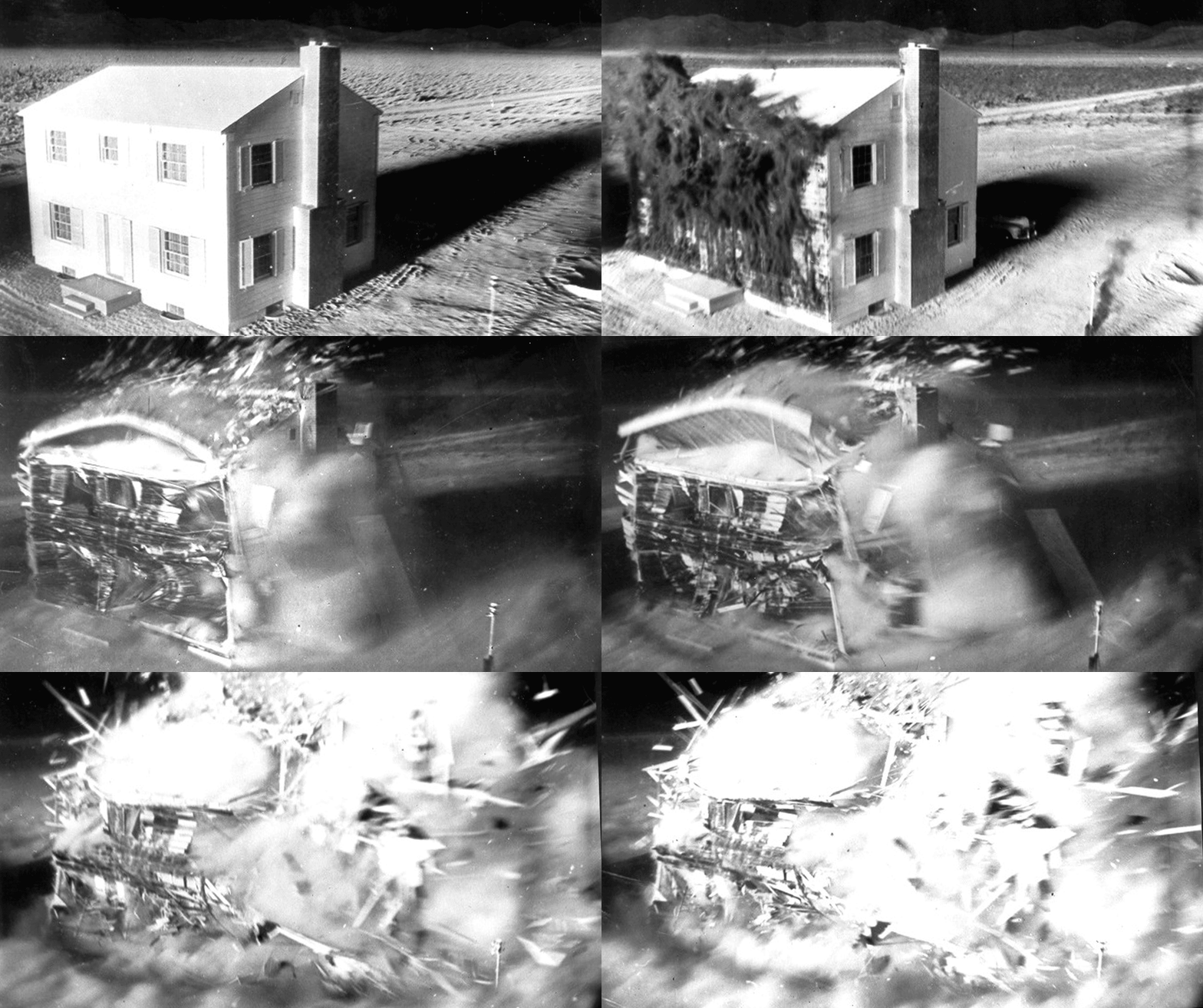
The below graphic shows the destruction of a test home by an atomic blast on March 17, 1953 at the Nevada Proving Ground. The structure was located 3,500 feet from ground zero, and the time from the first to last picture was 2.3 seconds. It shows the force of the blast wave then the radiating energy set it on fire.
Also, if a nuke is launched over our continent and explodes miles above the earth, it could create an electromagnetic pulse (EMP). An EMP is a split-second silent energy burst (like a stroke of lightning) that can fry electronics connected to wires or antennas like cell phones, cars, computers, TVs, etc. Unless electronics are grounded or hardened, an area or nation could experience anything from minor interference to crippled power, transportation, banking and communications systems.
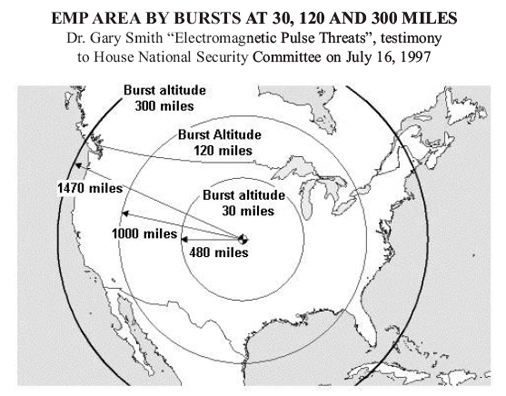
An EMP from a high-altitude nuke (where a nation or group succeeds in detonating a nuclear device carried miles into the atmosphere) could affect electronics within 1,000 miles or more as shown below. (Evidence suggests some countries and groups are working on enhanced and non-nuclear EMP weapons or e-bombs.)
What is the most dangerous part of a nuclear attack?
Both the initial nuclear radiation and residual nuclear radiation (also called radioactive fallout) are extremely dangerous.
Initial nuclear radiation is penetrating invisible rays that can be lethal in high levels.
Radioactive fallout (residual nuclear radiation) is created when the fireball vaporizes everything inside it (including dirt and water). Vaporized materials mix with radioactive materials in the updraft of air forming a mushroom cloud.
Fallout can be carried by winds for hundreds of miles and begin falling to the ground within minutes of the blast or take hours, days, weeks or even months to fall. The heaviest fallout would hit ground zero and areas downwind of that, and 80% of fallout would occur within 24 hours. Most fallout looks like grey sand or gritty ash and the radiation given off cannotbe seen, smelled, tasted or felt which is why it is so dangerous. But as the materials decay or spread out radiation levels will drop.
More about radiation
Types of radiation – Nuclear radiation has 3 main types of radiation…
- alpha – can be shielded by a sheet of paper or by human skin. If alpha particles are inhaled, ingested, or enter body through a cut, they can cause damage to tissues and cells.
- beta – can be stopped by skin or a thicker shield (like wood). Beta particles can cause serious damage to internal organs if ingested or inhaled, and could cause eye damage or possible skin burns.
- gamma – most dangerous since gamma rays can penetrate the entire body and cause cell damage throughout your organs, blood and bones. Since radiation does not stimulate nerve cells you may not feel anything while your body absorbs it. Exposure to high levels of gamma rays can lead to radiation sickness or death, which is why it is critical to seek shelter from fallout in a facility with thick shielding!
Radiation detection devices – You cannot see, smell, taste or feel radiation, but special instruments can detect even the smallest levels of radiation. Since it may take days or weeks before First Responders could get to you, consider having these devices handy during a crisis or attack since they could save your life.
Measuring radiation – Radiation was measured in units called roentgens (pronounced “rent-gens” and abbreviated as “R”) … or “rads” or “rem”. An EPA document called “Planning Guidance for Response to A Nuclear Detonation 2nd Edition June 2010” explains … 1 R (exposure in air) ≅ 1 rad (absorbed dose) ≅ 1 rem (whole-body dose). Although many measuring devices and older documentation use R and rem, officials and the media now use sievert (Sv) which is the System International or SI unit of measurement of radiation. The formula to convert sieverts to rems is quite simple … 1 Sv = 100 R (rem).
How many rads are bad? – High doses of radiation in a short span of time can cause radiation sickness or even death, but if that high dose is spread out over a long period of time, it’s not as bad.
According to FEMA, an adult could tolerate and recover from an exposure to 150R (1.5 Sv) over a week or 300R (3 Sv) over a 4-month period. But 300R (3 Sv) over a week could cause sickness or possibly death. Exposure to 30R (0.3 Sv) to 70R (0.7 Sv) over a week may cause minor sickness, but a full recovery would be expected. But radioactive fallout decays rapidly so staying in a shelter with proper shielding is critical!
The “seven-ten” rule – For every sevenfold increase in time after the initial blast, there is a tenfold decrease in the radiation rate. For example, a 500 rad level can drop to 50R in just 7 hours and down to 5R after 2 days (49 hours). In other words, if you have shelter with good shielding and stay put for even just 7 hours … you’ve really increased your chances of survival. Your detection devices, emergency radio or cell phone [if the last 2 are working, that is] can assist you in knowing when it’s safe to come out.
Coping with reality is the best way to beat it. Prepare. Most of us are. We are just waiting for the S to HTF, so to speak. Once it does, and it will again, we will be comfortable and unafraid while others won’t be able to function without submitting to their own enslavement in exchange for a can of corn.
So how do I protect myself and my family?
Basic shelter requirements – Whether you build a shelter in advance or throw together an expedient last-minute shelter during a crisis, the area should protect you from radiation and support you for at least 2 weeks. Some basic requirements for a fallout shelter include …
- shielding
- ventilation
- water and food
- sanitation and first aid products
- radiation monitoring devices, KI (potassium iodide), radio, weapons, tools, etc
Reduce exposure – Protect yourself from radioactive fallout with …
- distance – the more distance between you and fallout particles, the better
- shielding – heavy, dense materials (like thick walls, earth, concrete, bricks, water and books) between you and fallout is best. Stay indoors or below ground. (Taking shelter in a basement or a facility below ground reduces exposure by 90%. Less than 4 inches of soil or earth can reduce the penetration of dangerous gamma rays by half.)
- time – most fallout loses its strength quickly. The more time that passes after the attack, the lower the danger.
Indoor shelter locations – If you don’t have a fallout shelter, these options could provide protection from dangerous radiation by using proper shielding materials.
- basement – find the corner that is most below ground level (the further underground the better)
- 1-story home / condo / apartment – if no underground facility, find a spot in center of home away from windows
- trailer home – find sturdier shelter if possible (like a basement or brick or concrete building)
- multi-story building or high-rise – go to center of the middle section of building (above 9th floor if possible). Note: if rooftop of a building next to you is on that same floor, move one floor up or down since radioactive fallout would accumulate on rooftops. Avoid first floor (if possible) since fallout will pile up on ground outside.
Shielding materials – All fallout shelters must provide good protection from radioactive particles. FEMA suggests having a minimum of several inches of concrete or 1 to 2 feet of earth as shielding around your shelter, if possible, and the more the better. Per FEMA, the following shows examples of shielding materials that equal the protection of 4 inches (10 cm) of concrete …
- 5 – 6 inches (12 – 15 cm) of bricks
- 6 inches (15 cm) of sand or gravel
- 7 inches (18 cm) of earth
- 8 inches (20 cm) of hollow concrete block
- 10 inches (25 cm) of water
- 14 inches (35 cm) of books or magazines
- 18 inches (46 cm) of wood
Make an expedient shelter – Some very basic ways to build an expedient last-minute shelter in your home, apartment or workplace to help protect you from dangerous radiation include…
- Set up a large, sturdy workbench or table in location you’ve chosen. If no table, make one by putting doors on top of boxes, appliances or furniture.
- Put as much shielding (e.g. furniture, file cabinets, appliances, boxes or pillowcases filled with dirt or sand, boxes of food, water or books, concrete blocks, bricks, etc.) all around sides and on top of table, but don’t put too much weight on tabletop or it could collapse. Add reinforcing supports, if needed.
- Leave a crawl space so everyone can get inside and block opening with shielding materials.
- Leave 2 small air spaces for ventilation (about 4-6″ each) – one low at one end and one high at other end. (This allows for better airflow since warm air rises.)
- Have water, radiation detection devices, KI, battery operated radio, food and sanitation supplies in case you have to shelter in place for days or weeks.
In summary, those within the blast zone of Ground Zero (depending on the size of the nuke) won’t make it .. BUT .. if you are a few miles outside the zone your chances of surviving it are high but you MUST have detection devices to monitor levels of radiation and a plan to stay sheltered for at least 48 hours or up to a few weeks. First Responders will have to wait for the deadly fallout to decay before they enter a hot zone so the more you prepare, the better your odds of surviving a terrorist nuke.
You can also access the latest news at this address: www.whatfinger.com
-
First 13 Places to Avoid Going When SHTF
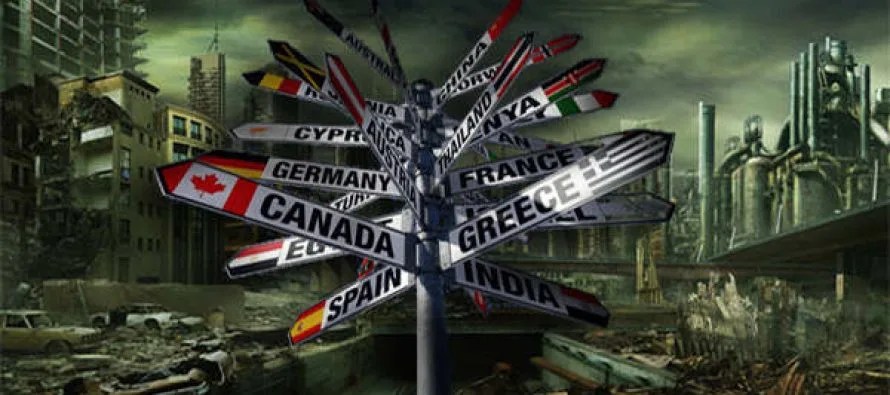
When it comes to being prepared for a SHTF event, preppers are focused on threats from natural disasters to nuclear wars, EMPs, and devastating cosmic events. The situations that people can focus on and become obsessed with preparing for and unpredictable and vary widely. There’s no way that one person or family could be completely prepared for every single type of event. So, most people choose one or several related events they believe are imminent and prepare as best they can for those.
But the less talked about threat that will be overwhelming no matter what the situation is that arises, is population density. For example, according to this map of population density by county shows that roughly two-thirds of the U.S population is located in the Eastern half of the United States. In fact, according to recent reports by the U.S. Census Bureau (2010 data), approximately half the population resided in just 146 counties out of 3000 counties in the United States.
That’s right. The biggest threat to your safety and the safety of your family is in fact, other people. They aren’t “bad” people out to get you. Some of them would likely give the shirt off the back to help others in normal circumstances. But in a SHTF situation, people just like you who are doing what they need to do to provide for their families can be a threat. Scared, and willing to do anything to get away from immediate danger, large numbers of these people can be the difference between life and death for your family.
So, when SHTF, how do you mitigate population density to increase your ability to keep yourself and your family safe? The easiest way is to plan to avoid other people as much as possible. The problem that most people run into during an emergency or SHTF situation is they are unprepared, and they panic. When you sense danger, the first instinct for most people is to flee. Sure, some people will naturally react with fight instead of flight, but the majority of people will flee first and fight only when cornered.
The best way to be prepared to avoid the crowds of desperate people is to know which places to avoid going when SHTF. We’ve listed some examples below:
1. Downtown
It goes without saying that downtown areas of any city should be avoided. This is especially true in mid to large cities where lack of regular sanitation services will create ideal conditions for diseases. The risk of rioting, looting, and violent attacks is also greater in downtown areas. City dwellers are statistically less prepared for a SHTF event as many families live paycheck to paycheck with very little stockpiled supplies.
In addition, because population density is highest in these areas, stores and other sources for supplies will be quickly cleaned out. Many city residents depend on public transportation on a daily basis and are less likely to have access to a vehicle to flee the city. Mass numbers of people in these areas will be desperately seeking food, water, and medical supplies, as well as transportation out of the city.
2. Main Roads, Intersections, and Freeways
If you are planning to bug out to an area outside of the city, or if you are caught away from home, it may seem like the shortest route is the best course of action. But, keep in mind that main roads and busy intersections will quickly become overwhelmed with people trying to flee just like you are.
Most people only know one or two ways to get out of the city and these are usually main roads. Those who are looking to steal supplies will see main roads and intersections as prime locations to ambush unwary travelers. Get a map of your area now and plan several routes out of the city and from work to home that use side roads rather than highways and state routes.
3. Bottleneck Points
A bottleneck can be any area that a majority of people must travel in order to get out of a cul de sac, neighborhood, city, county, or state. In most cases, this will be things such as bridges, overpasses, underpasses, freeway ramps, etc. If several hundred or thousands of people are fleeing the same area, and everyone must cross the same bridge to get out of town, that will quickly become a bottleneck point.
The same is true for any areas where there is only one road going in or out. Avoid these areas at all costs and look for alternative ways to get through or cross, even if it means taking a longer way around or traveling in a nontraditional way (motorcycle, private plane, bicycle, on foot, etc.).
4. Hospitals
It may seem weird to see hospitals on a list of places to avoid following a SHTF event because one would think this would be a place to find help. The reason to avoid hospitals if at all possible is because most people, especially those that are injured, will flock to them. Even people who aren’t injured may head for the hospitals to get help for family members who have been injured.
Emotions in this area will be high and the risk of violence is greater as people lose control. In addition, patients who are ill and/or patients dying from lack of resources will increase the risk of rampant infection and disease. The hospital and surrounding areas will be a petri dish environment for viruses and bacteria. With medical resources limited, you’ll want to avoid getting sick to increase your odds of long-term survival.
5. Prisons and Surrounding Areas
This one should be a no brainer. If there is a prison in your area or along the route to your bug out location (BOL), you’ll want to avoid the area as much as possible.
During a SHTF event, it’s likely that guards and staff may abandon their posts to care for their families which increases the likelihood that violent prisoners can escape and be on the roads. These prisoners will come out into the chaos without any supplies, they will be desperate to survive and could be more willing to use violence to commandeer your supplies or vehicle.
6. Police Stations and Military Bases
Like with hospitals, it may seem counterintuitive to avoid police stations and military bases following a SHTF event. Police and military are supposed to serve and protect citizens, right? But although it may seem like going to these locations would be a safer alternative, in most cases it will be a waste of precious time and may in fact get you killed or locked up instead.
Police stations and military bases will be among the most secure buildings. They will be heavily guarded, and they will not be opening their doors to the mass numbers of people who show up. Crowds outside these areas will be frustrated and angry at not being granted protection. The last thing you want is to step into the middle of that crowd with your BOB of supplies, food, and water.
7. Shelters or FEMA Camps
Although shelters are designed to help those people who find themselves without a place to sleep or food to eat, most shelters are understaffed and operating at or above capacity even in normal times. Homeless shelters and food banks will be quickly overrun by mass numbers of people. Some may be forced to close the doors to newcomers within days of a SHTF event.
These shelters and any publicized FEMA camps that spring up will have very poor conditions. Supplies will be rationed, tempers will be high, and violence will be rampant. As more people arrive, and conditions worsen, the buildings and surrounding areas will quickly become breeding grounds for infection and disease.
8. Grocery Stores and Shopping Plazas
For people who are not prepared, their first instinct will be to find food, water, and supplies. Humans are creatures of habit and thus many will flock to local grocery stores and shopping plazas and begin looting for needed supplies.
These areas will be picked clean within less than 24 hours of a SHTF event. Those that are left there will be the most desperate and scared for their lives. These crowds are unpredictable and often violent.
9. Gas Stations, Auto Parts, and Convenience Stores
The reason to avoid gas stations, auto parts, and convenience stores is similar to that of other stores and shopping areas. Desperate people are going to flock to the first places they think of to find supplies to get out of the area. Those trying to get of the city will want to try to gas up and/or get.
For all but those people who were quick to get on the road, getting gas will be nearly impossible. Lines at these places will be long, tempers will be high, and violence will be much more likely, especially when pumps run dry and shelves are bare.
10. Hardware and Sporting Goods Stores
One thing that people will be searching for when SHTF is guns, ammo, and other items to use for protection. Since sporting goods and hardware stores carry a lot of these items, these stores will be hot spots for looting. If you don’t already have your weapons ready when SHTF, you’re better off to look around your home for items you can use, rather than try for a quick trip to a hardware or sporting goods store.
11. Banks, Check-Cashing, & Pawn Shops
One thing just about everyone who isn’t prepared in advance will be looking to get first is accessing to cash. For this reason, banks, check cashing or loan offices, and pawn shops should be avoided following a SHTF event. This is where large numbers of people will flock toward first.
Many people in these areas will become trapped, unable to access their money, either because computers are down or because cash reserves were already depleted. When desperate people can’t get access to cash that they believe will help them get needed supplies, things will get ugly.
12. Large Shopping Malls and Public Squares
When things get chaotic just before a SHTF event, the last place you will want to be is in a public square or large shopping mall. These places can quickly become a gathering place for desperate, angry people. Rioting, looting, and violence will be high in these areas so it’s best to avoid them if possible.
13. Large Social Gatherings and Public Events
If you even suspect that things around you are getting chaotic. If you sense civil or economic unrest or have recognized other precursors to a SHTF event, you will want to avoid large social gatherings and public events. These events draw large crowds of people on the same date and time. Events or gathering that are tradition or annual events that can be predicted or are widely publicized are more dangerous. These are prime target events for terrorists.
What to do Instead:
Now that you know what places to avoid going when SHTF, here are some things you can do to make sure you can avoid these places and still have a good chance of surviving:
Starting today, make it a habit to keep your gas tank at least 3/4 full at all times. Take steps to properly store additional gasoline in approved containers so that you can fuel up at home and skip the last-minute trip to the gas station on your way out of town.
Follow a regular maintenance schedule for your vehicle to keep it in top running condition at all times. Proactively make vehicle repairs so that your risk of a breakdown is less when SHTF. Stockpile spare parts such as belts, spark plugs, wiper blades, washer fluid, transmission fluid, antifreeze, brake fluid, and engine oil so you can replenish as needed without that trip to the auto parts store.
Create safe storage places where you can begin to stockpile emergency cash so that you have it on hand when SHTF and do not need to make any last-minute runs to a bank, ATM, or pawnshop for cash.
Conduct a weapons inventory of any guns, ammo, knives, and personal self-defense weapons (mace, stun gun, etc.). Be sure to consider any other potential items (ball bats, shovels, chains, etc.) that could be used for weapons and protection during a SHTF event. Know what you have on hand and train yourself and family in how to use it if needed for protection.
Clearly mark danger zones in advance on a map or maps of your local area and surrounding areas. Plan several different escape routes so that you can quickly change course if needed due to unexpected danger or obstacles. Identify and plan to use alternative routes out of town including logging roads, railroad tracks, and power line easements if needed to avoid danger zones.
Locate and clearly map out any sources of fresh water that won’t be the first thought for others such as small lakes, ponds, private or public swimming pools, creeks, and rivers. Include a hand water pump and collapsible water jug in your BOB as well as a way to filter and boil water from these sources.
Stockpile lightweight food, ways to filter water, and medical suppliesso that you won’t be tempted to make a last run to grocery or other shopping areas. Create a system of hidden supply caches along your routes to your BOL so you can replenish supplies that are used, stolen, or confiscated along the way.
Planning a bug out can seem overwhelming. But the more you plan and prepare in advance, the more likely you will remember which places to avoid going when SHTF.
You can also access the latest news at this address: www.whatfinger.com
-
Americans that have only known the post WWII prosperity are ill equipped and educated to deal with depression level living. (Doug Casey believes we are headed for what he calls a super depression created by the ending of a debt super cycle.)

The forces are mounting that will eventually overwhelm most Americans and send their standard of living to unknown depths. Americans that have only known the post WWII prosperity are ill equipped and educated to deal with depression level living. Easy credit and instant gratification have created a nation of whining, self absorbed, entitlement minded people with no moral or mental toughness.
Doug Casey believes we are headed for what he calls a super depression created by the ending of a debt super cycle. The bigger the debt cycle the bigger the depression that follows. That’s how reality works and most people are not prepared for reality.
When this depression, which has already started, gets momentum, it will overwhelm the plans of a society that is expecting to get things like social security, pensions and payouts from retirement plans they have paid into for many years. All of those things will disappear almost overnight and leave society gasping and stupefied over what to do. Their reactions will be to yell and scream and try to identify who to blame but the only person they should blame is the one in the mirror.
Many very smart people have raised the alarm and done their best to warn the sleeping public, but those slumbering masses have ignored the warnings and hit the snooze button one more time. The masses do not understand economics, do not want to understand economics and they will pay dearly for that ignorance in the coming days.
When the real unemployment rate becomes common knowledge as it increases substantially, people will be left to survive on what resources they have saved up outside the banking system that cannot be stolen by the politicians and bankers. That is a key point here. The assets you have outside the system that cannot be stolen from you with a few key strokes on some computer.
Those hoping for some miraculous event that will send the U.S. back to the days of manufacturing might and jobs for all will never see it happen. Those days are gone. The west line theory tells us our economy will slow down and become more modest as the shipping center of the world moves west to the next powerhouse region which is Asia. This is what history teaches us.
When people suddenly wake up one morning and they have no job, their retirement is gone and they need to care for their family, what will they do? When government services have collapsed and they suddenly realize they are now living in a third world country with few government services, what will they do? When the banks are closed and only a select few connected people have any type of money or access to goods, what will they do?
This is the reality that many people will face in the future and they have no idea how bad it can get. They refuse to contemplate the harsh reality they will be living in and take steps to mitigate the effects. To do so would be to acknowledge it could happen and they are taking personal responsibility. Personal responsibility is a dirty phrase in today’s entitlement society. To see some of the effects one only has to look at the collapse of society in Venezuela today to see what awaits.
When it happens it will all fall back to you to take responsibility for your family and take care of them for the duration. To do that you need to plan now for that eventuality and build up the resources you will need to provide food, shelter, clothing and security when the system fails to do it for you. You need to be Noah on his ark not the people watching as he floated away.
Having resources stored up is a must but it may not get you all the way through if the situation lasts for many years. That is why you need some type of plan to replace those resources as time goes by and have some way to generate some type of income or at least items to trade. Usable goods are for the short term and things like gold ,silver and production equipment are for the long term to help you get through the crisis with the least amount of pain.
Even with proper planning the days ahead will not be easy as the standard of living of society will fall substantially to levels only seen in failed third world countries or old pictures. The assets actually owned by people today is very small compared to how they live. They will default on their home loan, their car loan, and their credit card debt leaving them with very few real possessions and few ways to move what they have left even if they have some place to go. Ultimately these people will become the new serfs to the wealthy class that will take possession of anything of value. Feudalism will once again rule.
The lack of planning by society will make this a reality if it is allowed. What will you do when everything you have worked a lifetime for is suddenly taken away? Do you have a plan to keep what you have? Do you have a plan to make money when you cannot find a job? Do you have a way to take care of your family until things stabilize? Do you have a home you will not lose if the whole system breaks down? What will you do if electricity or fuel is too expensive to buy or not available to the general population? These are the questions you should be asking yourself now and you better have a good answer because your family will be asking them when the greater depression sets in.
10 Weird Foods That Were Common During The Great Depression
1. Prune Pudding
Prunes were a humble, inexpensive food source during the Depression. First Lady Eleanor Roosevelt actually made headlines by pressuring her husband to eat prune pudding when guests came to the White House for a visit. Why prunes? They were easily stored and didn’t cost as much as other fresh fruits.
2. Dandelion salad
Foraging was not uncommon during the Great Depression, and it was easy and free to scavenge in the backyard for edible greens. Dandelions weren’t the only produce of choice; many Depression-era homesteaders also made soups or salads out of burdock root, wild onions and other weeds. Although dandelion salad is still popular in many cultures today, it’s typically accompanied by sweet or tangy ingredients to offset the bitterness of the plant.
3. Fish …. anything
Fishing was a popular pastime during this era, not just because it was an enjoyable way to spend a Sunday, but also because it put food on the table! A weekend fish fry would produce enough leftovers for the entire week. Bones, heads and tails could be used for soup or gravy stock.
4. Creamed chipped beef
This curious dish originated in Pennsylvania Dutch country and consisted of salted beef and milk. Any kind of beef-like meat could be used (cows were difficult and expensive to raise, so goats or wild game could also be used).
It was typically served on toast and became a staple for soldiers fighting overseas during World War II. Ever heard your grandparents talk about you-know-what on a shingle? This is it!
5. Ritz cracker crust
The purpose behind this crust has nothing to do with the crust itself, but what the buttery flavor of the Ritz crackers does for the apples. Apples were in short supply during the Depression, so the rich flavor of the crackers helped to supplement the limited apple flavor.
6. Spaghetti with boiled carrots
Carrots were easy to grow in most homestead gardens during the Great Depression. As a result, spaghetti with boiled carrots—with the addition of a simple white sauce—was a heavily promoted, relatively nutritious dish in schools throughout the country.
7. Meatless loaf
When raising livestock was impractical or impossible, many Depression-era cooks turned to meatless loaves for sustenance. Made out of vegetarian ingredients such as peanuts, rice, cottage cheese and flour, these cakes were popular before tofu was even a thing.
8. Vinegar pie
As mentioned, fruits were in low supply and high demand during the Great Depression. During cold winter months, most families found themselves without any fruit at all. What to do about dessert? Many bakers added vinegar to a mixture of spices (such as cinnamon and cloves) and—if fortunate enough—butter or cream to create a low-cost version of a pie or cobbler.
9. Peanut butter stuffed onions
This dish was commonly suggested in newspapers and magazines as a nutritious and delicious recipe for any family’s table. Although the glop wasn’t popular for its taste, texture or nutritive qualities, it must have contributed to at least a small uptick in oral hygiene.
10. Kraft macaroni and cheese — wait, what?
James Lewis Kraft, the founder of Kraft foods, patented the process of emulsifying and powdering processed cheese in order to give it a longer shelf life—a necessity during this time period. Although the packaged dish was originally sold as a bag of pasta with a package of powdered cheese attached to it, it still exists today as one of the few Depression-era meals with lasting popularity in American households.
Making ends meet was tough during the Great Depression, but with some creative thinking and adventurous palates, these homesteaders made the most of whatever they were given. Whether you’re planning meals for a large family or on your homestead, keep these tips in mind for ultimate success in living off the land.
In Venezuela, electricity has turned into a rare and unpredictable commodity. They don’t have it all the time, and blackouts have become a normal part of daily life.
If the grid were to go down for a prolonged period of time and no medical help was available, what would you do if you were injured?
In this video, we’ll go over a tool for this community that can mean the difference between life and death.
But if you want to find out how you can still manage in a situation like this, you must also look to Venezuela and learn the ingenious ways they developed to cope.
Also watch: www.whatfinger.com
-
The Safest Zones In The US. Do You Live Near One? We live in a MASSIVE nation full of all kinds of opportunity. There are areas that are incredibly dangerous, but the reality is we have a lot of wide open spaces that can be whatever you want them to be!

First take a look at one of the most shocking videos in the world! This video actually shows us what the secret of the Trump family is related to their expressive health!!! –FULL VIDEO HERE
You might be looking at your nation a little differently lately.
There have always been dangerous neighborhoods and boroughs. Places like Compton, Kensington, and Camden might come to mind when you think of places that have a reputation for crime. Some of these areas have actually improved from when I was child. However, there are lots of places all around this nation that have been dangerous and many that are getting worse.
The move towards lawlessness in many of our biggest cities has been brought on by the current attitude towards police and police funding. As states bandy about the issues and people worry about things like natural disasters and economic decline, many have moved or considered moving.
What are the safest zones in the US?
Safest Cities
There are safe havens all around this nation. There are places that have historically had low crime and great community cohesion. The key in most of these cities and towns is ownership and loyalty. Most often transient places are dangerous, and people are more likely to commit crimes in these places.
Let’s look at some of the safest cities and towns in America:
- Round Rock, Texas
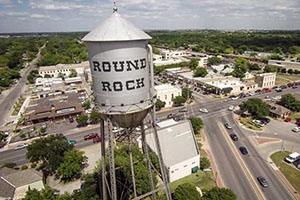
With a population just over 100,000 this smaller town in Texas is a very appealing place for preppers to live. It is also a very safe place with a median income of $70,000.
The low poverty rate in Round Rock has much to do with the safety and security of this Texas town.
Round Rock has been dubbed a “super suburb” as a place just outside of Austin
- Naperville, Illinois
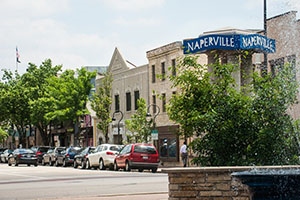
This Chicago suburb is a gem in an area that most people would not expect. The River Walk is an important part of Naperville, but it is hardly the only thing that this suburb offers. A population 144,000 people are a successful and well paid lot. The median household income is over $100,000.
The minimal crime rate, per 100,000 people, has much to do with the low poverty rate which is just over 4%. 77.6 violent crimes per 100,000 people is something to be proud of.
The safety of Naperville could also have to do with the tremendous outdoor opportunities. With over 130 parks and 2 public golf courses, there is nearly a park for every person!
- Port St. Lucie, Florida
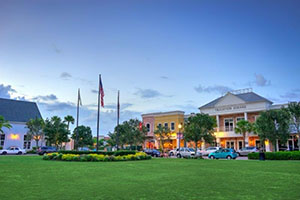
If you are going to pick a new safe place to live, why not consider a place where the weather is wonderful! Along the southern coast of Florida Port St. Lucie is a beautiful tropical zone with $169,000 a year median income.
You will have to be prepared for hurricanes. An evacuation plan is needed as the southern coast of Florida is at risk during hurricane season, but we are preppers!
You will not have as much to worry about when it comes to violent crime as there are just 115 violent crimes per 100,000 people. You will love near breweries, botanical gardens, preserves and marinas. Great fishing on the coast, too!
Best Regions to Survive Disasters
Along with safe cities and towns America also features some great regions to setup a life that are far away from some of the biggest threats. Remember, people are only one threat. Mother nature can have a devastating affect on the North American continent and has done so in the past. From massive super volcanoes to devastating earthquakes.
Also watch this video- According to NASA, we’re going to face a 100-YEAR LONG DROUGHT.
What are the safest regions to survive massive cataclysmic disasters?
- The Cascades
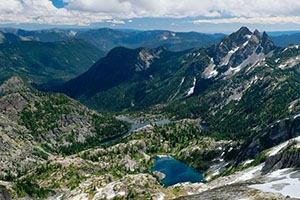
Deep enough inland and high enough up to counter things like flooding and tropical cyclones that affect the West Coast. The cascades are loaded with resources for survival like water, food, and wood. They are a beautiful backdrop to deal with the post-apocalyptic world and far enough away from southern California to inherit any of that mess.
The northernmost portions of the Cascades are even located in the American Redoubt, which we will discuss later in this article.
- The Blue Ridge Mountains
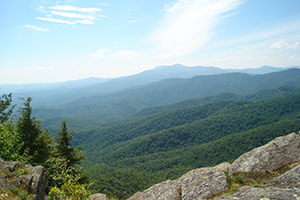
Another range of mountains that offer similar benefits as the Cascades. This east coast mountain range covers several states, has plenty of food, water, shelter, and game animals. Covering the land by food would not be easy but the seclusion from the chaos would be well worth it.
Because of elevation and distance from the coast there are almost no threats of flood, tsunami, or hurricane in this region. There is little seismic activity in the area.
West of some particularly important and sizeable cities, the Blue Ridge mountains could become a safe haven for millions of people in the very worst case scenario. That is the only weakness of this location.
- Appalachia

Further west still, on the other side of the blue ridge mountains in the region of Appalachia which runs from New York to Mississippi. This is another great region to consider because of its sparse population compared to the coasts. Its quick access to the Blue Ridge Mountains and safety from most major disasters.
Also watch this video- This Could Kick-Start World War 3 Fellow Patriot
Prepper Strongholds
Are you looking for even more benefits? Maybe you want the people and the safe places. There is nothing wrong with that. Around the nation there are several places that have not only been deemed safe and pleasant but are also filled with preppers!
Yup! The self-reliant and independent have taken up refuge in a few spots across the nation. They are often looking for more friends like them to build their prepper community. These areas are not just filled with preppers but are in rural areas where other people are as self sufficient as the prepper community.
- Redoubt
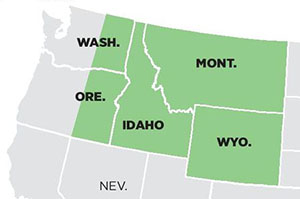
In 2011 James Wesley Rawles proposed Idaho, Montana, and Wyoming as the American Redoubt. The Redoubt also encompasses the eastern parts of Washington and Oregon. It is unclear how many people have moved to the American Redoubt with the intent of stockpiling, prepping, or homesteading for the long haul.
However, there is a small community of voices from Rawles, to John Jacob Schmitt, to the American Christian Network, that will align with much of what you believe. It has been estimated that thousands of people have moved to these areas as a safe haven from the growing turmoil of our world.
Because of its low population density and impressive access to resources, as well as low threat profile, as long as you can stay warm in the winter, the Redoubt has some tremendous benefits. You will also have plenty of wide open space so if you don’t align with everything Rawles proposed you can do your own thing and be just fine!
- Ozarks
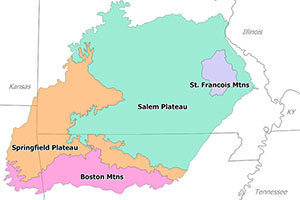
The Ozarks are more of a plateau than a mountain range with some of its tallest peaks between 1-2000 feet tall. Because of its location in the nation and its elevation, it has a tremendous amount of benefits to the average prepper looking for a safe zone.
The Ozarks are not affected by things like floods because of the elevation, it has this elevation without snow because it is in the south. It does not face any kind of earthquake threat, hurricane, or forest fire. There is a long growing season that features lots of rain.
Pastor Joe Fox of Viking Preparedness has been expanding his Shofar mountain and influencing preppers for many years to make their way to the Ozarks. COOHMP or Come Out of Her, My People as taken from the book of Revelation. A growing prepper stronghold has taken root in the Ozarks making it a wonderful place to move and a very safe region.
►”Deep State: How to Defeat America’s Greatest Enemy” and see what YOU can do about it!
Also, those who are not preppers in the Ozarks are looking to do their own things and basically be left alone. So, it is a sentiment we can all understand!
We live in a MASSIVE nation full of all kinds of opportunity. There are areas that are incredibly dangerous, but the reality is we have a lot of wide open spaces that can be whatever you want them to be!
Did you know there are even some places that will give you free land or pay you to live there! If you aren’t tethered to a location than you can take advantage of the areas, we mentioned. However, you should arrive there and become a part of the community. This is particularly important. You can never know the full potential of any area unless you integrate and become a member of the community.
Go forth and choose your destiny!

If you have any dissatisfaction with my content, you can tell me here and I will fix the problem, because I care about every reader and even more so about your opinion!
Article by JAMES WALTON, From- askaprepper.com (Original source)
-
Biden Debate Debacle Designed to Elect Trump

” Knowing that their man was completely incoherent, his people could have easily claimed illness, canceled the event, and either rescheduled or dropped it entirely. But they didn’t do that. Why?”
It’s possible that the Zionist faction of the Masonic Jewish dialectic is getting rid of Biden who is linked to the anti-Zionist Soros-Communist wing. Like WW2, WW3 is between the Zionist (Nazi, why Nazis fight with Ukrainians) and Communist wings of the Masonic Jewry. Trump is the Zionist wartime leader. (In WW2, FDR, Churchill and Stalin were all Communist Masons, and Hitler a Nazi Freemason.)
Franklin Rosenfeld (his real name) famously said, “In politics, nothing happens by accident. If it happens, you can bet it was planned that way.” A clear example is the televised “debate” last week between Donald Trump and an impostor claiming to be Joe Biden. If you got the feeling while watching it that you were seeing a circus sideshow, you were.
Nothing that you saw on television last Thursday night was real. Sure, there was a “debate.” But there was nothing spontaneous or unscripted about it.

Do you really believe that “Biden’s” people – the heads of the Democratic Party, the upper echelon of the Deep State, and donors willing to pour millions of dollars into his campaign – were caught unaware by his faltering performance? Is it even remotely possible that the man pretending to be Joe Biden wasn’t slurring his words and looking like he didn’t know where he was ten minutes before airtime? Thirty minutes before airtime? Hours before airtime? It is simply inconceivable to think so. Knowing that their man was completely incoherent, his people could have easily claimed illness, cancelled the event, and either rescheduled or dropped it entirely. But they didn’t do that. Why?
If you watched the staged CNN post-debate panel, hosted by CIA asset Anderson Cooper, it’s even more apparent how fake and gay the whole thing was. Those panelists knew exactly what they were going to say before the debate even started. Having CNN broadcast the panelists’ prearranged responses into the public consciousness within minutes of the debate itself is proof positive that the American people are being played once again. Not you, of course, you’re too smart for that. But the masses of asses that make up America are being duped, brainwashed, and told what to think for what seems like the millionth time.
In addition to running their fake debate and a fake discussion panel after their fake debate, CNN published a poll that allegedly shows 33% of the American public believes “Biden” won the debate.
Let’s start with that 33% number. Remember how often the number 33 came up during the entire fake pandemic? coronavirus 33 – Google Search That’s because 33 is a Masonic number. It was used continually to reassure those who knew the whole thing was fake, and also as a means to humiliate all of the dumbasses who fell for it. Could that be happening here too? Did the number 33 just come out of nowhere, or are the people behind the poll shoving it in the faces of a gullible public?
(The Deep State wants Trump)
That poll is fake. But let’s assume for a second that a sizable portion of people are so brain-damaged from the fake vaccine and so heavily inflicted with Trump Derangement Syndrome, that they actually do believe “Biden” won the debate. What does that say about the state of the country? That roughly a third of the population is simply too stupid and too degraded by sin to understand basic reality?Even the most mentally deranged Trump hater has to admit, if they’re being honest, that Trump utterly destroyed the man pretending to be Joe Biden in the debate. His victory was even more decisive than it was in the three debates he won over the hapless Hillary Clinton in 2016. Yet 33% of respondents claim otherwise?
Now we have the entire mainstream media calling in unison for the fake Joe Biden to step down. Friends, you’re watching a movie. Everything you are seeing was planned beforehand and is being carried out according to a prewritten script. The only difference is that now we’re looking at a White Hat operation.
As I’ve been saying for the last three years, Trump is going to win in November by the biggest margin of victory ever seen in American politics. You can take that to the bank. Nothing can stop what is coming.
-
24 Lost Survival Tips from 100 Years Ago – with Illustrations
When we’ll have no running water, no hyperactive emergency services, no electricity… we are going to turn back to what people did 100 years ago. Here you’ll find some “little” survival tricks popular in the early 1900’s and (some of them) useful even today.
100 years ago Gallaher Ltd printed a short “How-To” series, with clever hints for emergency situations. The cards were distributed with packs of cigarettes. All the pictures bellow are part of the George Arents Collection, The New York Public Library. Please enjoy the article.
1. How to Extract a Splinter

Take a wide mouthed bottle and fill it with hot water nearly to the brim. Now press the affected hand or foot tightly against the mouth of the bottle.
This will then cause a suction and pull the flesh down. The suction plus the steam will help pull out the splinter.
2. How to Make an Emergency Water Filter
A handy and efficient water filter can be made out of an ordinary bucket.
First make a hole at the bottom of the bucket.
Instructions: “The water percolates through the layers of fine and coarse sand, and clean picked gravel and stones, with which the pail is filled, filtering through to the bottom in a clear state.”
One of the best layers you should add to this bucket is one made of charcoal.
3. How to Engrave on a Knife

This method was widely used during the Middle Ages and all the engravings in swords or armors. Here are some armors engraved using this traditional way.
Instructions: “The steel to be worked upon should be covered completely with a coating of beeswax. The lettering or design to be engraved can then be drawn with the point of a clean quill pen. This lays bare the metal. A strong solution of sulphate of iron should then be repeatedly poured over the exposed surface for about ten minutes. The more prolonged the action of the sulphate the deeper will the steel be engraved.”
4. How to Make a Fire Extinguisher
Although is good to know, probably none of us will make these old fashion extinguishers since is much easier to buy one. And because the new ones are more effective (I guess) and definitely safer.
Dissolve one pound of salt and half a pound of salt-ammoniac into two quarts of water. Then bottle the liquid in thin glass bottles holding about a quart each.
Should a fire break out, dash one or more bottles into the flames, and any serious outbreak will probably be averted.
5. How to Purify Water in a Cistern
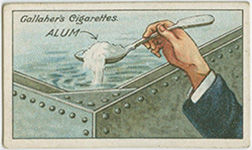
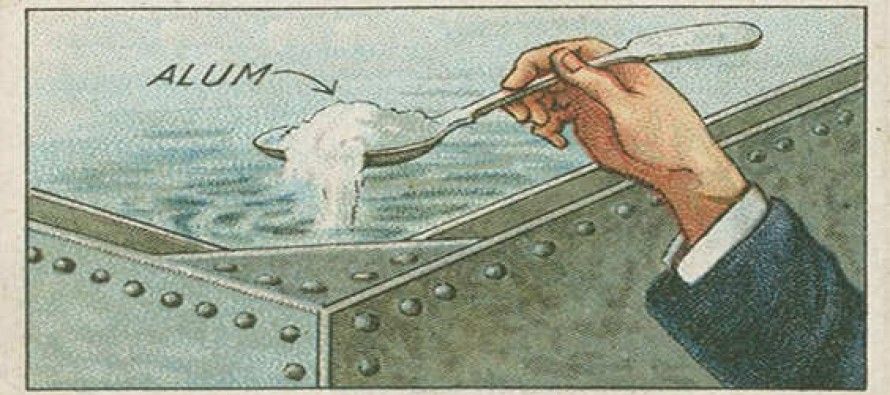
Easy! Stir in a tablespoon of powdered alum.
After 30 minutes the alum cause the particles and the bacteria to bound together and cause them to drop to the bottom leaving a clear purified water.
A tablespoon or half an ounce of alum will purify from sixteen to twenty gallons of water.
6. How to Treat an Animal Bite
First tight a ligature round the limb above the wound. This will stop a little bit the bleeding and it will give you a better visibility to evaluate the wound.
The next advice given back then was: “Thoroughly cleanse the wound and if there is any suspicion of madness in the attacking animal the place should be well sucked and cauterized with luna caustic, or a white hot iron, after cutting away the surrounding flesh with a sharp clean knife.”
The advice was really good for that time, when there were no vaccines. And even today doctors recommend thoroughly washing the wound as soon as possible with soap and water for approximately five minutes (to reduce the number of rabies particles). Povidone iodine or alcohol is then recommended to reduce the virus further. When SHTF and we’ll no longer be able to access vaccines this is your only option available.
7. How to Detect Escaping Gas
Gas leaks can be caused by faulty appliances, or by those that have been incorrectly installed or poorly maintained.
Some of us don’t even use gas anymore (like me) or some may have gas detectors, but either way, after an earthquake, or a hurricane or a tornado there will always be gas leaks.
This 100 years old method is risk free and quite reliable.
“Paint strong soap solution on the suspected length of pipe and the gas will then cause bubbles at the escaping point, which can be dealt with at once.”
8. How to Light a Match in the Wind
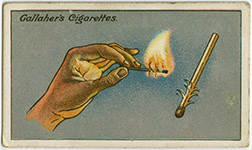
Instructions: “The familiar difficulty of lighting a match in the wind can be to a great extent overcome if thin shavings are first cut on the match towards its striking end, as shown in the picture.
On lighting the match, the curled strips catch fire at once; the flame is stronger and has a better chance.”
9. How to Find a Lost Trail
If a trail is lost, there isn’t much to do but to search for it.
A very good way to do that is to mark the last foot-print or sign you notice as the center of the circle and go round it at a distance of anything from 30 to 100 yards.
The trail should be discovered somewhere crossing the circular track you are following.
10. How to Cure Chilblains
“A simple and homely remedy, which immediately relieves the irritation and pain caused by chilblains, is salt and fresh apple juice.
The affected parts are rubbed gently with a slice of apple dipped in common salt. A good juicy apple should be used.”
11. How to Secure Loose Hammers and Axe Heads
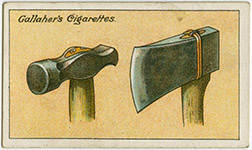
After wedging the handle of hammer as tight as possible, drill two holes at the end of wood and drive in two large screws.
An axe-head can be secured by boring a hole through the haft just bellow head and wiring through the hole and over top.
The wire should be twisted and staple driven into a hold position.
12. How to Tell the Points of the Compass with a Watch
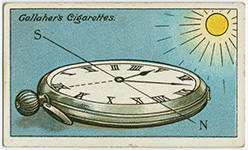
Take the watch of your hand. Point the hour hand at the sun and then lay a piece of wire or a blade of grass crosswise between the hour hand and the figure twelve.
The end of the wire between the twelve and the hour hand points south.
13. A Simple Cure for Catarrh

Treatment for catarrh may not be necessary because it often disappears within a few days, after your body has fought off the infection. But in some cases it doesn’t go away and it can be a health problem, especially for the underfed. In food crisis when people are poorly fed, these low-risk diseases kill more people than starvation itself.
Instructions: “Take a pinch of ordinary table salt up the nostrils, just as you would a pinch of snuff.
Then gargle the mouth and throat with warm water, being careful not to swallow it.
Do this each morning before breakfast.”
14. Three Useful Knots
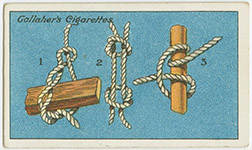
No. 1 is the Timber Hitch, which is especially useful in lifting all kinds of heavy work, such as huge beams.
No. 2, the Fisherman’s Knot, shows a good method of joining two ropes tightly together.
No. 3 is the famous Clove Hitch, which becomes tighter the harder it is pulled.
15. How to Bandage a Foot
A traditional method used to make the inflammation heal faster (especially for sprain ankles) was to place a leaf of cabbage between the bandage and the ankle.
In the picture: “Rest injured foot on operator’s knee on a clear towel.
Commence bandaging in manner shown by the lower diagram, the bandage being bound over and round the back of foot in spiral fashion, and eventually fixed by means of a safety pin, just beneath ankle, as shown in upper illustration.”
16. How to Make Roller Bandages

Instructions: “A roller bandage must be rolled evenly and tightly, so in the absence of a machine a chair will serve this purpose.
The picture illustrates procedure. Whilst one person carefully rolls another pulls tight opposite end of the bandage, and at the same time sees that no folds or creases are allowed to form.”
17. How to Fell a Tree
Having decided which side you wish the tree to fall, cut alternatively a downward and inward cut as you can see in the picture – in this order.
When about half through, proceed to cut the other side a few inches higher, and finally pull tree down with the help of a rope.
In a survival situation (and not only) you can use trees for their nutritious sap.
18. How to Build a Simple Shelter
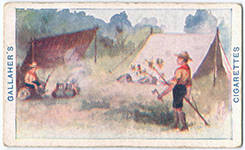
Instructions: “A simple shelter can be made by driving two forked sticks into the ground and connecting these by a pole resting on them.
Branches are then laid resting on the pole. The right angle should be around 45 degrees, and the screen fitted up with smaller branches, ferns, etc.”
19. How to Make a Water Fountain for Chickens
Instructions: “A simple water fountain, ensuring a supply of fresh water for the chickens, can be made from a pint wine bottle, supported by wire loops to a wooden upright as shown.
The bottle is inverted over an earthenware pan, with the mouth of the bottle about half an inch above the bottom of pan.”
I see that now there are even some “rodent resistant chicken feeders” which can be used together with the water fountain if you leave for 2-3 days.
20. How to Remove Foreign Particles from the Eye

Few things are more irritating than having something in the eye.
“Drop sweet or castor oil into the corner of the eye. Picture shows a ready method of allowing drop of oil to fall into eye from the poim of a paint brush.”
If the particle is of mortar or lime, bathe eye with weak vinegar and water.
21. How to Make a Chair to Cross a Stream
If your group has one or more people who cannot (maybe there are wounded) or don’t know how to swim, you might want to find a simple solution to help him cross a river. If there are nearby trees – and usually near rivers there are – all you need is a rope.
Fasten a strong rope to a tree and let somebody (who can swim) go across the stream and fasten the other end to a tree on an opposite bank.
Use another rope to improvise a chair fastening it into a running loop. “By means of a light rope fastened to the middle of (the) chair and held by someone at each end, those unable to swim are safely passed over.”
22. Keeping Plants Watered While Away on Holiday
There are many simple and cheap DIY tricks to keep your green friends properly hydrated so that you don’t return home to a house full of wilting and yellowing plants.
A traditional method is to fill a large bucket with water, and place it a little above the level of the plants.
You can group round or near as many plants as you want. Place one end of a strand of wool in the bucket and the other one to the plant.
You can place as many yarns as you want.
23. Rescue from Fire
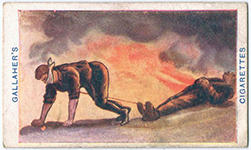
If it is necessary to enter a burning house in a search of unconscious persons, or to save a family member, first place a wet bandage over your nose and mouth and crawl in on all fours. You do this because the only Oxigen you may find is on close to the floor. (and the visibility is better)
Place a rope around his ankles. The other end of the rope around your chest or shoulders.
Then turn your back on him and drag him out. (you’re going on all fours with rope underneath)
24. How to Preserve Eggs

Preserve only eggs that are newly laid. Bury them in a box of salt.
This traditional way of keeping eggs has been almost forgotten. The eggs last about an year when they are totally buried in the salt. No air whatever must be allowed to get at the shells.
This way you’ll have eggs and salt for survival.
25. How to Treat Sprains
Elevate the injured joint and wrap in cloths wrung out in cold water. The picture shows how to keep the cloths constantly wet without having to change them.
Place a jug of water higher than the injured limb and a strip of linen with one end in the jug and the other end resting upon the wrapping of sprained joint.
The water will pass from the jug to compress keeping it constantly wet and cold.
The SHTF we all prep for is what folks 150 years ago called daily life. A hundred years ago people knew how to do a lot of things – that we now take for granted. Learning how to do stuff on your own is one of the most important things that one can do to prepare… And in time of crisis you need to be able to support and sustain your family without much outside aid.
Also watch: www.whatfinger.com
-
What preppers can learn from the Israel-Palestine war
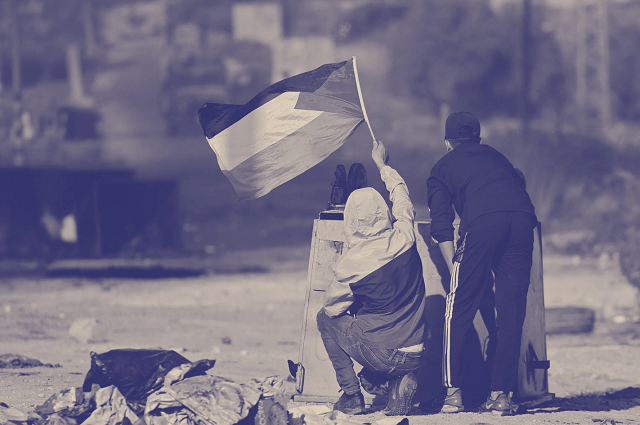
We live in a world marked by increasing uncertainty, geopolitical tensions, and unforeseeable disasters, where the concept of prepping has gained significant traction. More and more people are preparing for potential disasters, often focusing on stockpiling food, water, and emergency supplies to weather a wide range of crises.
However, what can preppers learn from one of the most enduring and complex conflicts of our time, the Israel-Palestine war?
A little bit of history hurts no one
The history of Israel’s formation and its impact on Palestine is a complex and contentious subject, marked by a series of events that have shaped the course of the Israeli-Palestinian conflict. Here are the key historical factors that led to the establishment of the State of Israel and how this process laid the foundation for the ongoing territorial disputes with Palestine.
I. The Balfour Declaration and the Mandate Era (1917-1947)
The origins of the Israeli-Palestinian conflict can be traced back to the end of World War I when the British government issued the Balfour Declaration in 1917. This document expressed support for the establishment of a “national home for the Jewish people” in Palestine, then under Ottoman rule. While the declaration promised to protect the civil and religious rights of non-Jewish communities in Palestine, it sowed the seeds of future discord.
Following World War I, the League of Nations gave Britain a mandate to govern Palestine. During the mandate period (1920-1948), Jewish immigration to Palestine increased significantly, fueled by the rise of Zionism, a political and cultural movement advocating for a Jewish homeland. This led to tensions with the Arab majority in the region, who saw their land and identity threatened by the growing Jewish presence.
II. United Nations Partition Plan (1947)
In 1947, the United Nations proposed a plan to divide Palestine into two distinct Jewish and Arab states, with Jerusalem under international administration. The plan was approved despite Arab opposition, leading to outbreaks of violence and ultimately, the Arab-Israeli War of 1948. During this conflict, Israel declared its independence, further exacerbating tensions with its Arab neighbors and displacing hundreds of thousands of Palestinians from their homes.
III. The Palestinian Nakba (1948)
The outcome of the 1948 war, which the Palestinians call the Nakba (catastrophe), led to the establishment of Israel as a state and the displacement of a significant Palestinian Arab population. This period marked the beginning of a long-standing refugee crisis, with Palestinians who fled or were expelled from their homes often unable to return. Israel expanded its territory beyond the boundaries proposed by the UN partition plan, retaining control over West Jerusalem and significant portions of the territory designated for the Palestinian state.
IV. The Six-Day War (1967) and Ongoing Disputes
In 1967, the Six-Day War resulted in Israel capturing the West Bank, Gaza Strip, and East Jerusalem, which had been under Jordanian and Egyptian control. This marked a turning point, as Israel’s control over these territories led to the construction of Israeli settlements and the intensification of the Israeli-Palestinian conflict. The status of these territories, along with the issue of Palestinian statehood, continues to be a point of contention today.
The formation of Israel and its territorial expansion have been deeply entwined with the Israeli-Palestinian conflict. These historical events have left a legacy of grievances, displacement, and competing claims to land that continue to shape the region’s dynamics.
The situation today
This month, the situation in the region escalated significantly. On October 7, militants from Gaza launched thousands of rockets toward Israeli towns and breached the heavily fortified border fence with Hamas sending militants into Israeli territory. According to Israeli authorities, this resulted in the loss of over 1,400 lives, including civilians and soldiers, and the taking of 199 hostages.
The attacks were notable for their unprecedented tactics and scale. Israel had not faced before a terror attack of this magnitude that claimed the lives of so many civilians. Hamas, in this operation, named “Al-Aqsa Storm,” stated that it was in response to perceived Israeli attacks on women, the desecration of the Al-Aqsa mosque in Jerusalem, and the ongoing Gaza siege.
In response to the attack, Israel declared war and initiated “Operation Swords of Iron,” targeting what it identified as Hamas and Islamic Jihad installations in Gaza. Israel also obstructed supply lines for basic necessities to the Gaza population, including fuel and water. Between October 7 and 12, Israel dropped approximately 6,000 bombs on the territory, which is more densely populated than New York, equivalent to the total number of airstrikes launched on the territory during the entire 2014 Gaza War (Operation Protective Edge), which lasted 50 days.
The Israel Defense Forces (IDF) advised civilians in Gaza to leave residential areas immediately for their safety, but some residents found it difficult to identify safe havens, especially with all crossings out of Gaza closed. The situation is further complicated by the hostages held by Hamas. While Hamas claimed that some hostages were killed by Israeli bombings, Israel hasn’t confirmed nor denied this assertion.
Israel imposed a “complete siege” on Gaza, blocking the delivery of water, electricity, fuel, and food until the hostages are released. On Friday the 13th, Israel’s military urged the 1.1 million people in northern Gaza to evacuate their homes immediately, indicating the imminent possibility of a ground invasion. The situation remains highly fluid and subject to ongoing developments.
What should preppers learn from this conflict?
I’ve been following the situation closely and checked various sources to find out more besides what the classic media reports. I believe that there are some things we, preppers, can learn from this, and the current situation serves as a reminder of why we are prepping. Here are my main conclusions:
Israel is far from being a good tourist destination
Nevertheless, Israel continues to draw millions of tourists annually. While the safety situation in the region can be notably unpredictable, a significant number of visitors are drawn to Israel owing to its profound religious and cultural significance.
However, I personally refrain from selecting it as a vacation destination, as I am inclined to avoid placing myself and my loved ones in the midst of an ongoing conflict. This decision is founded on principles of self-preservation and practicality. After all, what justifies taking such a risk? To showcase one’s travels on social media or to add another destination to a travel itinerary?
It’s worth noting that among those held hostage by the Hamas organization, there are tourists who attended an outdoor rave party. If one chooses to visit such locations, it is advisable to ensure stringent security measures are in place, maintain the means for a swift evacuation, and exercise moderation when participating in such events.
However, if there is a compelling reason for your visit, such as business or visiting relatives, it is possible to take steps to enhance your safety. Ultimately, you bear the responsibility for your well-being. Below, we outline key factors to consider when evaluating the safety of traveling to Israel:
Security Situation: Israel has a complex security environment due to the Israeli-Palestinian conflict and regional geopolitical dynamics. There have been occasional periods of heightened tension, demonstrations, and conflicts, particularly in areas like the West Bank and Gaza Strip. Visitors should stay informed about the situation and avoid areas with ongoing security concerns.
Travel Advisories: It’s advisable to check travel advisories from your government or relevant authorities before planning a trip to Israel. These advisories provide updated information on safety and security issues.
Local Guidelines: Follow any security or safety guidelines issued by Israeli authorities and local law enforcement. This may include restrictions on movement in certain areas and adherence to security measures in public places.
Restricted access to firearms is a bad idea
Many of the victims of the Hamas incursion into Israel lacked the means to defend themselves. I’ve come across numerous videos and photos depicting local residents being gunned down, and due to Israel’s stringent gun control laws, they were unable to retaliate.
Israel does not have the same level of civilian access to firearms as seen in some other countries, like the United States. The possession and use of firearms in Israel are subject to strict regulations and are generally limited to certain individuals and purposes. Here are some key points regarding firearms in Israel:
Firearm Ownership: Civilian firearm ownership is highly regulated in Israel. Most Israelis do not have access to firearms for personal self-defense or sporting purposes. Firearm ownership is primarily limited to individuals in specific roles, such as security personnel, law enforcement, and military personnel.
Licensing and Training: To obtain a firearm in Israel, individuals must go through a rigorous process that includes background checks, mental health evaluations, and the completion of training and safety courses. Firearm license applicants are typically required to demonstrate a genuine need for a weapon.
Carry Restrictions: Even those who are granted licenses to possess firearms typically have restrictions on carrying them in public. Firearms are generally required to be stored securely when not in use.
Never put all your trust in the government
The recent attack on Israel serves as a stark reminder that no government can guarantee absolute trust and protection. This incident is being viewed as a significant lapse in internal security and tactical intelligence oversight.
Reports suggest there was a degree of chaos in coordinating a timely response to the attack, and authorities struggled to ensure the safety of their citizens. Once again, this highlights the importance of not relying solely on the government for the safety of your family.
Taking precautionary measures to ensure your loved ones’ safety until government aid arrives is crucial. Whether it involves constructing a secure shelter or adhering to the necessary procedures for firearm ownership, the ultimate responsibility for safeguarding yourself and your family falls on your shoulders.
Conspiracy theories have also emerged, suggesting that the Israeli government had prior knowledge of the attack and allowed it to happen to provide a pretext for a forceful response in Gaza.
Others argue that the military’s readiness to respond was compromised because the attack occurred during the Jewish holiday of Yom Kippur, when a significant portion of military personnel is on leave, and military facilities operate with minimal staff.
Nevertheless, video footage reveals significant lapses in military preparedness, with military bases appearing disorganized and failing to follow established protocols. The absence of active patrols and watchful eyes raises questions about the soldiers’ readiness. Many of those who lost their lives were either inside their barracks, sleeping or congregating around open fires, eating and drinking. It appeared that there was little to no advance warning of the attack.
Don’t trust the media
I’ve come across a considerable amount of conflicting information online, along with reports that often contradict established facts. Both sides are engaged in a substantial amount of propaganda, and regrettably, people rarely take the time to verify sources or conduct their own investigations.
Propaganda primarily serves two purposes: first, it seeks to attract supporters to a cause, often drawing individuals with no prior allegiance to the cause or organization. Second, it disseminates information to justify the cause and the means used to achieve its objectives.
A prominent example of this is the unfounded rumor that Hamas terrorists were decapitating babies and young children, which rapidly spread like wildfire. To date, no evidence of such heinous acts has been confirmed, and the Israeli government has not verified the specific claim that Hamas attackers beheaded infants during their shocking attack.
When U.S. President Joe Biden publicly expressed his outrage at Hamas militants invading southern Israel and allegedly beheading babies at the Kfar Aza kibbutz last weekend, the public reaction was extensive and understandable.
However, subsequent reports indicated that no such beheadings had been substantiated by any Israeli or international source, most likely because they never occurred. This serves as a stark illustration of how false reports can swiftly permeate the public sphere through mass media, often with the intention of discrediting one’s adversaries and supporting one’s allies.
Biden’s statement followed a series of news reports and comments from Israeli officials, most of which have since been toned down or retracted. The allegations of beheadings, challenging to verify, have continued to circulate, partly due to the lack of clarity on the matter.
Alexei Abrahams, a disinformation researcher at McGill University in Montreal, noted that even without the claims of beheaded infants, “the actual facts themselves are horrifying enough to elicit the kind of response one would expect.” Stories involving babies are highly emotive and have historically been used to justify extremely harsh responses. Given the volatile nature of the information environment, such claims are inevitably taken out of context, both intentionally and unintentionally.
The key point here is that the media is primarily driven by viewership, as it generates significant revenue and can be easily swayed to take sides when emotional reactions are triggered. Additionally, it is widely acknowledged that there is no longer a truly free and independent media. It is crucial to conduct your own research and draw your own conclusions, as the truth can be readily manipulated.
There is however one piece of news that should give preppers pause, and that’s the information relayed by FBI Director Chris Wray who warned on Saturday the 14th that there was a spike in domestic terror threats in the US related to the war.
Always be ready to bug out
Switching over to the Palestinian side, from the videos I’ve seen online, it’s evident that many civilians are fleeing their homes with only the clothes on their backs. Some have had to depend on others for transportation due to a lack of fuel for their vehicles. This underscores the importance of having a bug-out bag or a basic survival kit ready in case you need to leave your home. It’s also wise to maintain a cache of essential supplies, particularly water, food, and fuel.
There have been concerns that the IDF (Israel Defense Forces) has targeted food, water, and fuel supplies because they may be used by both civilians and the Hamas terrorist organization. Regardless of this, it’s essential not to leave things to chance and create your own supply cache, regardless of its size.
Another aspect that caught my attention was the evacuation tactics adopted by civilians, whether by choice or necessity. Many of them traveled alongside vehicles such as ambulances, military trucks, and other targets that are typically at risk of IDF actions. It may have been more prudent for them to consider alternative escape routes or at least maintain a safe distance from such targets.
Concluding
The ongoing conflict continues to evolve, and further developments are anticipated from the affected region. As a prepper, this event serves as a stark reminder that no nation is impervious to instability, and we are constantly susceptible to the malevolent actions of our fellow human beings.
There are invaluable lessons to be gleaned from this protracted conflict, and I believe it is imperative to approach it with impartiality. In most cases, I refrain from aligning with any particular side, consistently prioritizing the welfare of myself and my loved ones.
Also watch: www.whatfinger.com
-
The Threat Of Cashless Societies (A cashless society truly is a scary world. Picture everything that you’ve read about in history books within other totalitarian regimes, and you’ll get a taste of what is to come.)

Cash is the king.
So the old adage goes anyway, and for the prepper – the one who’s keeping abreast of current events – cash is one of the last man-made means of protection that he or she has against governments that have grown to a degree of power that they never had before.
The Dangers of a Cashless Society
There are two predominant dangers that come with a cashless society, and just about every negative that you can think of due to such will fall into one of these two groups:
- Denial of purchasing power
- A complete loss of anonymity
Denial of Purchasing Power

A cashless society is a controlled society. If everything must go through an online banking or credit card process, then you have just lost virtually all control over what you buy.
Anything that is not politically sanctioned(guns, ammo, body armor, helmets, particular books, particular website premium subscriptions, political donations, etc.) could very easily be vaporized overnight.
This, of course, would drive the makers and holders of such products into a black market to barter their goods, and this in turn would be responded to by the use of overwhelming government force. This will come in the form of Stryker vehicles, concussion grenades, snipers, and men with automatic rifles and body armor.
Don’t believe me? Read FA Hayek’s The Road to Serfdom. Totalitarian governments must resort to force simply for the sole reason that people will naturally refuse to comply with widespread theft of their own goods. This force will only continue to grow in its usage.
Totalitarians do not accept blame for their own economical failures. The state is the end of all things to them, and as such, the end justifies the means – no matter how terrifying such a means may be.
A Complete Loss of Anonymity
Once cash is abolished everywhere, your attempts at any form of anonymity will be destroyed.

You already have an amazing amount of data that has been collected from you from your Internet search history, GPS data, voting history, bank statements, credit card statements, phone data, and a host of other publicly available information that easily allows people to deduce information from you.
And where humans fail, algorithms thrive. I have a hobby interest in algorithm creation (particularly multiple linear regression analysis) and have used it within my healthcare job as a means of predicting patient attendance rather accurately on any given day. I’ve also used them to (somewhat less accurately) predict when a patient was going to have episodes of heart block.
Algorithms are a powerful tool, and the more data you feed them, the stronger they get. With the amount of data that has been collected on you already, the government may be able to make a much stronger prediction about who you are, what you believe, and what you possess than you would’ve ever thought possible.
Just think about what a cashless society would mean for the following purchases:
- Medicine – The government can now invade your medical privacy to see what meds you need to live as well as know what could either improve or hamper your condition. For those who don’t believe that this is a concern, just keep in mind that it wasn’t that long ago that the US military was warning its soldiers against getting genetic testing to determine their family tree. Why? Because it was deemed to be a security risk. What do they know here that we don’t?
- Food – Algorithms can easily predict when you are buying much more than what you could eat within a particular span of time. This then means that food stores can be predicted and located. Come disaster time, your house could easily be one of the first that is targeted for “hoarding”. And what happens if it’s determined that those with large food stores are likely to be “domestic terrorists”?
- Firearms and Body Armor – This is the low-hanging fruit here. Weapons, ammunition, body armor – they could all be easily tracked (and later confiscated). Buying “too much” of one particular product may cause red flags to be attached to your file, and you could very easily end up with a visit from an alphabet agency full of men carrying what is now a felony for you to own.
- Ham Radios – There already seems to be an attack against ham radio users as the government has realized that this is the route that many fearing censorship/silencing are turning toward. If you can shut down all communication other than what is government sanctioned, you have effectively silenced free speech.
- Media – Do you like to watch documentaries that may be labeled as conspiracy theories? Is it that hard to imagine a “misinformation tax” to discourage Americans from imbibing in certain forms of media? Why not? We’ve already seen the “death by a thousand cuts” approach being used with firearms so that the argument can be made that “no, you can have a gun, but you just have to fill out these fifty forms, pay a $4000 fee, and have a license. See? There’s no infringement whatsoever.”
To think that the same idea couldn’t be applied to the news commentators that you like to listen to is naive.
Here are some arguments that will be used for a cashless society:
Physical Money Shortages
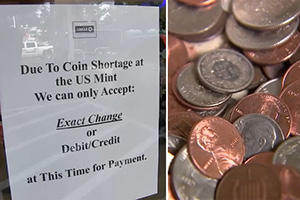
Throughout 2020 we were told that there was a coin shortage throughout the U.S.
As a result, retailers either quit giving coin change back or strongly discouraged customers from asking for it.
Kroger actually resorted to either giving you back your money in the form of credit vouchers (to that particular store of course) or by donating the change that they owed you to charity.
Control Over Dangerous and Illegal Purchases
In what can only be viewed as an incredibly ironic wordsmithing, we will be told that one of the benefits to a cashless society is that we can finally rein in purchases that are deemed by the government to be dangerous to the public.
Guns, ammunition, freedom-oriented books (“radical terrorist recruiting material”), and the like will be argued against so that we can keep our society safe. Notice that there is always an emphasis on safety throughout this entire process.
A Fomite of Disease

Once again, 2020 set the stage here. Cash purchases plummeted worldwide, with credit cards filling in the void as people began to avoid any and all cash purchases with the hopes of not getting themselves sick.
This was a talking point spouted throughout the mainstream media in 2020 and will continue to be used in the future as the push for the abolition of cash continues.
Cost of Creation Outweighs the Actual Value of Money
We see this already with the US penny. It actually costs 2.41₵ to produce a single penny.
While our government currently has no problem with making fiscally irresponsible decisions, when it finally does come around to deciding that “you know what, pennies aren’t worth it” – or any other form of cash for that matter – there will be nobody that will argue against them.
This decision will be portrayed as a means of reducing wasteful spending, and anyone who argues against this given reasoning for the abolition of cash will be labeled as an idiot who can’t do proper math.
Less Risk of Theft
We don’t often hear this argument being made currently, but it is out there.

The argument goes that if you’re mugged while you’re carrying $300 in cash, you simply lose all of your money.
However, if you’re mugged and all you have on you is your credit card, then you can quickly call the credit card company, cancel your card, and be reimbursed for any disputed charges that were made in the interim.
What Can We Do to Fight This Process?
While I do believe that a cashless society is inevitable, I do think that there are things we can do to fight against it and to slow it down.
Here is what we can do as freedom and privacy-loving Americans.
#1. You Need to Make Friends with Like-Minded People Now
I used to always blow off this idea. It wasn’t until I began talking with Forest of Prepper Net that I began to see the light on this issue. If you don’t have like-minded friends, you’re going to be up a creek without a paddle when a cashless society hits.
You need to know who has what skills, who has what goods, who can get what, and where their sympathies lie. Perhaps this is more of a cashless society survival skill, but nevertheless, refusal to comply is still a means of fighting against a cashless society.
And this isn’t just refusal to comply based on principal. This is refusal to comply because to do otherwise would mean certain death. When you’re not allowed into a store to buy food and other necessary goods for your family because you refuse to use Fedcoins for purchase or refuse to show a vaccination card you better be dang sure that you have some alternate means of getting what you need to live.
History has proven such. Read the diary of Anne Frank. Had Otto Frank (her father) not had connections with like-minded (this is key) people throughout his neighborhood well prior to his going into hiding with his family, they would’ve died well before the Nazis came and took them away.
Listen to what Good Patriot out of Texas has to say in her Fighting Back videos on Telegram. She’s echoing this same thought process. You need to make groupings of people who can work together to combat this evil.
#2. Develop Some Means of Production
Both Ayn Rand and Adam Smith harped on the fact that production is what equals true wealth. Whether it’s learning how to raise livestock, how to work with leather, how to tan hides, you need to learn some means of production so that you can still produce wealth when cash is taken from you.
You still have to eat. You still have to put bread on the table. And there are going to be others out there who have principles and love logic who will be of the same mind as you. They are going to want to trade for supplies. Barter will come back in full force. You’ll need to have some means of producing something of value so that you can get what you need.
#3. Invest in Precious Metals
Robert Kiyosaki harps upon this in his new book, Fake, the reason being, that precious metals have intrinsic value. They’ve been used as a form of money for roughly 6,000 years now, and they’re not going to stop being a store of value anytime soon. Within a barter society, this may be one of your best stores of wealth.
On top of this, over 40% of the US dollar supply has been printed within the past year alone. Every other economist you see is screaming about the signs of inflation. The U.S. dollar is about to collapse. There is no longer any denying it. Inflation has already risen drastically and will only continue to grow worse. You need to begin doing something to protect your wealth from inflation.
Precious metals are part of the solution.
#4. Start Using Masked Payments
If you don’t have one already, you need to set up a Privacy.com account. This is a form of masked debit card that will help to keep your purchases anonymous. Yes, this is a form of cashless payment, but it is still a way to fight against such a monster.
Provided that money is flowing out of your account but nobody can tell who you just bought from or what you bought, you’ll be much safer in your transaction privacy.
#5. Refuse to Cater to Businesses that Don’t Permit Cash Transactions
If you tug on their purse strings, they eventually change their mind. I’m sorry, but when good compromises with evil, evil wins. Do what you can to avoid these businesses like the plague, and then let them know why you’re avoiding them.
I used to carry around business cards detailing why I wouldn’t support businesses with ‘’no gun’’ stickers on the front doors. I’ve since ran out. I think that such a business card for businesses that don’t permit cash transactions would be an easy way to voice one’s displeasure as well.
Here’s a sample card template:
“I consider your refusal to accept cash as un-American, a forced invasion of my privacy, and a totalitarian tool. As such, I will cease from doing any business with you for the near future and will be spending my money at your competitors instead.”
This is similar to the language that I used within my Second Amendment business cards. I bought them easily off of Vistaprint (around 500 for $20 or so) and considered the money worth every penny.
#6. Learn How to Grow Your Own Food
There’s already a movement afoot within the U.S. to keep certain types of people out of grocery stores. Vaccination papers are beginning to be asked for before one gains access to certain venues or hotel chains. It won’t be long until cashless payments are the only means of accessing even groceries.
Because of this, I highly recommend that you learn how to grow most of your own food, and begin learning now. Gardening has quite a learning curve and is nowhere near as easy as Michael Bloomberg would have you believe. You need to ensure that your family can eat, and gardening is a great part of that process.
Final Thoughts
A cashless society truly is a scary world. Picture everything that you’ve read about in history books within other totalitarian regimes, and you’ll get a taste of what is to come. I implore you to do something now to protect yourself against the rolling stone that is coming down the mountain right for you.
If you follow the above advice, you’ll help to ease the blow. And there’s no doubt about it – it will be a smack in the face. But we can’t just sit back and do nothing as privacy dies a quiet death inside what was once the freest nation on Earth.
If you’ve found other ways to combat a cashless society that we did not cover within this article, by all means, please let us and others know within the comments. This is about helping our fellow man, and as much input is needed as possible.
Also watch: www.whatfinger.com
-
First 60 Survival Emergency Food Resources- When Disaster Strikes, There’s A Pretty Good Chance Your Local Grocery Stores Will be Stripped Bare In A Matter Of Hours.
When disaster strikes, there’s a pretty good chance your local grocery stores will be stripped bare in a matter of hours. From panicked people trying to stock up on last-minute supplies to those who failed to prepare for even short-term disasters and now find themselves facing the prospect of starving, your local grocery store will look like a battleground in a post-apocalyptic movie.
Most grocery stores have a maximum three-day supply of goods on hand before they run dry. That means even short-term disasters like hurricanes, floods, and earthquakes can cause supply chain problems that will quickly wipe out their inventory. Now throw in a long-term disaster that cuts off supplies for months, and you have a real recipe for disaster.
To be prepared to face an emergency situation where supply chains fail and food deliveries are blocked, you need to invest in a long-term food supply. This supply should be made up of at least six months’ worth of emergency food with a long shelf-life – preferably something that you already eat.
From Supermarket Shelves to Survival Pantry: Building Your Emergency Food Stockpile with Long-Lasting Food From The Grocery Store
In the face of so many uncertainties, it’s important to ensure you and your loved ones’ survival by stocking an emergency pantry with long-lasting food supplies. While many so-called survival experts try selling commercial ‘survival food’ as the answer, we advocate for building your stockpile with familiar foods you probably already eat – all from your local grocery store or farmer’s markets.
During an emergency situation, the last thing you want to do is eat a bunch of weird survival foods that you’ve never eaten before – from possible allergy concerns to the stuff just downright tasting like crap, now is not the time to start experimenting. On top of that, we don’t like wasting money, so buying foods you already eat and running them on a rotation system that ensures you don’t find yourself years from now with a pantry full of expired food!
With the help of suggestions that have come in from our readers, we have compiled a list of the top food items and emergency supplies that you can buy at the grocery store. The list contains foods with a long shelf-life, items that have multiple uses, and supplies that are great for bartering.
Survival Foods that add flavor & comfort:
Comfort foods can be a huge morale booster during a stressful survival situation, something that needs to be kept in mind when starting to stockpile food. These four things can be stored for over 10 years, and are a great way to add a little bit of flavor to your cooking. If stored properly they will probably last indefinitely.
- Salt: From food preservation to maintaining proper electrolyte balance in the body to enhancing the flavor of your food, salt is an an essential part of your food storage stockpile!
- Sugar: – Brown or White sugars can be stored for quite some time and during emergencies or high-stress situations can help boost energy levels and provide a quick source of fuel. It can also be a huge morale booster when things start getting tough.
- Raw Honey: Honey has an incredibly long shelf life contains numerous vitamins, minerals, and antioxidants. Honey has also been used for centuries as a natural remedy for wound healing due to its antimicrobial properties.
- Alcohol – Whiskey, Vodka, etc.: From bartering to health and medicinal uses, alcohol is one of those items that should be part of any good preparedness stockpile. Check out our article on which liquors are best to stockpile for preparedness.
Base cooking ingredients with a long shelf life

Many people today lack the ability to cook anything from scratch, relying heavily on prepackaged and processed foods. This trend is unhealthy, but it could prove deadly during a long-term survival situation. Learning how to cook from basic ingredients is crucial for successfully preparing for emergencies and ensuring self-sufficiency in food storage.
The following categories of food make up the foundation of most recipes and are all things that store well.
Hard Grains: Stored properly hard grains have a shelf life of around 10 – 12 years.
- Buckwheat
- Dry Corn
- Kamut
- Hard Red Wheat
- Soft White Wheat
- Millet
- Durum wheat
- Spelt
Soft grains: These soft grains will last around 8 years at 70 degrees, sealed without oxygen.
- Barley,
- Oat Groats,
- Quinoa
- Rye
Beans: Sealed and kept away from oxygen the following beans can last for around 8 – 10 years.
- Pinto Beans
- Kidney Beans
- Lentils
- Lima Beans
- Adzuki Beans
- Garbanzo Beans
- Mung Beans
- Black Turtle Beans
- Blackeye Beans
Flours and Mixes and Pastas: 5 – 8 years
- All Purpose Flour
- White Flour
- Whole Wheat Flour
- Cornmeal
- Pasta
- White Rice ( up to 10 years)
Oils: It’s important to include fats in your stockpile. Fats are a concentrated source of energy and are crucial for overall health and well-being.
- Coconut oil – Unrefined, virgin coconut oil has one of the longest shelf lives of any kind of oil. It can last for over 2 years, has numerous health benefits, and is a great item to add to your survival food supply list.
- Clarified butter (Ghee): Clarified butter, also known as ghee, is butter that has been heated to remove moisture and milk solids. The process increases the fats stability and extends its shelf life. Ghee can last for several months to a year when stored in an airtight container in a cool, dark place.
- Olive oil: Extra virgin olive oil has a decent shelf life and can be stored for up to a year or more if kept in a cool, dark location.
For more information on cooking from scratch, check out these articles and books:
- Important Homesteading Preparedness Skills: Learn how to cook from scratch
- Best War Time Recipes: A Look at Preparedness Cooking Skills from the Past
- Fanny Farmer Cookbook
- Better Homes and Gardens Cookbook
- The Pioneer Woman’s Cookbooks
What About Buying Canned Goods for your Survival Pantry?
Proper Storage and Shelf Life of Canned Goods
We get a lot of questions on canned goods and how long they can safely be stored. To ensure the quality and safety of canned goods, it’s important to store them correctly and be aware of how long the manufacturer recommends they be stored. And remember, most best-by dates are placed there to protect the manufacturer from lawsuits, The U.S. Department of Agriculture says that most shelf-stable foods are safe indefinitely. In fact, they say canned goods will last for years and that dating is for quality, not safety.
Here are some guidelines to follow when dealing with store-bought canned goods and most shelf-stable foods:
1. Storage: Keep commercially canned foods and other shelf-stable products in a cool, dry location. Avoid placing them above the stove, under the sink, or in areas prone to high humidity or temperature fluctuations, such as a damp garage or basement.
2. Shelf life: The shelf life of canned goods varies depending on the type of food. High-acid foods like tomatoes and fruits maintain their best quality for up to 18 months, while low-acid foods such as meat and vegetables can maintain their original quality for 2 to 5 years. But again, if cans are undamaged (no dents, swelling, or rust) and have been stored properly in a cool, clean, dry environment, they can remain safe indefinitely.
3. Safety precautions: While extremely rare, the production of toxins by Clostridium botulinum bacteria poses the most significant risk when dealing with canned goods. To minimize the risk, make sure your cans are in good condition and show no signs of damage or contamination. If any cans appear compromised (bulges or leaks), it’s best to get rid of them to avoid any potential health hazards.
Survival Foods that are great during short-term disasters

The following items are great for short-term emergencies, and will stay fresh for a long period of time. During most disasters, you’re going to want to have food that requires very little cooking, or can be eaten without any preparation at all. Make sure some of your stockpile includes these types of food.
Other good survival foods: 2 – 5 years of shelf life
- Canned Fish: Tuna, Salmon, Sardines
- Canned Meats: Chicken, Beef, Pork, Spam & Sausages
- Canned Vegetables & Fruits
- Peanut Butter
- Coffee
- Tea
- Ramen Noodles – not the greatest food in the world but they are very cheap so they made the survival food list.
- Hard Candy
- Powdered milk
- Dried herbs and spices
- Canned soups (a variety of flavors)
- Canned pasta sauces
- Canned broth or stock (chicken, beef, or vegetable)
- Crackers or rice cakes
- Dried fruits (raisins, apricots, cranberries)
- Nuts (almonds, walnuts, peanuts)
- Granola bars or energy bars
- Cereal or granola
Items that can be used for more than cooking:
- Apple Cider Vinegar – Cleaning, cooking and has antibiotic properties
- Baking Soda – Cleaning, cooking, etc…
- Honey – Mentioned again for its antibiotic properties and wound healing.
Nonfood items to stock up on at the grocery store:
- Bic Lighters
- Toilet Paper
- Soaps
- Bottled Water
- Multi-vitamins or supplements
- Medicines
- Bandages
- Peroxide
- Lighter fluid
- Canning Supplies
- Charcoal
More Emergency Food Resources
While we always advise the DIY approach to stockpiling food, this way you have the things that you would normally cook and eat and can then rotate them in and out of your normal life, there are some circumstances where commercially made survival food supplies might make sense. Here are some of the top emergency survival foods that can help you quickly bulk up your emergency supplies.
-
100+ Experts Outline Costs, Dangers & Options- Main Cause Of Species Loss & Driver Of The Migration Of Millions Of People By 2050 In Landmark Assessment Report

MUST WATCH!!! First take a look at one of the most shocking videos in the world! This video actually shows us what the secret of the Trump family is related to their expressive health!!! –FULL VIDEO HERE
Worsening land degradation caused by human activities is undermining the well-being of two fifths of humanity, driving species extinctions and intensifying climate change. It is also a major contributor to mass human migration and increased conflict, according to the world’s first comprehensive evidence-based assessment of land degradation and restoration.
The dangers of land degradation, which cost the equivalent of about 10% of the world’s annual gross product in 2010 through the loss of biodiversity and ecosystem services, are detailed for policymakers, together with a catalogue of corrective options, in the three-year assessment report by more than 100 leading experts from 45 countries, launched today.
Produced by the Intergovernmental Science-Policy Platform on Biodiversity and Ecosystem Services (IPBES), the report was approved at the 6th session of the IPBES Plenary in Medellín, Colombia. IPBES has 129 State Members.
Providing the best-available evidence for policymakers to make better-informed decisions, the report draws on more than 3,000 scientific, Government, indigenous and local knowledge sources. Extensively peer-reviewed, it was improved by more than 7,300 comments, received from over 200 external reviewers.
Warning!!! First Signs That U.S. Consumers Are In Very Serious Trouble
30 Million Americans Face Hunger As They Can’t Afford Insane Grocery Prices:Nearly 10 percent of the U.S. population is facing the threat of hunger and about 70 percent of Americans say they are struggling to pay their grocery bills right now.
The following video reveals the secrets of a future crisis, but the government does not want us to know the truth!

Serious Danger to Human Well-being
Rapid expansion and unsustainable management of croplands and grazing lands is the most extensive global direct driver of land degradation, causing significant loss of biodiversity and ecosystem services – food security, water purification, the provision of energy and other contributions of nature essential to people. This has reached ‘critical’ levels in many parts of the world, the report says.
“With negative impacts on the well-being of at least 3.2 billion people, the degradation of the Earth’s land surface through human activities is pushing the planet towards a sixth mass species extinction,” said Prof. Robert Scholes (South Africa), co-chair of the assessment with Dr. Luca Montanarella (Italy). “Avoiding, reducing and reversing this problem, and restoring degraded land, is an urgent priority to protect the biodiversity and ecosystem services vital to all life on Earth and to ensure human well-being.”
“Wetlands have been particularly hard hit,” said Dr. Montanarella. “We have seen losses of 87% in wetland areas since the start of the modern era – with 54% lost since 1900.”
According to the authors, land degradation manifests in many ways: land abandonment, declining populations of wild species, loss of soil and soil health, rangelands and fresh water, as well as deforestation.
Underlying drivers of land degradation, says the report, are the high-consumption lifestyles in the most developed economies, combined with rising consumption in developing and emerging economies. High and rising per capita consumption, amplified by continued population growth in many parts of the world, can drive unsustainable levels of agricultural expansion, natural resource and mineral extraction, and urbanization – typically leading to greater levels of land degradation.
By 2014, more than 1.5 billion hectares of natural ecosystems had been converted to croplands. Less than 25% of the Earth’s land surface has escaped substantial impacts of human activity – and by 2050, the IPBES experts estimate this will have fallen to less than 10%.
Crop and grazing lands now cover more than one third of the Earth´s land surface, with recent clearance of native habitats, including forests, grasslands and wetlands, being concentrated in some of the most species-rich ecosystems on the planet.
The report says increasing demand for food and biofuels will likely lead to continued increase in nutrient and chemical inputs and a shift towards industrialized livestock production systems, with pesticide and fertilizer use expected to double by 2050.
Avoidance of further agricultural expansion into native habitats can be achieved through yield increases on the existing farmlands, shifts towards less land degrading diets, such as those with more plant-based foods and less animal protein from unsustainable sources, and reductions in food loss and waste.
Strong Links to Climate Change
“Through this report, the global community of experts has delivered a frank and urgent warning, with clear options to address dire environmental damage,” said Sir Robert Watson, Chair of IPBES.
“Land degradation, biodiversity loss and climate change are three different faces of the same central challenge: the increasingly dangerous impact of our choices on the health of our natural environment. We cannot afford to tackle any one of these three threats in isolation – they each deserve the highest policy priority and must be addressed together.”
The IPBES report finds that land degradation is a major contributor to climate change, with deforestation alone contributing about 10% of all human-induced greenhouse gas emissions. Another major driver of the changing climate has been the release of carbon previously stored in the soil, with land degradation between 2000 and 2009 responsible for annual global emissions of up to 4.4 billion tonnes of CO2.
Given the importance of soil’s carbon absorption and storage functions, the avoidance, reduction and reversal of land degradation could provide more than a third of the most cost-effective greenhouse gas mitigation activities needed by 2030 to keep global warming under the 2°C threshold targeted in the Paris Agreement on climate change, increase food and water security, and contribute to the avoidance of conflict and migration.
Projections to 2050
“In just over three decades from now, an estimated 4 billion people will live in drylands,” said Prof. Scholes. “By then it is likely that land degradation, together with the closely related problems of climate change, will have forced 50-700 million people to migrate. Decreasing land productivity also makes societies more vulnerable to social instability – particularly in dryland areas, where years with extremely low rainfall have been associated with an increase of up to 45% in violent conflict.”
Dr. Montanarella added: “By 2050, the combination of land degradation and climate change is predicted to reduce global crop yields by an average of 10%, and by up to 50% in some regions. In the future, most degradation will occur in Central and South America, sub-Saharan Africa and Asia – the areas with the most land still remaining that is suitable for agriculture.”
The report also underlines the challenges that land degradation poses, and the importance of restoration, for key international development objectives, including the United Nations Sustainable Development Goals and the Aichi Biodiversity Targets. “The greatest value of the assessment is the evidence that it provides to decision makers in Government, business, academia and even at the level of local communities,” said Dr. Anne Larigauderie, Executive Secretary of IPBES. “With better information, backed by the consensus of the world’s leading experts, we can all make better choices for more effective action.”
Options for Land Restoration
The report notes that successful examples of land restoration are found in every ecosystem, and that many well-tested practices and techniques, both traditional and modern, can avoid or reverse degradation.
In croplands, for instance, some of these include reducing soil loss and improving soil health, the use of salt tolerant crops, conservation agriculture and integrated crop, livestock and forestry systems.
In rangelands with traditional grazing, maintenance of appropriate fire regimes, and the reinstatement or development of local livestock management practices and institutions have proven effective.
Successful responses in wetlands have included control over pollution sources, managing the wetlands as part of the landscape, and reflooding wetlands damaged by draining.
In urban areas, urban spatial planning, replanting with native species, the development of ‘green infrastructure’ such as parks and riverways, remediation of contaminated and sealed soils (e.g. under asphalt), wastewater treatment and river channel restoration are identified as key options for action.
Opportunities to accelerate action identified in the report include:
- Improving monitoring, verification systems and baseline data;
- Coordinating policy between different ministries to simultaneously encourage more sustainable production and consumption practices of land-based commodities;
- Eliminating ‘perverse incentives’ that promote land degradation and promoting positive incentives that reward sustainable land management; and
- Integrating the agricultural, forestry, energy, water, infrastructure and service agendas.
Making the point that existing multilateral environmental agreements provide a good platform for action to avoid, reduce and reverse land degradation and promote restoration, the authors observe, however, that greater commitment and more effective cooperation is needed at the national and local levels to achieve the goals of zero net land degradation, no loss of biodiversity and improved human well-being.
Knowledge Gaps
Among the areas identified by the report as opportunities for further research are:
- The consequences of land degradation on freshwater and coastal ecosystems, physical and mental health and spiritual well-being, and infectious disease prevalence and transmission;
- The potential for land degradation to exacerbate climate change, and land restoration to help both mitigation and adaptation;
- The linkages between land degradation and restoration and social, economic and political processes in far-off places; and
- Interactions among land degradation, poverty, climate change, and the risk of conflict and of involuntary migration.
Environmental and Economic Sense
The report found that higher employment and other benefits of land restoration often exceed by far the costs involved. On average, the benefits of restoration are 10 times higher than the costs (estimated across nine different biomes), and, for regions like Asia and Africa, the cost of inaction in the face of land degradation is at least three times higher than the cost of action.
“Fully deploying the toolbox of proven ways to stop and reverse land degradation is not only vital to ensure food security, reduce climate change and protect biodiversity,” said Dr. Montanarella, “It’s also economically prudent and increasingly urgent.”
Echoing this message, Sir Robert Watson, said: “Of the many valuable messages in the report, this ranks among the most important: implementing the right actions to combat land degradation can transform the lives of millions of people across the planet, but this will become more difficult and more costly the longer we take to act.”
What is the Most Powerful Force on the Planet?
Also watch: www.whatfinger.com
-
Subscribe
Subscribed
Already have a WordPress.com account? Log in now.
 Site Title